Commonly Confused Words: Affect vs Effect, Then vs Than

Commonly confused words are pairs of words that students swap in their writing, and this guide covers eleven of them with a plain meaning, a memory trick and example sentences for each. It also adds four ways to teach the pairs in class or at the kitchen table, plus a short note on practice packs.
Commonly confused words
Some word pairs get mixed up because they sound alike. Some look almost the same on the page. Others mean nearly the same thing, so it is hard to tell which one fits. A few pairs are true homophones, which means they sound exactly the same but are spelled differently: who’s and whose, your and you’re, principal and principle. Other pairs only sound close, such as affect and effect or then and than. Pairs like fewer and less sound nothing alike, yet students still swap them because the meanings overlap.
That mix of causes is why one trick does not cover every pair. Each of these confusing words needs its own small test or memory hook, and the sections below give one for each. The eleven pairs are:
- affect and effect
- then and than
- lose and loose
- principal and principle
- who’s and whose
- your and you’re
- advice and advise
- farther and further
- fewer and less
- who and whom
- good and well
In the example sentences below, the word in bold is the right one for that sentence.
Affect vs effect
Affect is usually a verb. It means to change or influence something. Effect is usually a noun. It means a result.
A simple memory trick: affect starts with A, like action. Effect starts with E, like end result. The action comes first, and the effect is what you see afterward.
Examples with affect:
- Heavy rain can affect the way a field drains.
- A noisy hallway may affect how well students concentrate.
Examples with effect:
- The cold weather had a strong effect on the garden.
- One effect of the storm was a power outage.
Both words have rarer uses. Effect can be a verb meaning to bring about, as in “The new principal hopes to effect change.” Affect can be a noun in psychology, where it names the emotion a person shows. Students in the upper grades may meet these uses, but the verb-and-noun rule covers most sentences they write.
Then vs than
Then is about time or order. It tells what comes next. Than is used to compare two things.
Here is a trick: then and when both end in -en, and both are about time. Than and compare both have an a, and both are about comparing.
- First stir the paint, then pour it into the tray.
- We finished the map, and then we hung it on the wall.
- My backpack is heavier than yours.
- She would rather read a book than watch a movie.
Lose vs loose
Lose is a verb. It means to misplace something or to not win. Loose means not tight, and it describes things such as a sleeve, a tooth or a screw.
The spelling note: lose has one o. Loose has two. A handy hook is that the extra o in loose makes it roomy, so the word has some space in it, like a loose shirt.
- Please do not lose your library card.
- Our team could lose the match if we stop trying.
- The screw on the chair leg is loose.
- Her loose sleeve got caught on the door handle.
Principal vs principle
Principal has two meanings. As a noun, it is the head of a school. As an adjective, it means main or most important. Principle is only a noun. It means a rule or a basic belief.
One memory trick: the principal is your pal, and principal ends in pal. Principle ends in -le, just like rule, and a principle is a kind of rule.
- The principal welcomed the new students at the door.
- The principal reason for the delay was a flat tire.
- Honesty is a principle I try to follow.
- The teacher explained the principle of fair play before the game.
Who’s vs whose and your vs you’re
The first word in each of these pairs is a contraction. Who’s is short for who is or who has. You’re is short for you are. The second word in each pair, whose and your, shows that something belongs to someone.
The test is to expand the contraction. Say the sentence with the full words. If “who is”, “who has” or “you are” fits, use the contraction. If it does not fit, use the possessive word. The post on apostrophe rules goes deeper on contractions and possession.
Who’s vs whose:
- Who’s coming to the meeting? (Who is coming to the meeting?)
- Who’s finished the book already? (Who has finished the book already?)
- Whose backpack is on the floor?
- I know whose turn it is.
Your vs you’re:
- Please bring your lunch to the room.
- You’re ready to start. (You are ready to start.)
- I think you’re going to like this story. (I think you are going to like this story.)
- Is that your pencil?
Advice vs advise
Advice is a noun. It names the help or suggestion someone gives. Advise is a verb. It means to give that help or suggestion.
The two words end with different sounds. Advice ends with an s sound, like ice. Advise ends with a z sound. That is also a spelling hook: advice has ice in it, and ice is a thing, just as advice is a thing.
- My coach gave me good advice.
- Her advice helped us finish on time.
- I advise you to read the directions first.
- The librarian will advise us on which book to choose.
Farther vs further
Use farther for physical distance, something you could measure in steps or miles. Use further for extra or more, and for degree, as in how deep or how much.
- The lake is farther down the road than the park.
- Can you throw the ball farther than the fence?
- I need further information before I decide.
- We will talk about the plan further tomorrow.
Many writers do not keep these two apart in everyday writing, and style guides do not all agree. It still helps students to learn the distinction, because they will see it in tests and textbooks.
Fewer vs less
Use fewer with things you can count one by one, such as chairs, pencils or books. Use less with amounts you do not count, such as water, sugar or time spent.
A sign you may know shows the rule: “Ten items or fewer.” Items can be counted, so fewer is the word.
- There are fewer chairs than students.
- I have fewer pencils in my case today.
- I drank less water than my sister.
- Add less sugar to the recipe.
Measurements are treated as a single amount, so less is used with them: “less than five miles” or “less than ten minutes”.
Who vs whom
Who is the subject form. It does the action. Whom is the object form. It receives the action, or it follows a word such as to, for or with.
The he/him test works in a few steps:
- Turn the question into a statement.
- Answer it with he or him.
- If he fits, use who. If him fits, use whom.
Try it. In “Who wrote the note?” the answer is “He wrote the note,” so who is right. In “Whom did you invite?” the answer is “You invited him,” so whom is right. In “To whom should I give this?” the answer is “You should give this to him,” so whom is right. A shortcut: him and whom both end in m.
Good vs well
Good describes a noun. Well usually describes a verb. Well can also mean healthy.
- She is a good reader. (Good describes the noun reader.)
- She reads well. (Well describes the verb reads.)
- He did a good job on the poster.
- He did the job well.
- I do not feel well today. (Here well means healthy.)
Ask what the word is describing. If it describes a thing, try good. If it describes how something is done, try well.
How to teach confusing words
These are four ways to work with the pairs. Pick one pair at a time instead of all eleven at once.
Pair cards with a memory trick on the back
Give each pair a card. Write the two words on the front and leave the meaning off. On the back, write one memory trick and one example sentence. Students quiz each other, flip the card to check, and then try to say the trick in their own words.
A class chart
Make a chart with one row for each pair. Add a short meaning and a sentence for each word. Let students add new sentences on sticky notes as they find the words in their reading. The chart stays on the wall as a quick reference during writing time.
Proofreading a short paragraph
Write a short paragraph with a few planted mistakes and ask students to find and fix them. For example:
“The new bus schedule will effect every family. There are less seats on the early bus then on the late bus, and the principle sent a letter.”
The fixes are: effect becomes affect, less becomes fewer, then becomes than, and principle becomes principal. Ask students to say why each fix is right, not just to circle the error.
Write your own sentences
Students write two sentences for a chosen pair, one for each word, and then trade papers with a partner. The partner checks that each sentence uses the right word and says which test or trick proves it. Writing the sentences themselves takes more thought than copying an example.
Practice material
Several other pairs that students mix up have their own packs. The Word Study Worksheets Bundle is for grades 2 to 7. It has four word study packets: the prefixes un, re, pre and dis, the suffixes ful, less and ness, and two pairs students mix up all the time, its and it’s, and accept and except. It has 183 pages and is 20% off the separate prices.
The same pairs also come as stand-alone packs:
- Accept and except: Accept vs Except Worksheets, listed for grade 7. It has fill in the blank sentences, sentence choice items and a reading passage, plus an answer key, a teacher only key with tips and a lesson plan.
- To, too and two: the To Too Two Worksheet is a 43 page homophones worksheet for grades 3 to 6, with multiple choice, fill in the blank, true or false and sentence writing, plus an answer key, answer sheet and lesson plan.
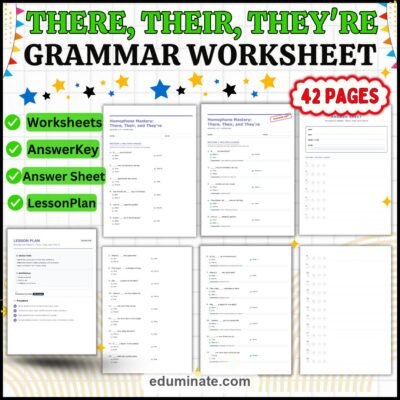
- There, their and they’re: the There Their They’re Worksheets set is for grades 4 to 8, with multiple choice, fill in the blank, true or false and short answer sections, plus a lesson plan, answer sheet and teacher key. The post on there vs their vs they’re explains the three words first.
- Its and it’s: the Its Vs It’s Grammar Worksheet has 70 questions and is built for Grade 4 practice with contractions and possessive pronouns. A plain answer key, a detailed teacher key and a one page lesson plan come with it.
For a single download that covers every grammar and ELA packet in the shop, there is the Complete Grammar Worksheets Bundle: 32 packets covering punctuation, nouns, verbs, word study, voice, reported speech, figurative language and the parts of speech. It has 1527 pages and is 35% off the separate prices.
Frequently asked questions
Are these words homophones?
Some are. Who’s and whose, your and you’re, and principal and principle sound exactly the same. Affect and effect or then and than sound close but not identical. Pairs such as fewer and less, or good and well, do not sound alike at all.
Is “less” ever right for things you count?
With measurements, yes. Distances, amounts of time and amounts of money are treated as a single amount, so “less than five miles” is correct. For separate items you can count one by one, such as chairs or pencils, use fewer.
Is whom still used?
Whom appears in formal writing, especially right after words such as to, for and with. The he/him test tells you when it fits: if him fits in the answer, whom is the right choice.
What grade learns these words?
The packs mentioned above cover different ranges. The word study bundle is for grades 2 to 7, the to, too and two set is for grades 3 to 6, the there, their and they’re set is for grades 4 to 8, the its and it’s worksheet is for Grade 4, and the accept and except set is listed for grade 7. The full grammar bundle covers grades 2 to 8.