List of Pronouns: Types, Examples and an Anchor Chart
A pronoun is a word that takes the place of a noun, and this list of pronouns covers every main kind with examples. It also explains antecedent agreement and offers an anchor chart and four ways to practice.
List of pronouns
Compare these two versions of the same sentences:
- Before: Maria opened Maria’s backpack. Maria took out Maria’s book.
- After: Maria opened her backpack. She took out her book.
The second version replaces the repeated noun with pronouns, and it reads more smoothly. These are the main types of pronouns covered below:
- Personal pronouns (subject and object)
- Possessive pronouns
- Reflexive pronouns
- Demonstrative pronouns
- Indefinite pronouns
- Relative pronouns (and a short note on interrogative pronouns)
What are pronouns
Pronouns are words that stand in for nouns so a writer does not have to repeat the same noun again and again. Because a pronoun stands in for a noun, it helps to know nouns first. The Common and Proper Nouns Worksheets are a grade 3 set with 62 questions across four sections. The 30 page PDF includes a worksheet, answer key, answer sheet and lesson plan.
Personal pronouns
Personal pronouns stand for people or things. They change their form depending on the job they do in the sentence. There are two main sets: subject pronouns and object pronouns.
Subject pronouns
Subject pronouns do the action. They are I, you, he, she, it, we and they.
Personal pronouns are also grouped by person. I and we are first person, because the speaker is included. You is second person, because the speaker is talking to someone. He, she, it and they are third person, because they are about someone or something else. Knowing the person helps students keep a piece of writing steady, so it does not slip from “we” to “you” halfway through a paragraph.
- She reads before bed.
- They built a tower out of blocks.
Object pronouns
Object pronouns receive the action, or they come after a word like to, for or with. They are me, you, him, her, it, us and them. If you need a refresher on those joining words, see the post with a list of prepositions.
- The teacher gave us a new book.
- Please sit next to him.
Here is a check for sentences with two people: take out the other person and see which pronoun sounds right alone. In “Her and I went to the store,” remove “and I.” “Her went” is wrong, so the sentence needs she: “She and I went to the store.” In “The teacher gave the book to Sam and I,” remove “Sam and.” “Gave the book to I” is wrong, so the sentence needs me: “The teacher gave the book to Sam and me.”
Possessive pronouns
Possessive pronouns show ownership, and they stand on their own without a noun after them. They are mine, yours, his, hers, ours and theirs.
- The red backpack is mine.
- That seat is yours.
- The idea was theirs, not ours.
- The blue jacket is hers, and the gray one is his.
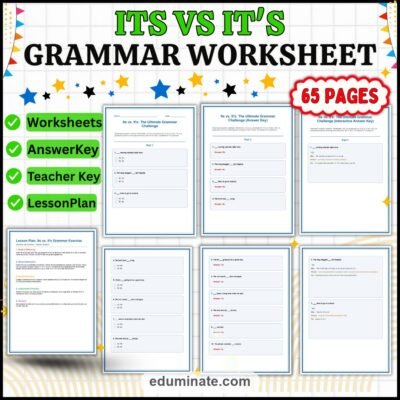
The words my, your, his, her, its, our and their also show ownership, but they go before a noun: my backpack, their idea. Possessive pronouns never take an apostrophe, so it is yours, not your’s. The Its Vs It’s Grammar Worksheet is a 70 question worksheet built for Grade 4 practice with contractions and possessive pronouns. It comes with a plain answer key, a detailed teacher key and a one page lesson plan.
Reflexive pronouns
Reflexive pronouns are used when the doer and the receiver of an action are the same. They are myself, yourself, himself, herself, itself, ourselves, yourselves and themselves.
- I hurt myself on the bike path.
- She taught herself to knit.
- We made ourselves a snack.
The forms “hisself” and “theirselves” are not standard English. Use himself and themselves.
A reflexive pronoun needs someone to refer back to. “Myself went to the store” is wrong because nothing in the sentence is acting on myself, while “I made myself a sandwich” works because the doer and the receiver are the same person. Plural forms end in -selves: ourselves, yourselves and themselves.
Demonstrative pronouns
Demonstrative pronouns point to something: this, that, these and those. This and these point to things that are near. That and those point to things that are farther away. Students can test a sentence by pointing: if the thing is close enough to touch, use this or these. If they would have to walk over to it, use that or those. Remember that this and that stand for one thing, and these and those stand for more than one.
- This is my seat. (near, one thing)
- These are my markers. (near, more than one)
- That looks like a tall tree. (far, one thing)
- Those are the books from last week. (far, more than one)
Indefinite pronouns
Indefinite pronouns do not name a specific person or thing. Examples include someone, everyone, nobody, anything, each, both, few, many and all.
Everyone and each are singular, so they take singular verbs: “Everyone has a pencil” and “Each of the students is ready.” Both, few and many are plural: “Both are here.” The word all can go either way, depending on what it stands for. The post on subject verb agreement rules covers this in more detail.
Here are more indefinite pronouns, sorted by number. Singular: anyone, anybody, anything, everybody, everything, nobody, nothing, somebody, something, either and neither. Plural: both, few, many and several. Students can sort these on cards and write one sentence with a singular pronoun and one with a plural pronoun.
Relative pronouns
Relative pronouns are who, whom, whose, which and that. They connect a clause to a noun and tell more about it.
- The student who won the prize shook hands with the principal.
- The book that I borrowed was very long.
- The woman whom I met at the library was very kind.
- The girl whose bike is red lives next door.
Interrogative pronouns look like some of these words, but they ask questions: who, what and which. “Who left this?” and “What is in the box?” are examples.
Pronoun antecedent agreement
The antecedent is the noun that a pronoun stands for. In “Maria lost her scarf,” Maria is the antecedent and her is the pronoun. For pronoun antecedent agreement, the pronoun has to match its antecedent in number: a singular noun takes a singular pronoun, and a plural noun takes a plural pronoun.
- Wrong: The boys left his coats in the hall.
- Fixed: The boys left their coats in the hall.
- Wrong: The pencils are on the desk, and it is sharp.
- Fixed: The pencils are on the desk, and they are sharp.
A pronoun also needs a clear antecedent. Take this sentence: “Dan put the lunch bag in the box, and then he lost it.” The word it could mean the bag or the box. The fix is to name the noun: “Dan put the lunch bag in the box, and then he lost the box.”
Pronouns anchor chart
A pronouns anchor chart works best with three columns: type, pronouns and example. Fill in one row as each type is taught. For instance:
- Subject: I, you, he, she, it, we, they. Example: She ran home.
- Object: me, you, him, her, it, us, them. Example: Please call us.
- Possessive: mine, yours, his, hers, ours, theirs. Example: The pencil is mine.
- Reflexive: myself, yourself, himself, herself, itself, ourselves, yourselves, themselves. Example: I taught myself.
- Demonstrative: this, that, these, those. Example: Those are heavy.
Leave space at the bottom for indefinite and relative pronouns, and let students add their own examples on sticky notes. Keep each example short enough to read from across the room. A different color for each type makes the chart easier to scan, and students can look at it whenever they check a draft.
Ways to practice
Replace the repeated noun
Write a short paragraph that repeats the same noun in every sentence. Students rewrite it with pronouns, then read both versions aloud to hear the difference. A good starter is “Sam took Sam’s coat and Sam went outside because Sam was cold.” Ask them to mark each place they changed a noun, and to say which pronoun they chose.
Sort pronoun cards
Write one pronoun on each card. Groups sort the cards into subject, object, possessive, reflexive and demonstrative piles, then check each other’s work against the anchor chart. Words that belong in two piles, such as you and it, make for a good group discussion.
Fix the unclear pronoun
Give students sentences where the pronoun could point to two nouns. They rewrite each one so the meaning is clear, and explain which noun they named. One easy set of sentences has two people and one pronoun, such as “Ben told Omar that he left his book.” Students decide what they think the writer meant and rewrite the sentence to say it plainly.
Pronoun hunt in a read-aloud
Read a short passage aloud. Students listen for pronouns and write them down. Afterward, they say which noun each pronoun stands for.
Practice material
The Pronoun Types Worksheet Packet is for grades 6 to 8. It has 45 pages, a lesson plan and an answer key, and students work through 70 questions across 6 sections.
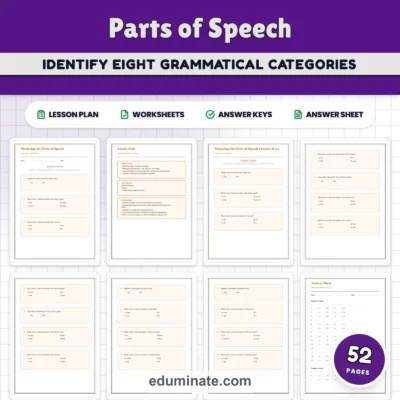
The Parts of Speech Worksheets Bundle is for grades 3 to 8. It has three packets on the building blocks of a sentence: the main parts of speech, pronoun types, and prepositions and prepositional phrases. It has 138 pages and is 20% off the separate prices. For younger students, the Parts of Speech Worksheets practice set is for grades 3 to 5. It has 52 pages, a lesson plan and an answer key, and students work through 85 questions across 6 sections.
The Complete Grammar Worksheets Bundle puts every grammar and ELA packet in one download: 32 packets covering punctuation, nouns, verbs, word study, voice, reported speech, figurative language and the parts of speech. It has 1527 pages and is 35% off the separate prices.
Frequently asked questions
Is “it” a pronoun?
Yes. It is a personal pronoun, and it works as both a subject pronoun and an object pronoun. “It fell off the shelf” uses it as the subject, and “Please give it to me” uses it as the object.
What is the difference between subject and object pronouns?
A subject pronoun does the action, as in “She wrote the note.” An object pronoun receives the action or follows a word like to or for, as in “The note is for her.”
Are my and your pronouns?
They show ownership and go before a noun, as in “my book.” Some grammar books call them possessive adjectives or determiners, and others group them with possessive pronouns. The forms that stand alone are mine, yours, his, hers, ours and theirs.
What grade learns pronouns?
The packs mentioned here cover different ranges. The common and proper noun set is for grade 3, the its and it’s worksheet is for Grade 4, the parts of speech practice set is for grades 3 to 5, the pronoun packet is for grades 6 to 8, the parts of speech bundle is for grades 3 to 8, and the full grammar bundle covers grades 2 to 8.