Adverbs Examples: Types, Lists and Easy Ways to Teach

Adverbs examples make the most sense when you look at the questions an adverb answers, because an adverb is a word that tells more about a verb, an adjective or another adverb. This guide covers the main types, the -ly spelling rules, how to tell adjectives from adverbs, adverb phrases and conjunctive adverbs.
Adverbs examples
Most adverbs answer one of five questions: how, when, where, how often and how much. Reading a sentence and asking which question the word answers is the quickest way to find an adverb. Here are six sentences, each with the adverb named and the question it answers:
- Maya walked slowly. (slowly: how did she walk?)
- We will leave tomorrow. (tomorrow: when will we leave?)
- Please put the books here. (here: where should they go?)
- He always checks his work. (always: how often does he check?)
- The soup is very hot. (very: how hot? It describes the adjective “hot.”)
- She finished the race quite quickly. (quite: how quickly? It describes the adverb “quickly.”)
The first four adverbs describe verbs. The fifth describes an adjective and the sixth describes another adverb. That is the full range of what an adverb can modify.
Types of adverbs
The five types of adverbs match the five questions above:
- Manner: how something happens
- Time: when something happens
- Place: where something happens
- Frequency: how often something happens
- Degree: how much or to what extent
Some lists add more types, but these five are the ones students meet first. The sections below give words and sentences for each one.
Adverbs of manner, time and place
Adverbs of manner
Adverbs of manner tell how an action is done. Many of them end in -ly. Examples: slowly, carefully, loudly, neatly, quickly, well.
- The bell rang loudly.
- The team listened carefully.
- Jordan wrote the answer neatly.
Adverbs of time
Adverbs of time tell when an action happens. Examples: now, today, soon, yesterday, later, tomorrow.
- The library opens soon.
- Please come back later.
- I finished my map yesterday.
Adverbs of place
Adverbs of place tell where an action happens. Examples: here, there, outside, upstairs, nearby, everywhere.
- The class lined up outside.
- Please look everywhere for the missing marker.
Adverbs of frequency and degree
Adverbs of frequency
Adverbs of frequency say how often something happens: always, usually, often, sometimes, never. Lined up in that order, they go from the most often to not at all. They usually come before the main verb, as in “We often read after lunch,” and after the verb “be,” as in “She is always on time.”
Adverbs of degree
Adverbs of degree say how much, or to what extent: very, quite, too, almost, really. They usually come right before the adjective or adverb they describe.
- The test was very short.
- Leo spoke quite softly.
- The box is too heavy for me to lift.
- We are almost finished.
Adverbs ending in ly
Many adverbs are made by adding -ly to an adjective: quick becomes quickly, slow becomes slowly and careful becomes carefully. A few spelling changes come up often:
- Adjectives ending in y change the y to i: happy becomes happily.
- Adjectives ending in le drop the e: gentle becomes gently.
- Some adjectives ending in e drop it: true becomes truly.
- Adjectives ending in ful simply add ly: careful becomes carefully.
- Adjectives ending in ic usually add ally: basic becomes basically.
Not every word that ends in -ly is an adverb. Friendly, lovely, lonely and silly are adjectives. In “a friendly neighbor,” the word “friendly” describes the noun “neighbor.”
Not every adverb ends in -ly, either. Fast, hard, late, well and soon are adverbs that students use all the time:
- The train moved fast.
- She worked hard on her report.
- We arrived late.
Fast, hard and late can also be adjectives (“a fast train,” “a hard test,” “a late bus”), so the job of the word in the sentence decides. The word “hardly” is a different word from “hard.” It means almost not at all, as in “I could hardly hear the speaker.”
Adjectives vs adverbs
An adjective describes a noun. An adverb describes a verb, an adjective or another adverb. Many adjective and adverb pairs share a root: quick and quickly, careful and carefully, loud and loudly, good and well. Here are four pairs of sentences:
- She is a quick runner. / She runs quickly.
- He gave a careful answer. / He answered carefully.
- That is a good drawing. / She draws well.
- The loud bell rang. / The bell rang loudly.
The pair good and well causes the most mix-ups. “Good” is an adjective and goes with a noun: a good drawing. “Well” is the adverb that goes with a verb: draws well. The post on a list of adjectives has more adjectives to compare with the adverbs here.
A two-question test sorts most cases:
- What does the word describe? If it describes a noun, it is an adjective. If it describes a verb, an adjective or an adverb, it is an adverb.
- What question does it answer? Adjectives answer “which one,” “what kind” or “how many.” Adverbs answer “how,” “when,” “where,” “how often” or “how much.”
One exception is worth teaching. After linking verbs such as “is,” “seem,” “smell” and “taste,” the next word is usually an adjective, because it describes the subject. “The soup tastes good” uses an adjective, and “good” is correct.
Adverb phrases
An adverb phrase is a group of words that works as one adverb. It answers the same questions as a single adverb. Here are five examples:
- The class meets in the morning. (when)
- He carried the jar with great care. (how)
- I read every day. (how often)
- Our books are kept at the library. (where)
- We play outside after lunch. (when)
Most of these phrases begin with a preposition, such as in, with, at and after. The list of prepositions is a handy companion when students start to find them. The prepositions and prepositional phrases packet for grades 4 to 6 has 41 pages and 70 questions in 6 sections, with a lesson plan and answer key.
Conjunctive adverbs
This section is for older students. A conjunctive adverb links two ideas. Common ones are however, therefore, meanwhile, also, instead and otherwise. When one of these joins two independent clauses, put a semicolon before it and a comma after it. Three correct examples:
- The forecast called for rain; however, the game started on time.
- We finished the map early; therefore, we had time to read.
- Mia cleaned the board; meanwhile, Leo stacked the chairs.
A conjunctive adverb can also move inside the second clause. In that case it is set off with commas: “The game, however, started on time.”
List of adverbs
This list of adverbs has 24 words in six groups. Each word is a real adverb in the way it is used here.
- Manner: gently, bravely, silently, happily
- Time: finally, later, yesterday, soon
- Place: inside, away, downstairs, nearby
- Frequency: always, often, rarely, seldom
- Degree: extremely, nearly, quite, very
- Conjunctive: however, therefore, meanwhile, otherwise
To check a word on any list, put it in a sentence and ask what it describes. “Nearby” in “The shop is nearby” tells where, so it is an adverb. “Nearby” in “the nearby shop” describes a noun, so there it is an adjective. A few words, such as nearby, fast and late, change jobs in this way, and the sentence always decides.
Adverbs anchor chart
An adverbs anchor chart works best when it stays simple enough to read from across the room. Here is what to put on it:
- The definition: an adverb tells more about a verb, an adjective or another adverb.
- The five questions: how, when, where, how often, how much.
- One column for each type, with three or four example words that students add to as they meet new ones.
- A spelling box for -ly words: happy becomes happily, gentle becomes gently.
- A side-by-side pair such as “quick runner / runs quickly” to show adjective and adverb together.
Write the example words on strips so students can move them when they find a better fit. A chart that students help build tends to be one they look at, so add words as they turn up in read-alouds and in their own writing.
Ways to practice
Act it out with adverb cards
Write an action on one card, such as “close the door,” and an adverb on another, such as “quietly.” A student picks one of each and acts it out while the class guesses the adverb. Use only classroom-safe actions. Nothing needs to be drawn.
Improve a plain sentence
Give students a short, plain sentence, such as “The bus stopped.” They add one adverb of manner, one of time and one of place, then read the sentences aloud. Students notice that each adverb answers a different question.
Adjective or adverb sort
Write pairs such as quick, quickly, careful, carefully, good, well on cards. Students sort them under two labels and then write a sentence for each card. Add friendly and lovely as a check on the -ly rule.
Adverb hunt in a paragraph
Hand out a paragraph and ask students to circle every adverb. Then have them draw an arrow from each adverb to the word it describes and label the question it answers.
Practice material
The parts of speech packet for grades 3 to 5 has nouns, verbs, adjectives and adverbs in its title. It is 52 pages with 85 questions in 6 sections, plus a lesson plan and an answer key. It is a general parts of speech pack, so use it alongside the activities above when the class needs adverbs in particular.
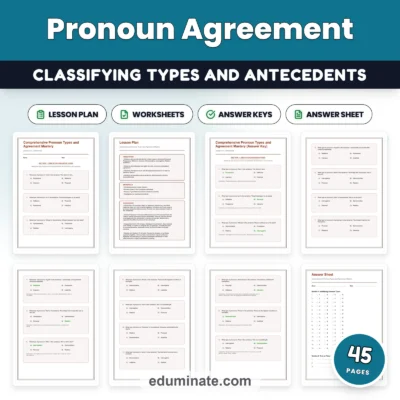
Other packs cover neighboring parts of speech. The pronoun types packet is for grades 6 to 8, with 45 pages and 70 questions across 6 sections. The common and proper nouns set is for grade 3, with 62 questions in four sections and a 30 page PDF that includes an answer key, an answer sheet and a lesson plan.
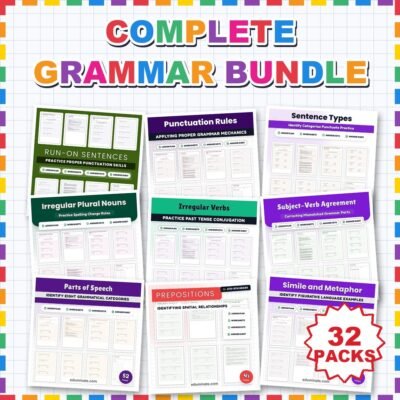
The parts of speech bundle holds three packets: the main parts of speech, pronoun types, and prepositions and prepositional phrases. It has 138 pages and is 20% off the separate prices. For every grammar packet in one download, the complete grammar bundle has 32 packets covering punctuation, nouns, verbs, word study, voice, reported speech, figurative language and the parts of speech. It has 1527 pages and is 35% off the separate prices.
Frequently asked questions
Is “not” an adverb?
Yes. “Not” is an adverb because it tells more about the verb by turning it negative. In “She did not finish,” the word “not” describes “finish.”
Can an adverb start a sentence?
Yes. “Suddenly, the lights went out” and “Yesterday we visited the museum” both begin with an adverb. A comma often follows an adverb at the start of a sentence, especially after a longer opener.
Is every -ly word an adverb?
No. Friendly, lovely, lonely and silly end in -ly but are adjectives. Check what the word describes. If it describes a noun, it is an adjective.
What grade learns about adverbs?
The packs linked in this article range from grade 2 to grade 8, and each product page lists its own grades. The parts of speech packet is for grades 3 to 5, the prepositions packet is for grades 4 to 6, and the pronoun packet is for grades 6 to 8.
Related resources
- Parts of Speech Worksheets – Nouns Verbs Adjectives & Adverbs Practice Set
- Parts of Speech Worksheets Bundle | Nouns, Verbs, Pronouns and Prepositions
- Complete Grammar Worksheets Bundle | 32 ELA Packets With Answer Keys
- Pronoun Types Worksheet Packet – Subject Object Reflexive & Relative Forms
- Common and Proper Nouns Worksheets | Grammar Practice for Grade 3 Sentence Work
- Prepositions and Prepositional Phrases Worksheets – Time Place & Direction