List of Adjectives for Kids: Types, Examples and Activities

An adjective is a word that describes a noun. This article gives a list of adjectives for kids, grouped by type: size and shape, color, feelings, the five senses, and number and quantity. It adds a second list for describing people by character and feelings, explains word order and comparing, and ends with three activities for practice in class or at home.
What is an adjective?
An adjective describes a noun or a pronoun. It answers one of three questions:
- Which one? that apple, the second row
- What kind? a red apple, a sweet apple
- How many? three apples, many apples
An adjective usually comes before the noun it describes (a tall tree), or after a linking verb such as is or looks (The tree is tall.). The words a, an and the are sometimes counted as adjectives and sometimes called articles or determiners. Use whichever name your school book uses.
List of adjectives by type
This list of adjectives uses words that suit elementary students. Each group answers a different “what kind?” question.
| Type | Examples |
|---|---|
| Size and shape | big, small, tiny, huge, tall, short, long, wide, narrow, round, square, flat |
| Color | red, orange, yellow, green, blue, purple, pink, brown, black, white, gray, golden |
| Feelings | happy, sad, angry, excited, nervous, proud, tired, surprised, calm, scared, lonely, worried |
| Taste | sweet, sour, salty, bitter, spicy, juicy |
| Touch | soft, rough, smooth, sticky, fuzzy, wet |
| Sound | loud, quiet, noisy, squeaky, silent |
| Smell | fresh, fragrant, smoky, stinky |
| Number and quantity | one, two, three, few, many, several, some, enough, all |
Some books call number and quantity words determiners. We keep them in this list because they answer “how many?”
List of adjectives to describe people
These adjectives describe how a person acts or feels, not how they look. Use this list of adjectives describing a person for stories, book reports, character studies and thank-you notes. They give students more exact words than nice or good.
| Adjective | What it means | Example sentence |
|---|---|---|
| kind | caring about others | Maya is kind to new students. |
| curious | wants to learn or find out more | Leo is curious about how plants grow. |
| brave | willing to do something hard or scary | The brave student spoke in front of the whole class. |
| patient | able to wait calmly | Mr. Reed is patient when students need extra time. |
| cheerful | happy and positive | Our cheerful neighbor waves every morning. |
| honest | tells the truth | Sam was honest and told the teacher what happened. |
| polite | uses good manners | A polite guest says please and thank you. |
| generous | gives or shares freely | Ana is generous and shared her snack. |
| thoughtful | thinks about other people’s feelings | It was thoughtful of Dev to hold the door. |
| responsible | can be trusted to do what needs to be done | Jordan is responsible and feeds the class fish every day. |
| determined | keeps trying and does not give up | Lena was determined to finish the puzzle. |
| friendly | acts in a welcoming way toward others | A friendly student welcomed the new classmate. |
We left out words about appearance or ability on purpose. When students write about real people, traits and feelings are the best place to stay. To describe how someone feels right now, pick from the feelings row above: excited, nervous, proud, tired or calm.
A list of adjectives to describe a person works best when students use it to replace a plain word. If a student writes Mr. Reed is nice, ask: “Nice how?” The answer, patient or thoughtful, is a more exact adjective.
Using adjectives in sentences
Word order
When two or more adjectives come before a noun, English speakers use a usual order. A simple version for students is opinion, then size, then color: a lovely big red balloon. Say it the other way (a red big lovely balloon) and it sounds wrong. Fourth graders are asked to order adjectives within sentences according to conventional patterns, and the standard’s own example is a small red bag rather than a red small bag.
Comparing with adjectives
Adjectives change form when we compare. Short adjectives add -er and -est, with the same spelling changes as other suffixes (happy becomes happier, big becomes bigger). Longer adjectives use more and most. A few are irregular.
| Adjective | Comparing two things | Comparing three or more |
|---|---|---|
| tall | taller | tallest |
| fast | faster | fastest |
| happy | happier | happiest |
| big | bigger | biggest |
| beautiful | more beautiful | most beautiful |
| good | better | best |
| bad | worse | worst |
Adjectives and other parts of speech
The same word can be an adjective in one sentence and another part of speech in the next. In a fast car, fast describes a noun, so it is an adjective. In She runs fast, it describes a verb, so it is an adverb. Adjectives describe nouns and pronouns. Adverbs describe verbs, adjectives and other adverbs.
Many adjectives are built by adding a suffix. The suffixes -ful and -less make adjectives from nouns: care becomes careful and careless, and hope becomes hopeful and hopeless. Our list of suffixes shows these and other word endings, with the spelling changes that go with them.
Activities to practice adjectives
Describe a mystery object
Put an object in a bag: a key, a sponge, a smooth stone or a pinecone. A student reaches in, feels it without looking and describes it using at least two adjectives. The class guesses what it is. Touch and shape words, like rough, smooth, round and hard, come up naturally.
Swap the plain adjective for a stronger one
Give students a sentence with a plain adjective and ask them to replace it with a more exact one:
| Plain sentence | Stronger sentence |
|---|---|
| It was a big dog. | It was an enormous dog. |
| The soup was hot. | The soup was boiling. |
| Mr. Park is nice. | Mr. Park is thoughtful. |
| The movie was good. | The movie was excellent. |
Remind students that stronger words are not always exact synonyms. A dictionary check shows whether a new word fits the sentence.
Adjective sort
Write 20 adjectives on cards and have students sort them into groups: size, color, feeling, sense and number. For a challenge, sort a second set into “describes a person” and “describes a thing” and talk about the words that fit both, such as quiet or happy.
Practice material
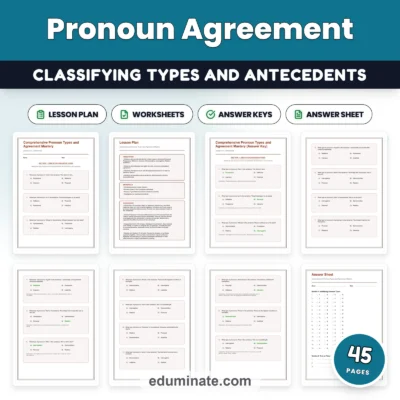
The Parts of Speech Worksheets cover nouns, verbs, adjectives and adverbs in a 52-page packet for grades 3 to 5, with a lesson plan, answer key and 85 questions across 6 sections. For the neighboring parts of speech, the Prepositions and Prepositional Phrases Worksheets are a 41-page packet for grades 4 to 6 with 70 questions in 6 sections, and the Pronoun Types Worksheet Packet is a 45-page packet for grades 6 to 8 with 70 questions across 6 sections.
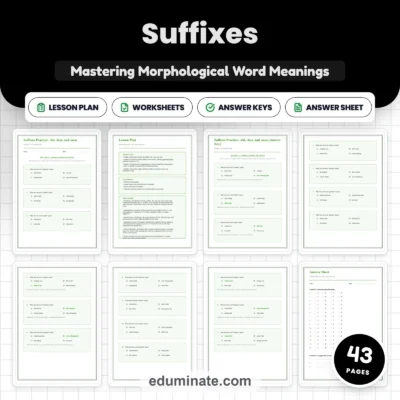
To practice adjectives made with suffixes, the Suffixes Worksheets teach -ful, -less and -ness with meaning questions, a word bank activity, true or false, spelling and short writing tasks, plus an answer key (grades 2 to 4).
If you want parts of speech in one download, the Parts of Speech Worksheets Bundle has three packets (main parts of speech, pronoun types, and prepositions and prepositional phrases) with 138 pages in total, listed for grades 3 to 8.
Frequently asked questions
What is the difference between an adjective and an adverb?
An adjective describes a noun or pronoun (a quiet student). An adverb describes a verb, an adjective or another adverb (She spoke quietly). Many adverbs end in -ly, but not all, and some words can be either, like fast.
Are “a,” “an” and “the” adjectives?
It depends on the book. Some grammar books call them adjectives, and others call them articles or determiners. Whichever name your class uses, the job is the same: they come before a noun and tell whether it is a specific one or any one.
How do I describe a person without describing how they look?
Use the person’s actions, traits and feelings. A student can ask what the person does or says and pick an adjective from the list above, such as patient, generous or curious. These words describe who a person is, not how the person looks.
When do students learn about adjectives?
The Common Core State Standards ask first graders to use frequently occurring adjectives. In third grade, students are asked to form and use comparative and superlative adjectives and adverbs, and fourth graders work on the order of adjectives, as described above.