List of Prepositions With Examples and Prepositional Phrases
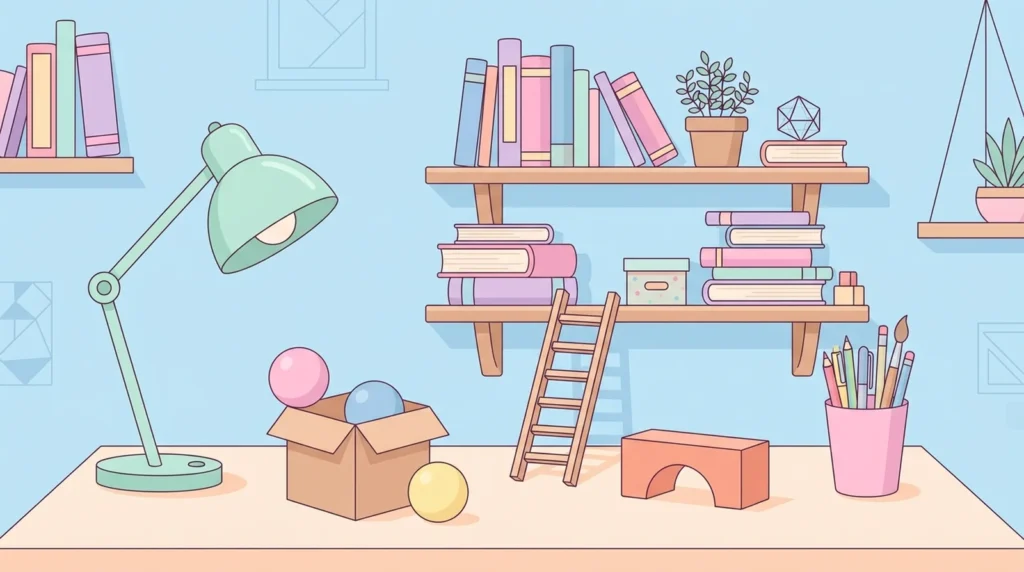
A preposition is a small word that shows how a noun or pronoun is connected to another word in the sentence. This page gives a list of prepositions sorted by place, direction and time, followed by prepositions examples in sentences. It explains what a prepositional phrase is, breaks down eight prepositional phrase examples, shows how to use prepositions correctly and ends with common mistakes and a few classroom games.
What is a preposition
A preposition shows a relationship, usually about place, time or direction. It comes before a noun or pronoun, and together they tell the reader where, when or which way.
Three short examples:
- The cat is under the table. (place)
- We eat lunch at noon. (time)
- She walked across the bridge. (direction)
A quick way to find a preposition in a sentence: look for a small word followed by a noun or pronoun that answers where, when or which way. In The mouse hid behind the box, behind comes before the box and tells where the mouse hid. Take the preposition away and the sentence loses its meaning: The mouse hid the box says something quite different.
If you are also reviewing nouns and verbs, see our parts of speech packet, which is listed for grades 3 to 5 with 52 pages, a lesson plan and an answer key.
List of prepositions
This list of prepositions groups the most common ones. A few words appear in more than one group because they can show place or time. There is no single fixed count of prepositions in English, so treat this as a set of the common ones, not a full list.
| Group | Prepositions |
|---|---|
| Place | in, on, at, under, over, above, below, beside, between, behind, near, inside, outside, among, beneath, against, next to, in front of |
| Direction | to, from, into, onto, toward, through, across, along, around, past, up, down, off, out of |
| Time | before, after, during, until, since, by, for, within, throughout, at, on, in |
| Other common ones | of, with, without, about, like, except, despite, instead of, according to |
The table holds more than 40 prepositions. Some, such as next to, in front of, out of and instead of, are made of more than one word but work as a single preposition.
Our list of adjectives sorts another part of speech the same way.
Prepositions examples
Here are twelve prepositions examples. The preposition is in bold.
- The cat sleeps under the table.
- We have lunch at noon.
- She walked across the bridge.
- The book is on the shelf.
- He ran into the room.
- I wait for the bus.
- School starts in September.
- The ball rolled between the two chairs.
- They played during recess.
- The bird flew over the fence.
- Put the pencil beside the notebook.
- We stayed inside until dark.
Notice that some prepositions are followed by a time word instead of a place word (at noon, during recess). The pattern is the same: preposition, then object.
What is a prepositional phrase
A prepositional phrase starts with a preposition and ends with its object, the noun or pronoun that follows. Any describing words in between belong to the phrase. The phrase does not have its own subject or verb, so it cannot stand alone as a sentence. If students are still learning that idea, our subject and predicate pages for grades 3 to 5 cover it.
Take the phrase under the old bridge:
- Preposition: under
- Describing words: the, old
- Object of the preposition: bridge
Prepositional phrases do the work of describing words. Some tell more about a noun: in The book on the shelf is mine, on the shelf tells which book. Others tell more about a verb: in She reads in the library, in the library tells where she reads. A sentence can also hold more than one phrase: The cat slept under the table during the storm has two, under the table and during the storm.
Prepositional phrase examples
This table breaks eight prepositional phrase examples into parts.
| Phrase | Preposition | Object | What it tells |
|---|---|---|---|
| under the table | under | table | Where |
| at noon | at | noon | When |
| across the bridge | across | bridge | Which way |
| on the shelf | on | shelf | Where |
| into the room | into | room | Which way |
| during recess | during | recess | When |
| with her friends | with | friends | Who with |
| after the long game | after | game | When |
Here are five sentences, with the prepositional phrase named in words:
- The cat sleeps under the table. The phrase is under the table.
- We have lunch at noon. The phrase is at noon.
- She walked across the bridge. The phrase is across the bridge.
- The children played during recess. The phrase is during recess.
- He talked with her friends. The phrase is with her friends.
Types of prepositions
The main types of prepositions are grouped by what they show:
- Place: where something is. The keys are on the desk.
- Time: when something happens. We leave after lunch.
- Direction: which way something moves. The dog ran through the gate.
Place prepositions answer where, time prepositions answer when, and direction prepositions answer which way. Some words work in more than one group: in can show place (in the box) or time (in July), and by can show place (by the window) or time (by Friday). Use the sentence to decide which group a word belongs to.
Most simple sentences use one of these three. The remaining prepositions in the table above, such as of, with and about, show other connections, like who with or what about.
How to use prepositions
At, on and in for time and place
These three small words cause the most confusion. A rough guide:
| Word | Time | Place |
|---|---|---|
| at | at noon, at 3 o’clock | at the door, at school |
| on | on Monday, on May 5 | on the table, on the wall |
| in | in July, in 2026, in the morning | in the box, in the room |
Prepositions after certain words
Some words take a particular preposition after them. English speakers learn these by hearing them often. Examples: good at math, afraid of storms, interested in art, listen to the teacher. If a pair sounds odd, check it in a dictionary.
The object of a preposition is a noun or pronoun
A preposition is followed by an object, and a pronoun in that spot takes its object form: me, him, her, us, them. So we say with her, not with she. Our pronoun types packet covers subject and object forms for grades 6 to 8.
Common mistakes with prepositions
| Wrong | Right | Why |
|---|---|---|
| Come with she. | Come with her. | The object of a preposition takes the object form. |
| Between you and I. | Between you and me. | Both words are objects of between. |
| Where is the library at? | Where is the library? | The at adds nothing. |
| He sat besides me. | He sat beside me. | Beside means next to. Besides means in addition to. |
| She is afraid from dogs. | She is afraid of dogs. | The word afraid goes with of. |
Preposition games and activities
An object and a place
Hide a small object in the room. One child describes where it is using a prepositional phrase: on the shelf, behind the plant. Others guess the spot.
Sort the sentence strips
Write sentences on strips of paper. Students sort them into piles for place, time or direction by looking at the preposition.
Write a paragraph that uses five prepositions
Give students a topic, such as a walk to school, and ask them to write a short paragraph with at least five different prepositions. Then they underline each prepositional phrase and circle the object. Partners can swap paragraphs and check each other’s work against the list above. This works well as a quick writing center or a warm-up at the start of a grammar lesson.
For other sentence work, see our post on types of sentences.
Practice material
For students who need more practice, prepositions and prepositional phrases practice pages are a 41-page packet for grades 4 to 6, with a lesson plan, an answer key and 70 questions in 6 sections.
The packet is also part of the parts of speech bundle, which has three packets on the main parts of speech, pronoun types, and prepositions and prepositional phrases, 138 pages in all, for grades 3 to 8. For grade-by-grade grammar ideas, see our post on 3rd grade grammar practice.
Frequently asked questions
Can a sentence end with a preposition?
Yes, in everyday English. What are you looking at? sounds natural. In very formal writing, some people rewrite such sentences, but it is not an error.
Is “to” always a preposition?
No. In to the store, to is a preposition. In to run, it is part of the infinitive verb form and there is no object.
What is the difference between a preposition and an adverb?
A preposition has an object. In He climbed up the ladder, up is a preposition with the object ladder. In He looked up, there is no object, so up is an adverb.
What grade learns prepositions?
Schools differ, so check your own curriculum. For reference, our prepositions packet is listed for grades 4 to 6, and the parts of speech bundle for grades 3 to 8.
Related resources
- Prepositions and Prepositional Phrases Worksheets, Time Place and Direction
- Parts of Speech Worksheets Bundle, Nouns, Verbs, Pronouns and Prepositions
- Parts of Speech Worksheets, Nouns Verbs Adjectives and Adverbs Practice Set
- Pronoun Types Worksheet Packet, Subject Object Reflexive and Relative Forms
- Subject and Predicate Worksheets, Complete Simple Compound Grammar Practice