There vs Their vs They’re: How to Tell the Difference

There, their and they’re sound the same, but each one does a different job. Students mix up their and there and they’re in writing even when they can explain the difference out loud. This guide to there vs their vs they’re gives you the short answer first, then an example of each word, memory tricks that work in a classroom, a table of common mix-ups and ideas for practicing.
The short answer: there vs their vs they’re
- There points to a place, or starts a sentence about something that exists: over there, there is, there are.
- Their shows that something belongs to more than one person or thing.
- They’re is a short way to write they are.
All three can appear in one sentence: They’re putting their coats over there.
There
The word there has two jobs. The first is to name a place that is not here.
- Please put the box over there.
- Our school is right there, next to the park.
The second job is to start a sentence that says something exists. In these sentences the real subject comes after the verb.
- There is a bird in the tree.
- There are 24 students in our class.
Their
Use their when something belongs to a group of people, animals or things. It always comes before the noun that is owned.
- The students put their backpacks on the hooks.
- The birds built their nest in the tree.
They’re
They’re is a contraction: two words squeezed into one. The apostrophe takes the place of the letter a in are.
- They’re going to the library after lunch.
- I think they’re ready to start.
Here is the test that settles most cases: say they are in place of the word. If the sentence still makes sense, write they’re.
Memory tricks that work in class
Here and there
There is here with a t added at the front. Both words are about place, so a student who is writing about a place can check for the word here hiding inside. Where belongs to the same family.
Find the heir in their
The word their has the word heir inside it. An heir is a person who gets something that belonged to someone else, so the spelling reminds students that their is about owning things.
Expand the contraction
For they’re, students replace the word with they are and read the sentence again. They’re going to the park becomes They are going to the park, which works. They’re backpacks are on the floor becomes They are backpacks are on the floor, which does not.
Three questions in order
Post these on the wall for writing time. The order is they’re, their, there on purpose: the contraction is the only one with a test that gives a clear yes or no, so it goes first.
- Can I say they are? Write they’re.
- Does it show that something belongs to them? Write their.
- If neither fits, it is probably a place or there is and there are. Write there.
Common mix-ups
| Wrong | Right | Why |
|---|---|---|
| Their going to the park. | They’re going to the park. | They are going makes sense. |
| They’re backpacks are on the floor. | Their backpacks are on the floor. | The backpacks belong to them, and they are backpacks does not make sense. |
| Put the box over their. | Put the box over there. | It names a place. |
| I like there new house. | I like their new house. | The house belongs to them. |
| Their are three apples on the table. | There are three apples on the table. | It says the apples exist. Nobody owns them in the sentence. |
Related pairs that cause the same trouble
Students who mix up there, their and they’re often confuse these words too. They are worth teaching in the same unit.
| Word | Meaning | Example |
|---|---|---|
| to | toward, or the start of a verb | I went to the store. I want to read. |
| too | also, or more than enough | I like pizza too. It is too hot. |
| two | the number 2 | I have two pencils. |
| its | belongs to it | The dog wagged its tail. |
| it’s | it is, or it has | It’s raining. |
| accept | to take or agree to | I accept your gift. |
| except | leaving out | Everyone came except Sam. |
Ways to practice
Sort the sentences
Write sentences with a blank on cards or strips: ___ going to the zoo. We left our lunches over ___. The class forgot ___ coats. Students put each strip under the right word, then read it aloud with the word in place. For a quick whole-class version, give each student three small cards and have them hold up the right one as you read a sentence.
Proofread a paragraph
Write a short paragraph with five mistakes on purpose and have students find and fix them using the three questions. Proofreading real writing is the best practice because that is where the mistakes happen. If you are building this into a weekly routine, our guide to ELA worksheets for 4th graders shows how to fit short grammar practice into the week.
Short quizzes
A five-sentence quiz at the end of the lesson shows you quickly who still mixes the words. Put all three words in one quiz so that students have to choose each time, instead of repeating one word. Here is a sample you can copy:
- ___ going to visit their grandmother. (They’re)
- The students left ___ lunches in the classroom. (their)
- ___ are four chairs at the table. (There)
- I think ___ lost. (they’re)
- Please hang your coat over ___. (there)
Ask students to write the test they used for each answer, not only the word. That shows you whether they understand the rule or are guessing.
Practice material
The There Their They’re Worksheets are listed for grades 4 to 8 and include multiple choice, fill in the blank, true or false and short answer sections, with a lesson plan, answer sheet and teacher key.
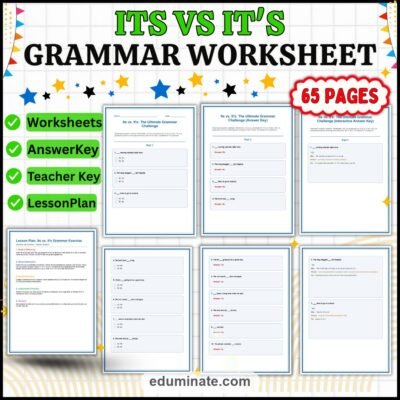
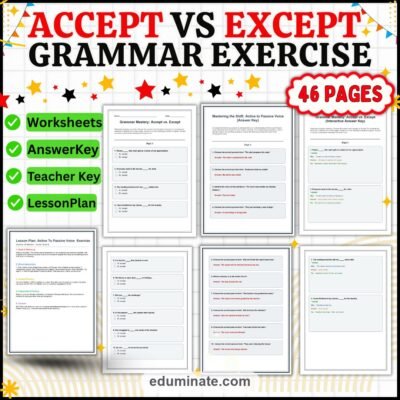
For the related pairs, the To Too Two Worksheet is a 43-page packet for grades 3 to 6 with multiple choice, fill in the blank, true or false and sentence writing, plus an answer key. The Its Vs It’s Grammar Worksheet is a 70-question worksheet for grade 4 with a plain answer key, teacher key and one-page lesson plan. For older students, the Accept vs Except Worksheets (grade 7) have fill in the blank, sentence choice and a reading passage, with an answer key, a teacher key with tips and a lesson plan.
The Word Study Worksheets Bundle has four packets: prefixes (un, re, pre, dis), suffixes (-ful, -less, -ness), its and it’s, and accept and except. It does not include there, their and they’re, which are in the separate worksheet set above.
Frequently asked questions
Why do there, their and they’re sound the same?
They are homophones: words that sound alike but have different spellings and meanings. English has many sets of them, which is why these mistakes are so common in writing.
What is the difference between “there’s” and “theirs”?
There’s means there is: There’s a spider on the wall. Theirs means belonging to them and stands alone, without a noun after it: Those books are theirs. Theirs has no apostrophe.
When do students learn the difference?
The Common Core State Standards ask fourth graders to correctly use frequently confused words, with to, too, two, there and their given as examples. Many students need practice after that, because the mistake is easy to make while writing quickly.
Why doesn’t spell check catch these mistakes?
A basic spell check looks at spelling, and there, their and they’re are all real words, so it may not flag them. Reading a sentence with they are in place of they’re is a more reliable check.