Complex Sentence Examples: Simple, Compound and Complex
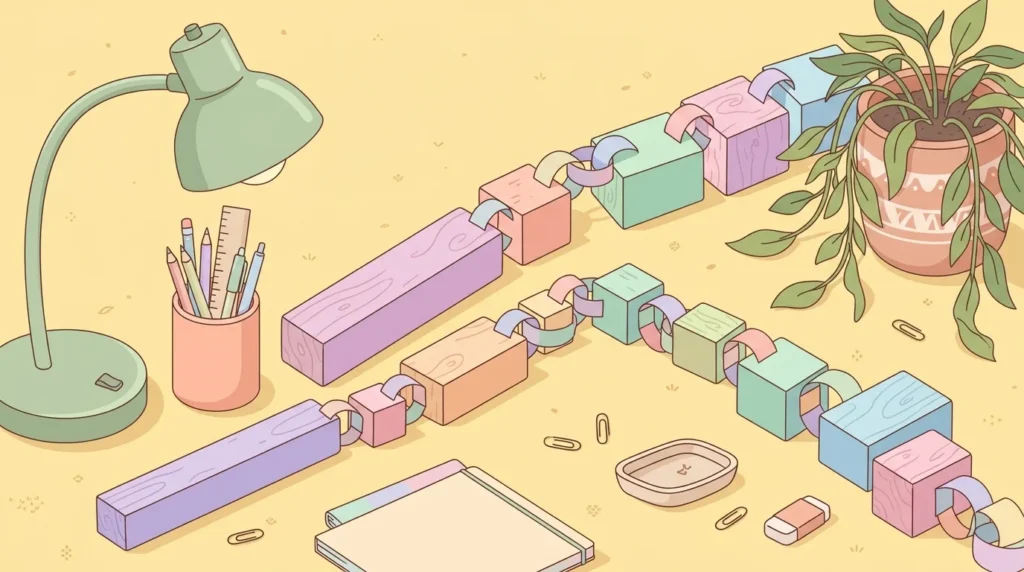
A complex sentence has one independent clause and at least one dependent clause, and complex sentence examples are easiest to follow when they sit beside simple, compound and compound-complex ones. This guide shows all four structures, explains clauses and subordinating conjunctions, and gives a step-by-step way to build your own.
Sentence structure examples
Sentences are built from clauses. A clause is a group of words with a subject and a verb. The number and kind of clauses decide the structure. Here are four sentence structure examples, one for each, using the same idea so the differences are easy to see:
- Simple: The students read.
- Compound: The students read, and the teacher listened.
- Complex: The students read while the teacher listened.
- Compound-complex: The students read while the teacher listened, and then they discussed the story.
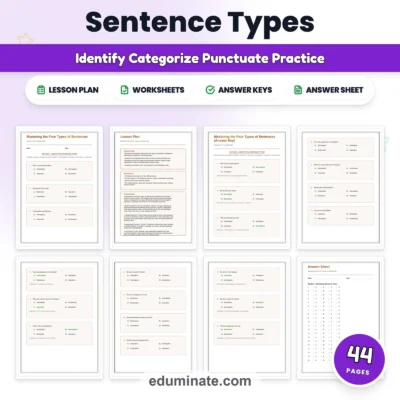
Structure is about how the clauses are built. It is a different idea from the four types of sentences, which sort sentences by purpose: statements, questions, commands and exclamations. The post on types of sentences covers those. The four types of sentences set is a practice option for grades 3 to 5, with worksheets, an answer key, an answer sheet and a lesson plan.
Simple sentences examples
A simple sentence has one independent clause. It can be short or long, and it can have more than one subject or more than one verb, as long as there is only one clause. Here are five simple sentences examples:
- The bell rang.
- Mia and Leo ran and jumped. (two subjects and two verbs, one clause)
- After lunch, the class walked to the library.
- The tall grass swayed in the wind.
- My sister and I built a model of a bridge.
Simple does not mean basic or weak. Careful writers use simple sentences on purpose, often for a short, direct point after a longer sentence. The label only tells you how many clauses there are.
In sentence 3, “After lunch” is a phrase, not a clause, because it has no subject and verb of its own. That is why the sentence stays simple.
The subject and the predicate are the two halves of every clause. The subject and predicate set for grades 3 to 5 covers complete, simple and compound subjects and predicates, with an answer key, an answer sheet and a lesson plan.
Compound sentence examples
A compound sentence has two independent clauses. They are joined by a comma plus a coordinating conjunction, or by a semicolon. The seven coordinating conjunctions are for, and, nor, but, or, yet and so. Some teachers use the memory aid FANBOYS for that list, one letter for each word.
Here are five compound sentence examples:
- The rain stopped, and we went outside.
- Maya wanted a snack, but the cupboard was empty.
- You can read now, or you can read after lunch.
- The bus was late; the class waited inside.
- It was cold, so we wore coats.
Each one has two full clauses that could stand alone. A comma alone is not enough to join them. Doing that creates a comma splice, a kind of run-on. The post with run on sentence examples shows how to fix it, and the run-on sentences packet for grades 5 to 7 has 46 pages and 70 questions in 6 sections, with a lesson plan and answer key.
One more point is easy to miss. The word “and” does not always make a sentence compound. “Mia and Leo ran” is simple, because “and” joins two subjects, not two clauses.
Independent clause examples and dependent clause examples
Every clause has a subject and a verb. An independent clause can stand alone as a sentence. A dependent clause cannot, because it starts with a word that makes it depend on something else.
Four independent clause examples:
- The students finished.
- Maya opened the window.
- It rained all night.
- We walked home.
Four dependent clause examples:
- because it rained
- when the bell rang
- although she was tired
- if you finish early
Each dependent clause has a subject and a verb: “it rained,” “the bell rang,” “she was tired” and “you finish.” The first word of each makes the thought feel unfinished. When one stands alone, it is a fragment, not a sentence. “Because it rained.” leaves the reader waiting. “Because it rained, the game was canceled.” finishes the thought.
Complex sentence examples
Here is the complex sentence definition in one line: a complex sentence has one independent clause and at least one dependent clause. The dependent clause can come first or second. Six complex sentence examples:
- Because it rained, the game was canceled.
- The game was canceled because it rained.
- When the bell rings, the class lines up.
- Maya smiled after she found her notebook.
- Although the box was heavy, Leo carried it upstairs.
- We will stay inside unless the rain stops.
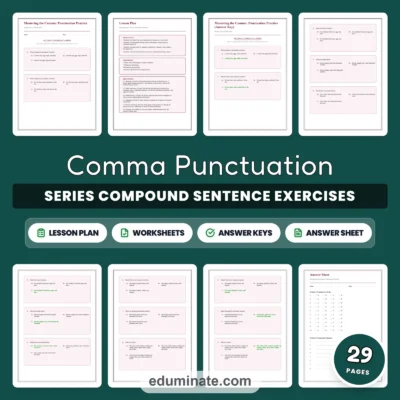
Sentences 1 and 2 use the same clauses in a different order. The comma rule follows from that: when the dependent clause comes first, put a comma after it. When it comes second, usually no comma is needed. The post on comma rules covers this and other cases. For practice, the comma usage packet for grades 3 to 6 has 29 pages and 40 comma questions across 4 sections, with a lesson plan and answer key.
A dependent clause can also begin with who, which or that. In “The book that I borrowed was long,” the clause “that I borrowed” cannot stand alone, so the sentence is complex.
Subordinating conjunctions list
A subordinating conjunction is the word that turns a clause into a dependent clause. This subordinating conjunctions list holds the ones students meet most: because, although, since, when, while, if, unless, until, after, before, as, whenever and even though.
It helps to group these words by the job they do. Because, since and as give a reason. When, while, after, before, until, since and whenever show time. Although and even though show a contrast. If and unless set a condition. A word such as since or while can belong to more than one group, so read the whole sentence before deciding.
Here is one example for four of them:
- Leo stayed inside because it was cold.
- Take an umbrella unless the sky is clear.
- Wait here until the bell rings.
- Even though she was tired, Maya finished her page.
A dependent clause is also called a subordinate clause. So the clauses in the examples above, such as “because it was cold” and “until the bell rings,” are subordinate clause examples as well. Some of these words, such as after, before and since, can also begin a phrase with no clause. “After lunch” is a phrase. “After we ate lunch” is a clause, because it has a subject and a verb.
How to write a complex sentence
Students can build a complex sentence from two short ones. These steps show how to write a complex sentence:
- Start with two simple sentences: “The picnic was moved inside.” “It started to rain.”
- Decide how the ideas relate. Here, the rain is the reason for the move.
- Pick a subordinating conjunction that fits the relationship. “Because” shows a reason.
- Add it to the sentence that holds the reason, and join the two: “The picnic was moved inside because it started to rain.”
- Check the comma. The dependent clause comes second, so no comma is needed. If you move it to the front, add one: “Because it started to rain, the picnic was moved inside.”
Try the same steps with a different pair. “We cleaned the room.” “The guests arrived.” The relationship is time, so “before” or “after” fits: “We cleaned the room before the guests arrived.” Students can try both orders and place the comma each time.
Two mistakes are common at this stage. The first is leaving a dependent clause alone, which makes a fragment: “We stayed home. Because the roads were icy.” The second is dropping the comma after an opening dependent clause. Reading the sentence aloud and listening for the pause often catches both.
Punctuation is part of sentence building. The punctuation rules packet for grades 4 to 6 has 44 pages and 70 questions in 6 sections, with a lesson plan and answer key.
Compound-complex sentences
A compound complex sentence has two or more independent clauses and at least one dependent clause. It combines the compound and complex patterns. Three examples, with the clauses named:
- When the bell rang, the students lined up, and the teacher opened the door. (dependent: “When the bell rang.” Independent: “the students lined up” and “the teacher opened the door.”)
- Maya packed her bag because the trip was early, but Leo packed his bag last night. (dependent: “because the trip was early.” Independent: “Maya packed her bag” and “Leo packed his bag last night.”)
- We stayed inside until the storm passed; then we walked to the park. (dependent: “until the storm passed.” Independent: “We stayed inside” and “then we walked to the park.”)
After simple compound complex sentences have been taught in that order, this last pattern combines two ideas students have already seen. A good method is to find the dependent clause first, then count the independent clauses that remain.
Quick check
Label each sentence as simple, compound, complex or compound-complex. For each one, find the verbs first, then ask whether each clause could stand alone. The answers are below.
- The students cleaned the room.
- The students cleaned the room, and the teacher thanked them.
- After the students cleaned the room, the teacher thanked them.
- Maya packed her lunch, but she forgot her water bottle.
- Because the road was icy, the bus ran late.
- Leo and Mia read quietly and wrote notes.
- When the rain stopped, we walked outside, and we looked for puddles.
- Leo forgot his jacket because it was warm in the morning.
Answers:
- Simple (one independent clause).
- Compound (two independent clauses joined by a comma and “and”).
- Complex (the dependent clause “After the students cleaned the room” plus one independent clause).
- Compound (two independent clauses joined by a comma and “but”).
- Complex (the dependent clause “Because the road was icy” plus one independent clause).
- Simple (a compound subject and a compound predicate, but only one clause).
- Compound-complex (one dependent clause and two independent clauses).
- Complex (one independent clause and the dependent clause “because it was warm in the morning”).
Practice material
The packs linked above each cover one piece of the sentence: subjects and predicates, sentence purpose, commas, other punctuation and run-ons. The punctuation and sentence structure bundle puts six grammar packets together. They cover how a sentence is built and how it is punctuated, from subjects and predicates to commas, quotation marks and run-ons. It has 254 pages and is 20% off the separate prices.
Frequently asked questions
Does complex mean hard?
No. A complex sentence can be short, such as “I smiled when she waved.” The name describes the structure: an independent clause plus a dependent clause.
Can a sentence begin with “because”?
Yes, as long as the dependent clause is followed by an independent clause. “Because it rained, we stayed in” is a full sentence. “Because it rained.” alone is a fragment.
Is a long sentence always complex?
No. A sentence can be long and still simple if it has only one clause. “The tall students in the back row waved at the bus and shouted loudly” has one subject group and one compound predicate. Count the clauses, not the words.
What grade learns sentence structure?
The packs linked in this article cover grades 3 to 7, and each product page lists its own range. The subject and predicate set and the four types set are for grades 3 to 5, and the run-on sentences packet is for grades 5 to 7.
Related resources
- Subject and Predicate Worksheets | Complete Simple Compound Grammar Practice
- Run-On Sentences Worksheets – Comma Splices and Fused Sentence Practice Set
- Four Types of Sentences Worksheets | Sentence Types Practice | Grammar Activity
- Comma Usage Worksheet Packet – Series Introductory Clauses and Dates Rules
- Punctuation and Sentence Structure Worksheets Bundle | 6 Grammar Packets
- Punctuation Rules Worksheets – End Marks Commas Colons & Semicolons Packet