Run on Sentence Examples and Sentence Fragment Examples
A run-on sentence joins two complete sentences without the right punctuation, and a sentence fragment is missing a piece it needs to stand alone. This page gives run on sentence examples and sentence fragment examples side by side, each with a corrected version.
What is a complete sentence
What is a complete sentence? It has a subject (who or what the sentence is about), a predicate (what the subject does or is) and it expresses a complete thought. If any one of those is missing, the group of words is not a sentence.
Two correct examples: The dog barked. My brother plays soccer after school.
Complete sentence examples
These complete sentence examples have the subject and predicate marked in words. Even a short sentence can be complete.
| Sentence | Subject | Predicate |
|---|---|---|
| The cat sleeps. | The cat | sleeps |
| My sister reads books every night. | My sister | reads books every night |
| Rain fell all morning. | Rain | fell all morning |
| The tall boy kicked the ball. | The tall boy | kicked the ball |
| We ate lunch outside. | We | ate lunch outside |
| Close the door. | (you, understood) | Close the door |
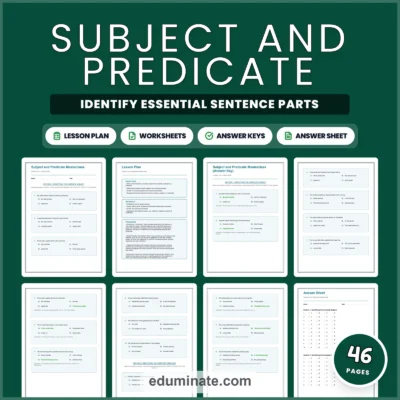
In the last sentence, the subject you is not written, but every reader understands it. Commands like this one are complete sentences. Our subject and predicate pack covers complete, simple and compound subjects and predicates for grades 3 to 5, and the post on types of sentences explains statements, questions, commands and exclamations.
Sentence fragment examples
Sentence fragment examples all share one problem: the group of words is missing a subject, a verb or a complete thought. A fragment may start with a capital letter and end with a period, but it still is not a sentence.
| Fragment | What is missing | Corrected sentence |
|---|---|---|
| Running down the hall. | Subject and helping verb | Sam was running down the hall. |
| Because it was raining. | A finished thought | Because it was raining, we stayed inside. |
| The tall girl with the red backpack. | Predicate | The tall girl with the red backpack walked to school. |
| Eats breakfast at seven. | Subject | My brother eats breakfast at seven. |
| After the game ended. | A finished thought | After the game ended, we went home. |
| In the big blue box. | Subject and verb | The toys are in the big blue box. |
| When the bell rings. | A finished thought | When the bell rings, class begins. |
| My friend who lives next door. | Predicate | My friend who lives next door plays soccer. |
How to fix a sentence fragment
To learn how to fix a sentence fragment, ask what the group of words is missing and then add it. There are three moves:
- Add the missing subject. Eats breakfast at seven becomes My brother eats breakfast at seven.
- Add the missing verb or predicate. The tall girl with the red backpack becomes The tall girl with the red backpack walked to school.
- Join the fragment to a sentence. Because it was raining needs a main clause: Because it was raining, we stayed inside.
Fragment vs sentence
When students are not sure about fragment vs sentence, they can run three checks:
- Who or what is this about? (the subject)
- What happened, or what is it like? (the predicate)
- Does the thought feel finished, or am I waiting for more?
If any answer is missing, it is a fragment. The table compares a complete sentence vs fragment in four pairs.
| Fragment | Complete sentence |
|---|---|
| Ran to the store. | Maya ran to the store. |
| The bus. | The bus stopped. |
| Although she was tired. | Although she was tired, she finished her homework. |
| Under the bed. | The shoes are under the bed. |
What is a run on sentence
A run-on sentence is two or more complete sentences joined with no punctuation, or with the wrong punctuation. Reading a run-on aloud often exposes it, because there is no natural place to stop. A run-on can be short: I like pizza my sister likes pasta has two complete thoughts squeezed into one.
Run on sentence examples
Each sentence in this table really is a run-on, and each fix is punctuated correctly.
| Run-on | What is wrong | Fixed version |
|---|---|---|
| I like pizza my sister likes pasta. | Two sentences with no punctuation between them | I like pizza. My sister likes pasta. |
| It was cold outside we wore coats. | Two sentences with no punctuation | It was cold outside, so we wore coats. |
| My phone died I forgot to charge it. | Two sentences with no punctuation | My phone died because I forgot to charge it. |
| We went to the park we played on the swings and then we went home. | Three sentences run together | We went to the park and played on the swings. Then we went home. |
| She studied for the test she got a good grade. | Two sentences with no punctuation | Because she studied for the test, she got a good grade. |
| The bell rang everyone lined up. | Two sentences with no punctuation | The bell rang, and everyone lined up. |
What is a comma splice
What is a comma splice? It is a run-on in which two complete sentences are joined by only a comma. A comma alone is not strong enough to hold two sentences together.
Comma splice examples
These comma splice examples each have a corrected version:
| Comma splice | Corrected |
|---|---|
| I wanted to go outside, it was raining. | I wanted to go outside, but it was raining. |
| She loves soccer, she plays every weekend. | She loves soccer; she plays every weekend. |
| The store was closed, we went home. | The store was closed, so we went home. |
| Tom is tall, his brother is short. | Tom is tall. His brother is short. |
Fused sentence
A fused sentence is a run-on with no punctuation at all between the two sentences. The cat sat on the mat the dog slept on the rug is a fused sentence. One fix is to split it: The cat sat on the mat. The dog slept on the rug.
How to fix a run on sentence
There are four ways to fix a run-on, and the same sentence can be repaired with each one. The run-on: The rain stopped we went outside.
- Use a period. The rain stopped. We went outside.
- Use a semicolon. The rain stopped; we went outside.
- Use a comma and a conjunction such as and, but or so. The rain stopped, so we went outside.
- Use a subordinating conjunction such as because or when. When the rain stopped, we went outside.
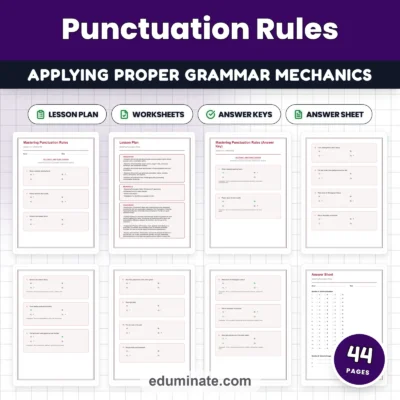
The comma in fix 3 goes before the conjunction, and the comma in fix 4 goes after the opening clause. Both are covered in our post on comma rules. For a longer look at periods, commas, colons and semicolons, the punctuation rules packet has 44 pages for grades 4 to 6, with 70 questions across 6 sections.
Sentence fragments and run ons together
Mixing the two problems means students must decide which one they are looking at. Label each of these six items fragment, run-on or complete.
- Because the game was canceled.
- We walked home it started to rain.
- My grandmother bakes bread every Saturday.
- Running as fast as he could.
- The test was hard, I studied for hours.
- Please sit down.
Answers: 1 is a fragment (a finished thought is missing). 2 is a run-on (two sentences with no punctuation). 3 is complete. 4 is a fragment (it has no main clause: who was running?). 5 is a run-on (a comma splice). 6 is complete (the subject you is understood).
Ways to teach it
Read it aloud
Have students read their own writing out loud and listen for places where they run out of breath, or where the sentence stops too soon. Both are clues.
Sentence-building cards
Make two sets of cards: subjects (The dog, My cousin) and predicates (barked loudly, plays soccer). Students pair them to build complete sentences. Leave a few cards unpaired and ask what is missing.
Edit a paragraph with colored pens
Give students a short paragraph with a few fragments and run-ons. They circle fragments in one color, mark run-ons in another, and rewrite the paragraph.
Practice material
For focused practice, the run-on sentences packet is a 46-page set for grades 5 to 7, with a lesson plan, an answer key and 70 questions across 6 sections.
The punctuation and sentence structure bundle has six grammar packets that cover how a sentence is built and how it is punctuated, from subjects and predicates to commas, quotation marks and run-ons. It runs 254 pages, for grades 3 to 7. For students who also need practice with sentence types, the four types of sentences pack covers declarative, interrogative, imperative and exclamatory sentences, for grades 3 to 5. Quotation marks come up in the same units, and our post on quotation marks rules covers them.
Frequently asked questions
Is a long sentence always a run-on?
No. A long sentence can be correct. After the rain stopped, we put on our boots, walked to the park and played on the swings until dinner. That sentence is long, but it has one subject (we) and a clear structure. A run-on is about joining sentences incorrectly, not about length.
Is a comma splice a run-on?
Yes. A comma splice is one kind of run-on. The other kind is the fused sentence, which has no punctuation at all.
Can a fragment ever be right?
In formal writing, students should use complete sentences. In dialogue and quick answers, writers sometimes use fragments on purpose, as in “Where are you going?” “To school.” It helps students to know the rule before they learn when it can be broken.
What grade learns this?
Schools differ, so check your curriculum. For reference, our packs are listed for grades 3 to 5 (subject and predicate, four types of sentences), grades 4 to 6 (punctuation rules) and grades 5 to 7 (run-on sentences), with the bundle covering grades 3 to 7.
Related resources
- Run-On Sentences Worksheets, Comma Splices and Fused Sentence Practice Set
- Punctuation and Sentence Structure Worksheets Bundle, 6 Grammar Packets
- Punctuation Rules Worksheets, End Marks Commas Colons and Semicolons Packet
- Subject and Predicate Worksheets, Complete Simple Compound Grammar Practice
- Four Types of Sentences Worksheets, Sentence Types Practice, Grammar Activity