Text Structure: Types, Examples, Signal Words and Charts

Text structure is the way an author organizes the ideas in a piece of writing, and the five structures taught most often are description, sequence, compare and contrast, cause and effect, and problem and solution. This guide gives a short example of each, the signal words that point to it, the graphic organizer that fits, an anchor chart layout and activities.
Text structure
Two texts can cover the same topic and still read very differently. One may list facts about a storm. Another may explain what caused the storm and what followed. The facts could be the same, yet the plan behind each text is not.
That plan is the text structure. When students can see it, they know where to look for the main point and how the details connect. Many students read a page as a pile of facts. Structure gives them a map.
What is text structure
If a student asks what is text structure, a short text structure definition is this: it is the pattern an author uses to arrange ideas so that the reader can follow them. The structure of a text affects how the information is ordered, how the sentences link together and which words show the connections.
It helps to separate two ideas that sound alike. Text features are the parts you can point to on a page, such as headings, captions and bold words. Structure is the pattern underneath. A page can have a heading and a caption and still be organized as a sequence, a comparison or a list of causes.
Types of text structure
There are several types of text structure in informational writing. Five are taught the most, and each gets its own section of text structure examples below:
- Description
- Sequence (also called chronological order)
- Compare and contrast
- Cause and effect
- Problem and solution
Real texts often mix these. A single article might describe a place, then show a sequence of events, then explain a cause. Students can still name the main pattern of each paragraph.
Descriptive text structure
Descriptive text structure gives details about a person, place, thing or idea. The author tells what it is like, using details that answer who, what, where and how.
Example: A lighthouse is a tall tower built near the sea. It has a bright lamp at the top that shines out over the water. The walls are thick, and a spiral staircase winds up the inside.
Signal words: for example, for instance, such as, including, looks like, next to, in front of, on top of.
Graphic organizer: a web, with the topic in the middle and details on lines around it.
Sequence text structure
Sequence text structure puts events or steps in the order they happen. It is used for instructions, timelines, life cycles and processes.
Example: First, a seed is planted in soil. Next, it takes in water and swells. Then a root grows down and a small stem pushes up. Finally, the first leaves open to the light.
Signal words: first, next, then, after, before, later, finally, at last, dates and times.
Graphic organizer: a chain of boxes joined by arrows, or a numbered list.
Compare and contrast text structure
Compare and contrast text structure shows how two or more things are alike and how they are different.
Example: Both bikes and scooters have wheels and handlebars. A bike has pedals and a chain, but a scooter is pushed along with one foot.
Signal words: both, alike, similar, the same as, also, different, but, however, unlike, while, on the other hand.
Graphic organizer: a Venn diagram, with what is alike in the overlap, or a two-column chart.
Cause and effect text structure
Cause and effect text structure explains why something happened and what came of it. The cause is the reason. The effect is the result.
Example: Heavy rain fell all night. As a result, the river rose over its banks, and the path was covered with water.
Signal words: because, so, since, as a result, therefore, due to, if, then.
Graphic organizer: a two-column chart with causes on the left and effects on the right, or boxes joined by arrows.
One tip is worth sharing. Students often find the effect first, because it is the visible event. Ask them to go back and find the reason for it. Some texts also show a chain, where one effect becomes the cause of the next.
Problem and solution text structure
Problem and solution text structure names a difficulty and then describes one or more ways to fix it.
Example: Library books kept going missing from the shelves. To solve the problem, the librarian placed a sign-out sheet by the door. Now every book can be tracked.
Signal words: problem, issue, challenge, solution, solve, fix, answer, so that.
Graphic organizer: a box for the problem with arrows pointing to one or more solution boxes.
Text structure signal words at a glance
Signal words are clues, but they are not always present. Some paragraphs use none at all. Here are the groups in one place for a quick reference:
- Description: for example, such as, including, next to
- Sequence: first, next, then, finally, before, after
- Compare and contrast: both, similar, different, however, unlike
- Cause and effect: because, as a result, so, therefore, since
- Problem and solution: problem, solve, solution, issue, fix
Some words appear in more than one group. The word so can show a cause and effect link or a problem and solution link. Students need to read the whole passage and think about what the author is doing, and cannot rely on a single word.
How to find the structure of a text
A short routine helps students work out the structure of a text on their own:
- Read the title and any headings. They often hint at the pattern.
- Read the first paragraph and ask what the author wants you to learn.
- Circle signal words as you read.
- Ask what the author is doing: describing, ordering, comparing, explaining a reason or fixing a problem.
- Choose the organizer that fits and fill it in with details from the text.
- Check the organizer. If the details do not fit, try another structure.
Finding the structure also supports finding the main point. Our guide to what is the main idea shows how details support a central point, and the structure tells students where those details are likely to sit.
Narrative text structure in fiction
The five patterns above belong to informational writing. A story follows a different plan. A narrative usually has a beginning that introduces the characters and setting, a middle where a problem grows, and an ending where the problem is settled. Students often chart this as a plot line with the setting, the problem, the main events and the resolution. For words that describe those characters, see our character traits list.
If your class is still sorting out the difference between stories and fact-based writing, the post on fiction vs nonfiction is a good place to start before moving into structure.
Text structure anchor chart
A text structure anchor chart keeps the five patterns visible during reading and writing. A simple layout is a table drawn with five rows:
- Name: the structure, written large.
- What it does: a short note in student words.
- Signal words: three or four of the most useful ones.
- Organizer: a quick sketch of the shape, such as a web, a chain or a Venn diagram.
Build the chart one structure at a time. After each lesson, students add a sentence of their own to the example column. By the end, the chart holds the class’s own writing.
Using a graphic organizer for text structure
A text structure graphic organizer turns an abstract idea into something students can fill in. Match the shape to the structure:
- A web for description.
- A chain of boxes for sequence.
- A Venn diagram for compare and contrast.
- A two-column chart or arrow boxes for cause and effect.
- A problem box with arrows to solution boxes for problem and solution.
Start with an organizer the teacher has filled in, then move to a blank one for the whole class, and finally let students pick the right organizer on their own.
Activities for text structure
Paragraph sort
Write or print short paragraphs, one for each structure, and cut them apart. Students read each one, sort it under a structure name and circle the signal words that helped. Ask them to defend any choice that the group disagrees on.
Same facts, new structure
Give students a list of facts about one topic, such as a storm. Ask them to write one paragraph as a sequence and another as cause and effect. They see that the author picks the structure, and the facts alone do not decide it.
Signal word hunt
Give each group a passage and a set of colored highlighters, one color for each structure. Students mark every signal word they find, then count which color shows up most and name the main structure.
Build the organizer
After reading a passage, students draw the matching organizer on plain paper and fill it with details. Pairs trade papers and try to guess the passage from the organizer alone.
Practice material
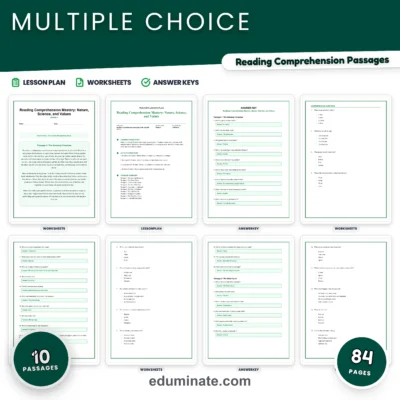
Passages give students real text to study. Teachers can choose one and ask for the structure, the signal words and a filled-in organizer. The fifth grade informational text passages are ten informational texts across 74 pages with questions and complete answer keys. The fourth grade multiple choice passages cover ten topics across 84 pages with complete answer keys.
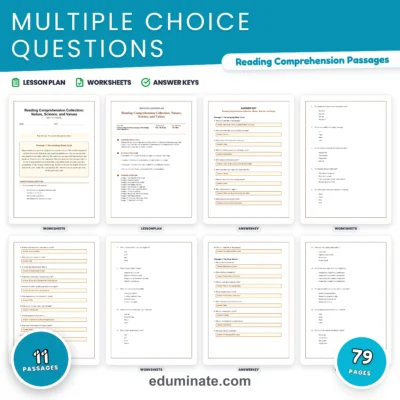
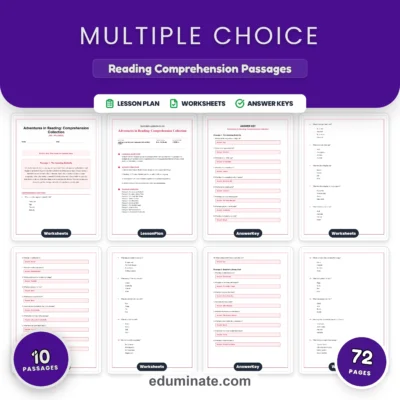
For a wider range of grades, the multiple choice reading comprehension packet has eleven texts across 79 pages for grades 2 to 5, and the multiple choice reading passages pack has ten stories across 72 pages for grades 2 to 5. The science reading comprehension packet has ten STEM topics across 48 pages for grades 2 to 5, with complete answer keys.
Frequently asked questions
What is the difference between text structure and text features?
Text features are the parts of a page, such as headings, captions and bold words. Text structure is the pattern the author uses to organize the ideas. A page can have many features and one main structure.
Can a text have more than one structure?
Yes. Longer texts often mix structures. Students can name the main structure of the whole text and also name the structure of a single paragraph.
Do stories have a text structure?
Stories have a structure too, usually called a narrative structure. It follows the characters, the setting, a problem and how the problem is settled.
What grade learns about text structure?
Students start noticing how texts are organized in the early grades and study the patterns by name in the upper elementary years. The reading packs below cover grades 2 to 5, with the fourth grade and fifth grade packs aimed at one grade each.