Compound Word Worksheets: Lists, Rules and Activities
Compound word worksheets ask children to take two small words and join them into a new one, such as “sun” and “flower” to make “sunflower”. This guide explains the three kinds of compound words, gives lists you can check, and adds rules, games and ideas for teaching them.
What are compound words?
A compound word is a word made from two whole words put together. Each part can stand on its own, and the new word has a meaning of its own. “Rain” and “coat” are both words. Put together, they make “raincoat”, a coat that keeps off rain.
Compound words are a friendly place to start word study. Children can see the two parts, say each part, and then say the whole word. That makes them easier to spell and read than many longer words.
The meaning of a compound word often comes from its parts, but not always. A “sunflower” is a flower. A “butterfly” is not made of butter, and a “pineapple” has no pine in it. These surprises make a good talking point, and they show why checking the meaning matters.
Three kinds of compound words
Compound words appear in three forms. Dictionaries sometimes disagree about which form a particular word takes, so when you are unsure, look it up.
Closed compound words
The two words are joined with no space. Closed compound words are the easiest place to start, and here are some compound word examples.
- notebook, sunflower, playground, backpack, airplane
- classroom, homework, lunchbox, raincoat, seashell, football
Open compound words
The two words stay separate but act as one idea.
- ice cream, post office, living room, school bus, full moon
- high school, peanut butter, washing machine, bus stop
Hyphenated compound words
The two parts are joined by a hyphen. This form turns up in reading, often in descriptions.
- well-known, part-time, self-control, T-shirt, check-in, merry-go-round
For young learners, start with closed compounds and add the other two forms later.
A compound words list sorted by the first word
Grouping a compound words list by a shared part makes patterns easy to see. These families are all closed compounds. Read each word aloud and look for the two parts.
- sun: sunshine, sunset, sunlight, sunglasses, sunflower
- rain: raincoat, rainfall, raindrop, rainstorm
- home: homework, homemade, homesick, hometown
- book: bookmark, bookcase, bookshelf
- foot: football, footprint, footstep, footpath
- water: waterfall, watermelon, waterproof, watercolor
- play: playground, playtime, playroom
- back: backpack, backyard, background, backbone
- air: airplane, airport, airmail
- sea: seashell, seaside, seaweed
The shared part can also come second. These words all end in “book” or “room”:
- book: notebook, textbook, workbook
- room: classroom, bedroom, bathroom, playroom
Compound words for kindergarten
Compound words for kindergarten should be short, concrete and easy to picture. These are good first choices, all closed compounds with two short parts:
- sunset, sunshine, raincoat, bedroom, bathtub
- pancake, popcorn, cupcake, football, backpack
- notebook, homework, airplane, sailboat, lunchbox
Say the parts first, then the whole word: “sun, set, sunset”. Clap the parts of the word if that helps, or tap two fingers on the table, one for each part.
Some of the first words children read are compounds too, though they may not look like it: into, inside, outside, without, myself, something, everyone, today and maybe. The guides to sight words for kindergarten and high frequency words include several of them. Pointing out the two parts can make a tricky word feel less random.
Compound word worksheets: what a good page asks for
Look for pages that make the child do more than copy. These task types work well in compound word worksheets.
Join the two parts
Two columns of word halves, with a line between the pairs. Mix up the order so a child cannot rely on position. Start with five pairs and build up.
Split the word
A list of compound words, each with two blanks. The child writes the two words that make it up. “Playground” becomes “play” and “ground”.
Fill in the missing half
A sentence with a gap and a clue. For example: “I wore a ____ coat because it was wet”, with “rain” as the answer.
Sort by type
A mixed list of closed, open and hyphenated compounds, sorted into three columns. This is for older children who have met all three forms.
Write a sentence
The child chooses a compound word and writes a sentence with it. Sentences show whether the child knows the meaning.
Compound word games and activities
Compound word games turn the idea into movement and play. All of these use plain cards and paper.
Matching halves
Write one half of a compound word on each card, for example “sun” on one card and “flower” on another. Shuffle the cards and lay them face up. Children find the pairs. For more of a challenge, put more than one match on the table: “sun” goes with “flower”, “shine” and “set”.
Tile building
Use blank cards or tiles. Write a handful of words that can be joined, such as sun, rain, book, foot, ball, house, fall, mark and coat. Children build as many compound words as they can and write each one down. Some combinations will be real words, and some will not. Talking about the difference is part of the lesson.
Compound word hunt
Read a short passage aloud, or hand out a page of text. Ask children to find compound words and underline them. Place a sticky note beside each find if you prefer not to write on the page.
Mystery halves
Give a clue and let children guess the missing half. “I am thinking of a word that starts with ‘base’. You hit me with a bat.” Answer: ball, making baseball. Keep the clues plain and short.
Picture cards and word halves
Picture word cards give you easy halves to work from. A set of vocabulary cards that includes “ball” and “house” can start a conversation: baseball, football and basketball all end with ball, and greenhouse, lighthouse and birdhouse all end with house. Ask children to think of more.
Why compound words help readers and spellers
Compound words let children use what they already know. A child who can read “sun” and “set” has the tools to read “sunset”. Looking for two small words inside a long word is a way into text that otherwise looks heavy. When a child meets “sidewalk” or “bedroom” in a story, finding the two parts turns one long word into two short ones.
Splitting a word works for spelling too. Say the two parts slowly, write the first, then write the second. “Note” and “book” are easier to hold in mind than the nine letters of the whole thing at once.
There is one thing to watch. A few compounds are said differently from their parts. “Cupboard” is a good example: the second part is spelled like “board” but sounds more like “berd”. Mention this when you meet such words, and tell children that a compound can sound different from the two words said alone.
Rules for spelling and plurals
Compound words have few rules, and that is part of their appeal.
- Keep every letter. Join the two words as they are. “Sun” plus “shine” makes “sunshine”, and “class” plus “room” makes “classroom”, with both s letters kept.
- Make the whole word plural at the end. In most closed compounds, the s goes on the last part: notebooks, backpacks, classrooms, sunflowers.
- Open compounds work the same way. Add the s to the last word: post offices, school buses.
- Divide by the parts. When you divide a compound into syllables, the break often falls between the two words: note-book, sun-shine, play-ground.
The plural of a compound with an unusual form needs a dictionary. In general, teach the common pattern first and treat the odd ones as exceptions.
Compound words are not the same as other word types
Children sometimes confuse compounds with other things that combine parts. A quick comparison helps.
- Compound words join two whole words: sun and flower make sunflower.
- Words with prefixes or suffixes add a word part that cannot stand alone: the un in unhappy, or the ful in helpful. The guide to prefixes and suffixes covers these.
- Contractions squeeze two words together and replace letters with an apostrophe: “can’t” for “cannot”, “it’s” for “it is”.
A compound word is a combination of full words with every letter intact. If a letter is missing and an apostrophe stands in, it is a contraction. If one of the parts could not be a word on its own, it is probably a prefix or suffix.
Printables for word study and reading
These options from our shop support the reading and word study around compound words.
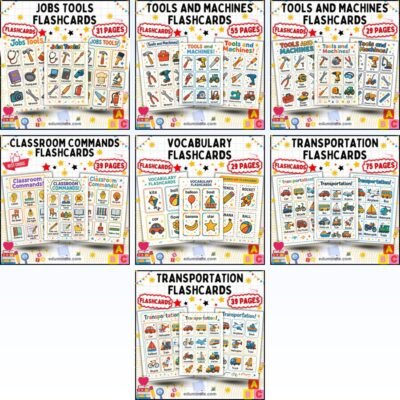
The sight words flashcards packet has 68 card pages, with four to twelve cards on each page, such as a, and, big, blue and come. The English vocabulary flashcards have 26 card pages with four picture word cards on each, 104 cards in all, such as apple, house, ball and train. The vocabulary flashcards bundle brings together seven flashcard sets: tools, community helpers, vehicles, classroom commands and English vocabulary. It runs 297 pages and is 30% off the separate prices.
For reading practice with short stories, the first grade reading comprehension passages are a 62 page packet with ten stories, where students practice sight words, simple sentences and recall, with complete answer keys. While reading the stories, children can hunt for compound words.
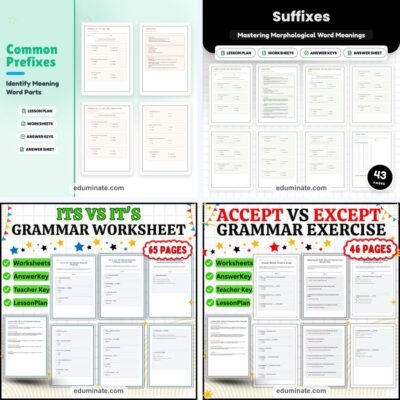
For word study beyond compounds, the word study worksheets bundle holds four packets: the prefixes un, re, pre and dis, the suffixes ful, less and ness, and the pairs its and it’s, and accept and except. It has 183 pages and is 20% off the separate prices. The prefixes and suffixes practice packet is a 41 page set for third, fourth and fifth grade with a one page lesson plan and an 18 page student worksheet with 70 scaffolded questions across 7 sections.
For first readers, the guide to words for first graders has word lists for early readers.
Frequently asked questions
Is “ice cream” a compound word?
Yes. It is an open compound, two words that act as one idea. Not every compound is written as one word.
What is the difference between a compound word and a contraction?
A compound word joins two whole words with no letters removed, as in “notebook”. A contraction replaces missing letters with an apostrophe, as in “don’t”.
Does the meaning of a compound word always match its parts?
Not always. “Sunflower” and “raincoat” are easy to guess from their parts. “Butterfly” and “pineapple” are not, so it helps to check the meaning with a dictionary.
What grade learns compound words?
Compound words appear in early reading and spelling and come up again in later grades. Check the grade range on each product page before you print.