Words for First Graders: Spelling and Reading Lists
Words for first graders fall into a few clear groups: short vowel words, blends, digraphs, silent e words, vowel teams, compound words and sight words. This guide gives a list for each group, a way to choose which words to teach first, and practice ideas you can use at school or at home.
Words for first graders: how to choose a list
A first grade word list works best when the words share a pattern. A child who learns “ship”, “shop” and “fish” together is learning one idea: the letters s and h make a single sound. A child who learns the same three words scattered across three alphabetical lists learns three separate spellings.
So sort by pattern, then start where the child already is. If short vowel words still feel shaky, spend more time there before moving on. If they are easy, go to the next group. The lists below run roughly from simpler to harder, but you can move around freely.
Two kinds of words sit side by side in first grade. Decodable words can be sounded out with the patterns a child has been taught. Sight words, sometimes called high frequency words, appear so often that children need to know them quickly, and some of them do not follow the patterns yet. Both kinds need practice, and they are covered separately below.
First grade reading words: short vowel review
Most first graders arrive with some short vowel words already in hand. A quick review shows what is solid and what needs more time. For a longer treatment, see the full guide to CVC words.
Short a: cat, map, bag, jam, nap, tap, van, sad, pan, mat
Short e: red, bed, pen, net, hen, leg, web, jet, ten, wet
Short i: sit, pin, lid, zip, fin, kid, win, lip, big, six
Short o: dog, pot, mop, box, hop, top, log, job, fox, dot
Short u: cup, bus, sun, mud, rug, hug, jug, nut, bug, run
Ask the child to read each row aloud, then pick three words and write them without looking. Spelling a word from memory is a harder test than reading it.
Words with blends
A blend is two or three consonants side by side where each letter keeps its own sound. Say “frog” slowly and you can hear the f and the r. The blends below are the ones that show up most in early reading, grouped by the letter they share.
Beginning blends
l blends: black, clap, flag, glad, plan, slip
r blends: brick, crab, drip, frog, grab, trip
s blends: skip, smell, snap, spin, stop, swim
Ending blends
Blends can come at the end of a word too. These words have a short vowel followed by two consonants: hand, jump, nest, milk, lamp, tent, desk, gift, help, belt.
When a child gets stuck, cover everything except the first blend, say it, then add the rest of the word. “Fr” then “og” is easier to manage than the whole word at once.
Words with digraphs
A digraph is two letters that make one sound. This is the difference from a blend: in “ship” the s and h do not keep separate sounds, they join to make /sh/. First graders meet these five.
sh: ship, shop, fish, dish, wish, shell
ch: chip, chop, chin, rich, much, lunch
th: this, that, thin, bath, math, with
wh: when, whip, whisk, which
ck: duck, back, sock, pick, neck, truck
The ck list is a good place to explain a spelling habit: ck comes straight after a short vowel at the end of a word, as in “duck” and “sock”. It never starts a word.
Silent e words
When an e sits at the end of a word and one consonant stands between it and the vowel, the vowel usually says its own name. “Cap” becomes “cape”, “kit” becomes “kite” and “hop” becomes “hope”. The e itself makes no sound.
a_e: cake, make, name, game, late, gate
i_e: bike, time, five, line, kite, smile
o_e: hope, home, bone, rope, nose, stone
u_e: cube, tube, huge, use, rule, cute
The pairs are the best teaching tool here. Write “tap” and “tape” next to each other and let the child say both. For more words and activities, use the CVCe word list.
Vowel team words
A vowel team is two letters that work together to make one vowel sound. Some of them are very reliable and some have more than one sound, so teach them a pair at a time.
ai and ay (long a): rain, tail, mail, train, paint, wait, day, play, tray, stay
ee and ea (long e): see, tree, feet, green, sleep, seed, eat, leaf, bean, beach
oa (long o): boat, coat, road, soap, goat, toast
oo: moon, food, room, spoon, school, pool
The team ea also says a short e in words like “bread” and “head”, so it is worth telling children early that a vowel team can have more than one sound. Read the word in a sentence, and the meaning tells you which one fits.
Compound words for first grade
A compound word is two small words joined into one. Children often find these easy to read because each half is a word they already know, which makes them a confidence builder.
Here are compound words for first grade that fit school and home life: backpack, notebook, homework, classroom, playground, sandbox, lunchbox, pancake, cupcake, raincoat, sidewalk, bathtub, bedroom, airplane, toothbrush, bookshelf, sunflower, football, basketball.
Cut index cards in half and write one small word on each side of the cut. Children match the halves, read the new word and use it in a sentence.
First grade sight words
Sight words are the ones children need to read on sight because they turn up in nearly every sentence. Some can be sounded out, like “and” and “big”, and some cannot, like “the” and “of”.
The Dolch first grade list includes these words: after, again, any, ask, could, every, from, give, going, how, just, know, let, open, over, put, round, some, stop, take, thank, think, walk, when. You can read how the lists differ in the guides to Dolch sight words and the kindergarten sight word list, since first graders often review the kindergarten words first.
Teach a few at a time. Show the card, say the word, spell it aloud, then use it in a spoken sentence. Short and frequent review beats one long session.
Spelling words for first graders: how many at a time
First grade spelling words work best in small sets. Choose one pattern, such as short a words or the sh digraph, and give the child a handful of words from it. First grade word lists built this way keep the week focused and let the child see the pattern clearly.
Here is one way to lay out four weeks of words for 1st graders:
- Week one: short a and short i words, such as “map”, “sad”, “sit” and “lid”.
- Week two: sh and ch words, such as “ship”, “fish”, “chip” and “lunch”.
- Week three: ending blends, such as “hand”, “jump”, “nest” and “milk”.
- Week four: silent e words, such as “cake”, “bike”, “home” and “tube”.
Add two or three sight words to each list so that children also practice words that do not follow the patterns yet. At the end of the month, mix words from all four weeks and see which ones stuck. The ones that did not stick move into the next list.
Ways to practice these words
Sort the words by pattern
Write 12 words on cards, mixing two or three patterns, such as “ship”, “duck”, “chop” and “sock”. The child sorts them under headers like sh, ck and ch. Sorting makes the pattern visible without a lecture.
Build the word with letter tiles
Say a word, and the child builds it from tiles or cut paper squares, one sound at a time. Then change one tile to make a new word: “map” to “mop” to “top”.
Read the words inside a sentence
A word list on its own does not show whether a child can read the word in context. Write a short sentence for each pattern: “The fish is in the dish.” “We ran to the school bus.” Have the child read it twice, then spell one of the words.
Write, cover, check
The child reads a word, covers it, writes it, then uncovers it and checks. Fix any letter that is wrong and write the word once more. A handful of words per sitting is plenty.
Practice material
Once the lists are familiar, reading connected text is the next step. The CVC Worksheets Bundle puts nine reading packets in one download, covering CVC words, short vowels, decodable passages and simple stories, at 30% off the separate prices. Two of those packets are available on their own: Short Vowel Worksheets has ten decodable phonics stories with comprehension questions, and Decodable Passages has ten short vowel adventure stories with 150 comprehension questions.
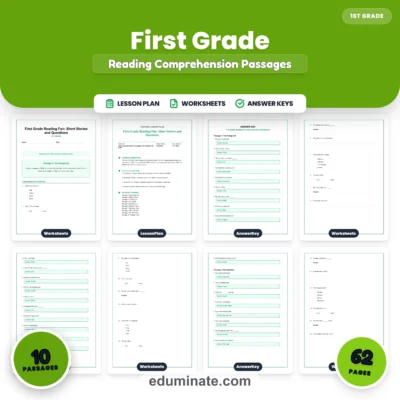
For children reading past the first few patterns, the first grade reading comprehension passages include ten stories where students practice sight words, simple sentences and recall, with answer keys. For the word cards, the Sight Words Flashcards come as 68 card pages with 4 to 12 sight word cards on each page, such as a, and, big, blue and come. The Alphabet Flashcards PDF Bundle is four flashcard sets in one download, covering alphabet cards, sight words, addition facts and multiplication facts.
Frequently asked questions
How many words should a first grader know?
There is no one number that fits every child. Schools and programs use different lists, and children arrive at different points. A better question is which patterns the child can read and spell without help, then teach the next pattern.
What is the difference between sight words and decodable words?
Decodable words can be sounded out with the patterns a child has learned. Sight words are the very common words children need to read quickly, and some of them have spellings that do not follow the patterns yet. Both belong in a first grade word list.
How can I practice these words at home?
Pick one pattern per week and use the sorting, building and write-cover-check ideas above. Keep each sitting short, and let the child read a sentence aloud so the words are not only seen on cards.
When should a child move from short vowels to blends?
When the child reads most short vowel words smoothly and spells them correctly from memory, add a blend. There is no need to wait for perfection, since the short vowel words keep getting practice inside the new words.
Related resources
- CVC Worksheets Bundle: CVC Words, Short Vowels and Decodable Stories
- Short Vowel Worksheets: CVC Words Reading Passages and Questions
- Decodable Passages: Decodable CVC Printable Pages and Questions
- Reading Comprehension Activities: First Grade Reading Passages
- Sight Words Flashcards: Printable Sight Word Cards
- Alphabet Flashcards PDF Bundle: Alphabet, Sight Words and Math Fact Cards