Phonics Worksheets: Skills in Order With Practice Ideas
Phonics worksheets give children a place to practice the link between letters and sounds, and they work best when the skills arrive in a sensible order. This guide lists the phonics skills from first letter sounds to vowel teams, shows what a useful page asks a child to do, and adds activities and printables for practice.
What phonics worksheets are for
Phonics is the teaching of how letters and groups of letters stand for sounds. A child who knows that the letter b says /b/ and the letters sh say /sh/ can read a new word by working through its sounds. The same knowledge helps in the other direction: to spell a word, the child listens to its sounds and chooses letters for each one.
A worksheet is a short, focused place to try this out. It is not a lesson by itself, since children first need to hear the sound, say it and see it used. After that, a page lets them do the job alone, and an adult can see at a glance which sounds are secure and which are still wobbly.
Phonics skills in order
Programs differ on the exact sequence, so treat the list below as one common path rather than the only one. Each skill builds on the one before.
- Letter names and sounds. Each letter, upper and lower case, with the sound it makes.
- Short vowel CVC words. Words such as “cat”, “bed”, “sit”, “dog” and “cup”. See the guide to CVC words for lists.
- Digraphs. Two letters, one sound: sh, ch, th, wh and ck, as in “ship”, “chin”, “this”, “whip” and “duck”.
- Blends. Two consonants, both sounds heard: “frog”, “stop”, “hand”, “lamp”.
- Silent e. Words like “cake”, “bike” and “hope”, where the final e makes the vowel say its name. The CVCe word list covers this step.
- Vowel teams. Pairs such as ai, ay, ee, ea and oa in “rain”, “play”, “feet”, “beach” and “boat”.
- R-controlled vowels. The letter r changes the vowel sound: car, star, fern, bird, corn, fur.
- Longer words. Breaking words into parts, such as “pic-nic”, “bas-ket”, “nap-kin” and “sun-set”.
A child does not have to master one step perfectly before seeing the next. A little overlap keeps things moving, and old words get practiced again inside new ones.
What a good phonics page asks the child to do
Phonics sheets vary a lot in how much they ask. The most useful ones mix reading and writing, so the child uses the sounds in both directions. Here are task types worth looking for:
- Read a word and match it to a short sentence that uses it.
- Fill in the missing letters in a word, given the sounds.
- Circle the word that matches a sound said by the adult.
- Write a word after hearing it, then check the spelling.
- Read a short passage made only of words that follow the patterns taught.
The last task is the one that matters most. A child can fill in blanks on a page and still hesitate when the same word turns up in a sentence. Reading connected text with the patterns learned so far shows whether the skill has really taken hold.
Kindergarten phonics worksheets: where to begin
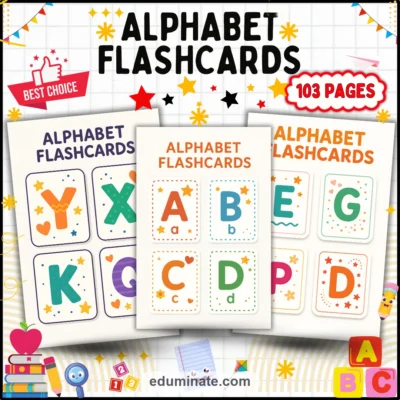
For kindergarten, the starting point is letters and their sounds, then short vowel words. If a child is still learning to tell letters apart, begin with letter cards before any page of words. The Alphabet Flashcards are a 103 page PDF of printable alphabet flashcards showing uppercase and lowercase letters for all 26 letters, made for PreK and kindergarten letter recognition drills.
Tracing helps too, since forming a letter ties the shape to the sound. The Alphabet and Number Posters include 41 printable posters for tracing alphabet letters and numbers from 0 to 9. Teachers can display them as wall references or laminate them for reusable dry-erase practice.
Once letter sounds are steady, kindergarten phonics worksheets move to simple three-sound words. Keep the first pages short. A few words read and written correctly do more than a full page that ends in frustration.
Phonics activities beyond the page
Worksheets are one tool. Children also need to move letters, say sounds and talk, and these phonics activities use materials you probably already have.
Sound boxes
Draw a row of boxes, one box for each sound in a word. For “ship” there are three boxes, since sh is one sound. The child pushes a counter into a box for each sound while saying it, then writes the letters. This makes the difference between letters and sounds easy to see.
Word building with tiles
Give the child letter tiles or small squares of paper, each with one letter. Call out a word, and the child builds it, reads it and takes it apart. Mix in digraph tiles when sh, ch and th are taught, so that the two letters sit together on one tile.
Word chains
A word chain changes one sound at a time. Try this one: cat, bat, bit, sit, sip. Say each word and ask which sound changed. For a harder chain, use ending sounds: tent, test, best, bust.
Sorting words by sound
Write words on index cards and sort them under headers. Short a and long a make a good pair: “map”, “tap”, “cake”, “gate”, “can”, “tape”. The child reads each card and decides where it belongs, which brings the sound difference out in the open.
Read, then retell
After reading a decodable sentence or story, ask the child to say in their own words what happened. It keeps the focus on meaning and not only on sounding out. The post on decodable books explains what makes a text match the sounds a child has learned.
How to use phonics printables well
Phonics printables stretch further when they are used in more than one way. A few ideas:
- Slip a page into a clear sleeve, and the child writes with a dry-erase marker. The page can be used again the next week.
- Cut cards apart for a center, then store each set in its own envelope with a label.
- Pick one page for a small group and a different one for independent work, so that children are not all doing the same task.
- Keep a folder of finished pages. Looking back over them shows how much the child can do now.
Check each page for the pattern it practices before handing it out. A page of silent e words is the wrong choice for a child still working on short vowels.
Decoding words: a routine children can use
Decoding words means turning letters into sounds and blending them into a word. Give children a short routine, so they are not guessing from the first letter.
- Look at the whole word and find any letter teams, such as sh, ch, th or ai.
- Say each sound in order, touching under the letters.
- Blend the sounds together and say the word smoothly.
- Check that the word makes sense in the sentence.
Guessing is the habit to watch for. A child who sees “hand” and says “house” is using the first letter and a picture in their head, not the whole word. Cover the end of the word and uncover it one letter team at a time, so every part gets read.
Mistakes that show up on phonics sheets
- Swapping short vowels. Reading “bed” for “bad” means the child is not checking the middle sound. Use word pairs that differ only in the vowel.
- Dropping the end of a word. Reading “tent” as “ten” means the last sound was skipped. Tap out every sound.
- Mixing up b and d. The two letters look alike. Keep a model of each letter in view, and trace them in the air before writing.
- Reading a digraph as two sounds. “Ship” read as s, h, i, p shows the child has not met sh as one sound yet. Underline the digraph.
Treat each mistake as a clue about what to practice next. One pattern at a time is easier to fix than three at once.
Phonics practice material
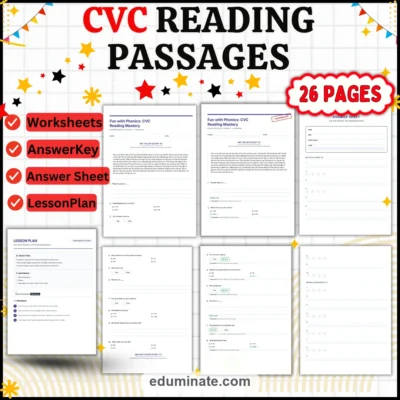
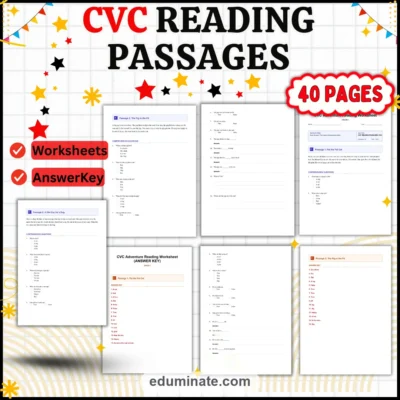
When children are ready to read connected text, passages with comprehension questions are the natural next step. The CVC Worksheets Bundle gives nine reading packets in one download, covering CVC words, short vowels, decodable passages and simple stories. It runs 371 pages at 30% off the separate prices. Two single packets suit a smaller start: CVC Reading Passages Worksheets has five short vowel decodable stories with ten questions per section, bubble answer sheets, a lesson plan and complete teacher answer keys, and Decodable Passages has ten short vowel adventure stories with 150 comprehension questions across 30 student worksheet pages.
Sight words need their own practice alongside phonics, since many of the most common words are not fully decodable yet. The Sight Words Flashcards come as 68 card pages with 4 to 12 sight word cards on each page, such as a, and, big, blue and come.
Frequently asked questions
What order should phonics be taught in?
A common path starts with letter sounds and short vowel CVC words, then digraphs, blends, silent e, vowel teams and r-controlled vowels. Your own program’s sequence is the best guide, since the pages should match what the child has been taught.
Are phonics worksheets enough on their own?
No. Children also need to hear sounds, build words with their hands and read real sentences and stories. Worksheets are the independent practice part of that mix.
How do I know if a child is ready for the next skill?
Watch whether the child reads words of the current pattern smoothly inside a sentence and spells most of them correctly from memory. If both are true, add the next pattern and keep reviewing the old one.
What is the difference between a digraph and a blend?
A digraph is two letters that make one sound, like sh in “ship”. A blend is two or three consonants that each keep their own sound, like the f and r in “frog”.
Related resources
- CVC Worksheets Bundle: CVC Words, Short Vowels and Decodable Stories
- CVC Reading Passages Worksheets for Kindergarten and First Grade Phonics Set
- Decodable Passages: Decodable CVC Printable Pages and Questions
- Alphabet Flashcards Printable: Letter Recognition PDF for PreK and K
- Alphabet and Number Posters: Printable Tracing Anchor Charts
- Sight Words Flashcards: Printable Sight Word Cards