Digraphs Worksheets: Sounds, Word Lists and Activities
Digraphs worksheets give children practice with letter pairs that stand for a single sound, such as sh in “ship” and ch in “chin”. This guide explains what a digraph is, lists the common ones with word lists you can check, and shows how to build activities around them.
What is a digraph?
A digraph is two letters that work together to make one sound. The word comes from “di”, meaning two, and “graph”, meaning written. In the word “ship”, the letters s and h do not say /s/ and /h/ one after the other. Together they say /sh/. The word has four letters and three sounds: sh, i, p.
Digraphs trip up new readers because the letters look like separate sounds. A child who has learned that s says /s/ and h says /h/ will try to read “ship” as /s/ /h/ /i/ /p/. The child needs to learn that some pairs are a team.
Blends and digraphs are not the same
A blend is two or three letters whose sounds are each still heard. In “frog”, you can hear /f/ and /r/ side by side. In “stop”, you can hear /s/ and /t/. A digraph makes a new sound that is different from either letter alone.
- Blends: fr in “frog”, st in “stop”, bl in “block”, cl in “clap”, sp in “spin”.
- Digraphs: sh in “shop”, ch in “chop”, th in “thin”, wh in “whip”, ck in “duck”.
Mixed words exist too. “Brush” has the blend br and the digraph sh. “Stick” has the blend st and the digraph ck. Counting sounds helps tell them apart: “brush” has four sounds (b, r, u, sh), and “stick” has four (s, t, i, ck).
The common consonant digraphs
Consonant digraphs are the first set most children meet. Here are the common ones, each with a short word list. Read every list aloud to check that the pair really says the sound in the heading.
The sh digraph
Sound: /sh/. It can come at the start or at the end of a word.
- Start: ship, shop, shed, shut, shell
- End: fish, dish, wish, brush, crash
The ch digraph
Sound: /ch/, as in “chin”.
- Start: chin, chip, chop, chat, chest
- End: much, such, rich, lunch, bench
Not every ch says /ch/. In “school” and “echo” it says /k/, and in “chef” and “machine” it says /sh/. Save those for later, after the main sound is secure.
The th digraph
Sound: th has two sounds. The soft, breathy sound is in “thin” and the voiced sound, where your throat hums, is in “this”.
- Breathy /th/: thin, thick, thumb, math, bath, path, cloth
- Voiced /th/: this, that, them, then, than, these
The names “voiced” and “unvoiced” are optional. A child can put a hand on the throat and feel the difference.
The wh digraph
Sound: /w/ in most speech. Some speakers say it with a puff of air first. Either way, the pair is found at the start of a word.
- when, whip, which, whisk, wheel, white, wheat
Two words with wh do not follow the pattern: “who” and “whole” start with /h/.
The ck digraph
Sound: /k/. It comes right after a short vowel at the end of a word or syllable, and never at the start of a word.
- back, deck, duck, kick, lock, neck, pack, sock, truck, stick
The ck digraph is a good one to teach after short vowel words. The short vowel comes before it every time in the list above, so words such as “duck” and “sock” look like CVC words whose last sound is spelled with two letters.
The ng digraph
Sound: /ng/, a single sound made at the back of the mouth. It sits at the end of a word or syllable.
- ring, king, long, hang, wing, bang, thing, lung, sting, strong
The ph digraph
Sound: /f/. This one comes mainly from Greek, and it is seen in longer words.
- phone, photo, graph, phonics, dolphin, elephant, alphabet
Silent-letter pairs
Some programs also teach pairs where one letter is silent: kn says /n/ as in “knit”, “knot” and “knee”, and wr says /r/ as in “write”, “wrap” and “wrong”. Others handle these as spelling patterns instead of digraphs. Follow your own program.
Three-letter spellings: tch and dge
Two common endings use three letters for one sound. The letters tch say /ch/ in “match”, “catch” and “ditch”. The letters dge say /j/ in “badge”, “edge” and “fudge”. These follow the same rule as ck: they come after a short vowel at the end of a word. Teach them after the two-letter digraphs.
Digraphs worksheets and where they fit in the phonics order
Programs vary, but a common order puts consonant digraphs after the first CVC words and before long vowels. A child should be able to read words like “sit”, “mop” and “bag” before facing “ship”, “chop” and “bath”. The guide to phonics worksheets lays out the whole sequence.
Vowel digraphs (ai, ee, oa and similar) exist too, and they usually come later. This guide is about consonant digraphs. Vowel pairs deserve their own lessons.
How to teach digraphs step by step
- Introduce one digraph. Say the sound and show the two letters side by side. Point out that the two letters make one sound.
- Read a list together. Choose five or six words. The child reads each one with you, then alone.
- Use sound boxes. Draw a row of boxes, one for each sound. For “ship”, draw three boxes and put the sh in one. For “lunch”, draw four boxes: l, u, n, ch.
- Build words with tiles. Write a digraph on a single tile or card, so it moves as one piece.
- Sort and compare. Contrast two digraphs once both are familiar.
- Read in sentences. The new words should show up in connected text.
Teach one new digraph at a time. After sh, move to ch. Once both are secure, put them side by side. Several useful pairs of words differ only in the digraph: ship and chip, shop and chop, shin and chin. Add thin to make the trio shin, chin, thin.
Digraph activities for kindergarten
Digraph activities for kindergarten should be short and physical. These need nothing but cards, tiles and paper.
Sound boxes
Say a word slowly. For each sound, the child pushes a counter into a box. When the word is “chop”, the child pushes three counters, because ch is a single sound. This is a quick way to check whether a child hears the digraph as one unit.
Word chains
Change one sound at a time and read each new word. Here are two chains to try:
- ship, shop, chop, chip, chin, thin
- back, pack, pick, sick, sock, lock
Each word differs from the one before by a single sound. Give the chain to the child on a strip of paper, or build it with tiles and change them one at a time.
Digraph hunt
Give each child a short text and a highlighter, or a sticky note to place beside each find. Ask them to find every word with the digraph you are teaching. Count the finds together at the end.
Sort the words
Write words on cards and ask children to sort them into groups by digraph. A first sort might use just two groups, sh and ch. Add a third group when the child is ready.
Dictation
Read a short sentence aloud and ask the child to write it. Keep the words decodable. Three to try:
- Chip sat on a bench.
- Which shop has the thick cloth?
- The king had a long path.
CVC words with digraphs
CVC words with digraphs form a bridge between simple short vowel words and longer ones. A word such as “ship” follows the same pattern as “sit”: a consonant sound, a short vowel, a consonant sound. The first consonant is a digraph, so the word counts as three sounds in a CVC shape even though it has four letters. Other digraph words with a short vowel:
- sh: shop, shed, shut, fish, dish, wish
- ch: chin, chip, chop, chat, much, such, rich
- th: thin, math, bath, path, this, that, them
- wh: when, whip, which
- ck: back, deck, duck, kick, lock, neck, pack, sock
Because the vowel is short in each of these, children who read CVC words well can often move on to these with a little extra teaching. The short i words list and the short o words list are useful sources for words to start with.
Practice material
If you want printables that build the reading skills that come before and alongside digraphs, these options are in our shop. They focus on CVC words and short vowels, which is the step that comes before digraphs.
The CVC worksheets bundle holds nine reading packets in one download, covering CVC words, short vowels, decodable passages and simple stories. It runs 371 pages and is 30% off the separate prices.
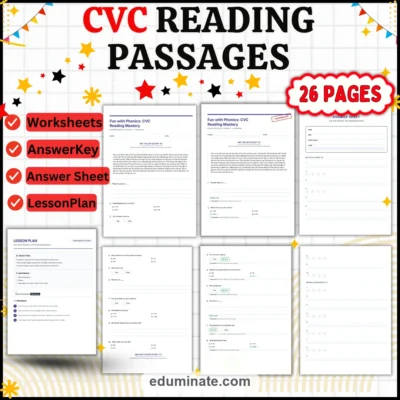
If you prefer single packets, the CVC reading passages worksheets have five short vowel decodable stories with ten questions per section, bubble answer sheets, a ninety minute lesson plan and teacher answer keys. The decodable CVC passages feature ten short vowel stories with 150 comprehension questions across thirty student worksheet pages and ten pages of answer keys.
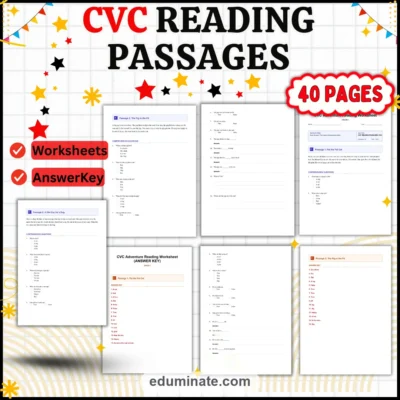
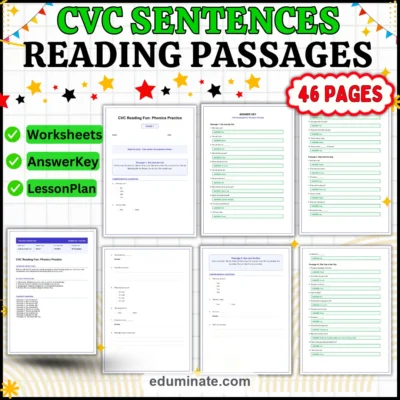
The simple CVC sentences packet has ten decodable stories with structured questions across thirty-one worksheet pages, a detailed lesson plan and fourteen pages of teacher answer keys. The CVC stories reading comprehension set has ten decodable stories, forty student worksheet pages with varied text-dependent questions, a lesson plan and seventeen pages of answer keys.
For letter cards, the alphabet flashcards printable set has uppercase and lowercase letters for all 26 letters. Place two cards side by side to show how two letters become one sound.
Frequently asked questions
How many digraphs are there?
It depends on how a program counts. The ones taught first are sh, ch, th, wh and ck. Some programs add ng and ph, and some include silent-letter pairs such as kn and wr.
Is “ck” a digraph?
Yes. The two letters c and k together say one sound, /k/. It is found after a short vowel at the end of a word, as in “duck”.
What is the difference between a digraph and a blend?
In a blend, each letter keeps its own sound and you can hear them one after the other, as in “frog”. In a digraph, two letters make a single new sound, as in “ship”.
At what grade are digraphs taught?
Programs differ, but digraphs are usually taught once children can read simple short vowel words. Check each product page in our shop for its grade range and contents before you print.