CVCC Words: Word List by Ending Blend and Activities
CVCC words are short vowel words with one consonant sound at the start and two at the end, such as “hand”, “lamp” and “best”. This guide gives a CVCC words list sorted by ending blend, explains the exceptions to watch for, and offers activities that move children from CVC words to this next step.
What are CVCC words?
CVCC stands for consonant, vowel, consonant, consonant. It describes sounds, not letters. In “tent” the sounds are /t/, /e/, /n/ and /t/: one consonant, one vowel, then two consonants side by side. The last two consonants are an ending blend, which means each one keeps its own sound when you say the word slowly.
The step comes right after CVC words. A child who can read “ten” and “tap” is ready to meet “tent” and “tank”, because the only new thing is one extra sound at the end. The vowel is still short.
Teachers sometimes call these words CVCC words and sometimes ending blend words or final consonant blends. They are the same group. Once children can read them, the pattern grows into CCVC words such as “stop” and “clap”, and CCVCC words such as “stamp” and “plant”.
CVC and CVCC words: counting sounds, not letters
A word can have more letters than sounds, so count what you hear. “Duck” has four letters but three sounds: /d/, /u/ and /k/. The ck together make one sound, so “duck” is a CVC word. “Ring” has four letters and three sounds as well, since the ng makes one sound. “Fish” and “lunch” work the same way with sh and ch.
Words with a doubled letter follow the same rule. “Hill”, “mess”, “buzz” and “puff” each end in two letters but one sound, so they are CVC words too. A CVCC word needs two separate consonant sounds at the end, which is why “lamp” counts and “hill” does not.
This matters in the classroom because a child who counts letters will say “duck” has four sounds, then try to find one that is not there. Tapping out the sounds on the fingers, one tap per sound, fixes this quickly.
CVCC words list by ending blend
Teach one ending blend at a time and read the whole group aloud before moving on. Every word below has a short vowel, and each ending is two separate consonant sounds.
Words ending in nd
hand, sand, land, pond, bend, send, lend, mend, fund
Words ending in nt
tent, bent, dent, went, sent, rent, lint, mint, hint, pant, cent
Words ending in nk
bank, tank, sink, pink, link, rink, wink, junk, bunk, sunk, dunk, honk
Words ending in mp
lamp, camp, damp, ramp, jump, bump, pump, lump, dump, hump, limp, romp
Words ending in sk
desk, task, mask, risk, disk, husk, tusk, dusk
Words ending in st
best, nest, rest, test, vest, west, fast, last, past, mast, mist, list, fist, dust, must, rust, just, cost, lost
Words ending in lt and ft
lt: belt, melt, felt, tilt, wilt, pelt
ft: left, lift, gift, soft, raft, loft, sift, tuft
Words ending in lk, lp and ct
lk: milk, silk, bulk, sulk
lp: help, yelp, gulp, pulp, kelp
ct: fact, pact, tact, duct
Words ending in nch, pt, xt and sp
nch: bench, lunch, bunch, punch, munch, hunch, pinch, ranch
pt: kept, wept
xt: next, text
sp: gasp, wasp, lisp, rasp
The nch words are a useful reminder that a digraph can sit inside a blend. In “lunch” the n is one sound and the ch is the second, so the ending is still two sounds.
VCC words and other near neighbors
Some short words start with the vowel and still end in two consonant sounds. Examples are “and”, “end”, “ink”, “act”, “elf” and “ant”. These are VCC words. They sit in the same family as CVCC words, and they are often easier to read because there is no first sound to hold in mind.
The step after CVCC is words with a blend at the start as well. Compare these groups:
- CVC: sat, pan, hop, cup
- CVCC: sand, lamp, best, milk
- CCVC: stop, clap, frog, swim
- CCVCC: stamp, plant, blend, crust, stand
Read each group aloud and notice which sound was added each time.
Exceptions to know about
Not every word that ends in two consonants has a short vowel. A few endings pull the vowel long, and children will meet these words soon, so it helps to name the pattern.
- i and o before ld: old, cold, gold, hold, told, wild, mild, child
- i before nd: find, kind, mind, blind
- o before st: most, post, host
- o before lt: bolt, colt, jolt
Put these on a separate card set and label it “long vowel, even though it looks like a CVCC word”. The word “wind” can be said two ways depending on its meaning, which is a good moment to talk about reading the word in a sentence. These exceptions are a small group next to the many regular CVCC words, so teach them after the regular ones feel easy.
CVCC words for kindergarten and first grade
Ending blends come once short vowel CVC words are secure. The child’s readiness matters more than the calendar or the grade level.
A sensible starting set has the nd, nt, mp, st and sk endings, since the words are common and easy to say: sand, tent, lamp, nest, desk. Add the rest when those feel easy.
Plain sentences show whether a child can use the words, not only recognize them. Here are some to read aloud:
- The milk is on the desk.
- Dad will lift the lamp.
- We can sit on the bench at lunch.
- I felt the soft rug.
- Mom put a mint in the jar.
- Dust fell on the vest.
- We jump and run on the sand.
How to teach CVCC words step by step
- Review CVC words. Read a few short vowel words together to warm up.
- Add one sound to a known word. Say “ten”, then say “tent”. Ask what was added at the end.
- Segment the sounds. Say “lamp” slowly and tap four times: /l/, /a/, /m/, /p/.
- Blend the sounds. Slide the sounds together to read the word, then say it at normal speed.
- Spell the word. The child says the sounds and writes a letter for each one.
- Read it in a sentence. Finish with a short sentence so the word carries meaning.
Use the same order with each new ending blend. These CVCC words examples make a good first set, one for each of four endings: “sand” for nd, “tent” for nt, “lamp” for mp and “nest” for st.
A child who drops the last sound, reading “tent” as “ten”, is a common reason to use pairs. Put a CVC word beside its CVCC partner and have the child read both: ten and tent, bed and bend, sad and sand, wet and west, lap and lamp, mad and mask. The pair makes the extra sound easy to hear. These CVCC words for first grade readers also work as a review for older kindergarten children.
Activities for practicing CVCC words
Tap out four sounds
Say a word such as “camp” and tap the thumb to a different finger for each sound: /k/, /a/, /m/, /p/. Four taps tell you it is a CVCC word. Then write the word and check that each sound has a letter.
Four-box sound boxes
Draw four boxes on a sheet of paper. The child pushes one counter into each box while saying the sounds, then writes one letter in each box. Counters can be buttons, small blocks or paper squares.
Change one sound at a time
Word chains show how one sound change makes a new word. Try this one: tent, test, best, bust, must, mist, list, lift, gift. Say each word, then ask the child which sound changed from the last word.
Sort by ending blend
Put the nd, nt and mp words on cards. The child lays out three headers and sorts the cards beneath them. A small mixed pile is plenty for one sitting.
Build the word with tiles
Give the child wooden or paper letter tiles and call out a word. They build it, read it, then swap the last two tiles to make a new word, such as “lamp” to “lump” to “limp”.
Reading CVCC words in stories and passages
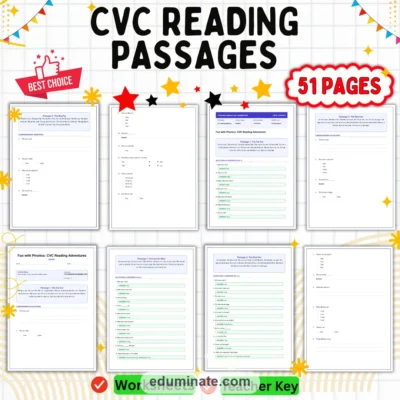
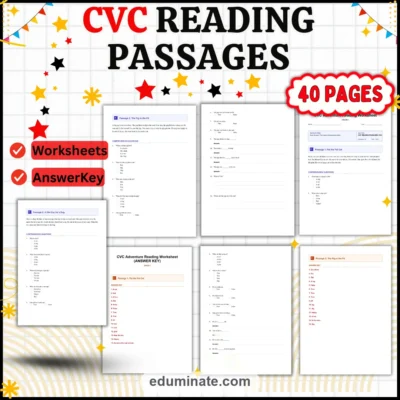
A word list only goes so far. The real test is whether the child can read these words inside a story. The CVC Worksheets Bundle is nine reading packets in one download, covering CVC words, short vowels, decodable passages and simple stories, at 371 pages and 30% off the separate prices. If you prefer to start with one packet, Short Vowel Worksheets has ten decodable phonics stories with comprehension questions across 31 worksheet pages, and Decodable Passages has ten short vowel adventure stories with 150 comprehension questions. The full guide to decodable books explains how to choose text that matches the sounds a child has learned.
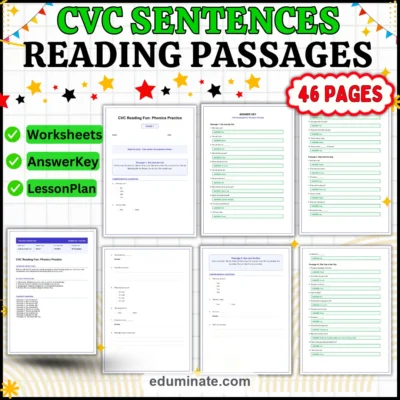
For sentence-level reading, Reading Simple CVC Sentences Worksheets brings ten decodable stories with comprehension questions across 31 worksheet pages, a lesson plan and 14 pages of teacher answer keys. Sight word cards pair well with all of these, since children meet words like “the” and “was” in every story. The Sight Words Flashcards are 68 card pages with 4 to 12 cards on each page, such as a, and, big, blue and come.
Frequently asked questions
Are CVCC words harder than CVC words?
They add one more sound to hold in mind, so some children need a little more time. Starting with the nd and nt endings and tapping out each sound helps.
Is “back” a CVCC word?
No. Back ends in the ck digraph, which makes one sound, so it is a CVC word with four letters.
What comes after CVCC words?
Words with a blend at the start, called CCVC words, come next. After that, CCVCC words such as “stamp” and silent e words such as “cake” build on the same skills. The CVCe word list covers the silent e step.
Do I need to teach every ending blend?
No. A few common endings give the child the idea, and the pattern carries over to the others.
Related resources
- CVC Worksheets Bundle: CVC Words, Short Vowels and Decodable Stories
- Short Vowel Worksheets: CVC Words Reading Passages and Questions
- Decodable Passages: Decodable CVC Printable Pages and Questions
- Reading Simple CVC Sentences Worksheets for Kindergarten and 1st Grade
- Sight Words Flashcards: Printable Sight Word Cards