Tense Worksheet Guide: Past, Present and Continuous
A good tense worksheet makes students choose a verb form for a reason, not just fill a gap, and this guide shows what that looks like for the simple present, present continuous, past simple and past continuous. You will also find sample sentences, common mistakes and ways to use a worksheet in a lesson.
What a good tense worksheet should include
A verb tense tells the reader when something happens, and verb tenses are easiest to learn one at a time. A weak worksheet gives a list of sentences with a verb in brackets and asks students to change it. A stronger one mixes question types, so students have to think about meaning as well as form.
Look for these features:
- Multiple choice, so students compare forms side by side.
- Fill in the blank, so they produce the form themselves.
- Negative sentences and questions, not only positive statements.
- Error correction, where a sentence contains a mistake to find and fix.
- An answer key that explains why an answer is right.
The questions on a page matter more than the page count. Ten well-built items teach more than forty copies of the same pattern.
Simple present: habits and facts
The simple present describes habits, routines and facts. It uses the base verb, with an -s or -es ending for he, she, it and singular nouns.
- I walk to school. She walks to school.
- They play soccer on Saturday. He plays soccer on Saturday.
- We watch a science show. The class watches a science show.
- Plants need water. A plant needs water.
Notice that “watch” takes -es, not -s. Verbs ending in -ch, -sh, -s, -x or -z add -es. A verb ending in a consonant plus y changes the y to i before -es, so “study” becomes “studies” and “carry” becomes “carries”.
Negatives and questions use “do” or “does”, and the main verb goes back to its base form:
- She does not walk to school. (Not “She does not walks.”)
- Do they play soccer on Saturday?
- Does the class watch a science show?
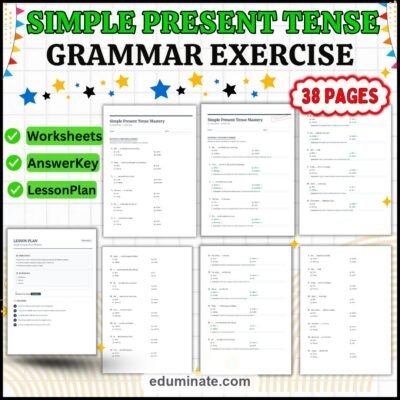
The Simple Present Tense Worksheets set includes multiple choice, fill in the blank, negative sentence and question practice, plus a full answer key with explanations and a one page lesson plan.
Present continuous: actions happening now
The present continuous describes an action in progress. It uses am, is or are plus the verb with -ing.
- I am reading a book.
- She is writing a letter.
- They are cooking dinner.
Spelling changes cause many of the errors, so give them their own practice:
- Verbs ending in a silent e drop the e: make becomes making, write becomes writing.
- Short verbs with one vowel and one final consonant double the consonant: run becomes running, sit becomes sitting.
- Most other verbs just add -ing: play becomes playing, read becomes reading.
Time words such as “now” and “at the moment” signal this tense. Our post on present simple vs present continuous compares the two side by side, which helps students decide between “She reads every night” and “She is reading now.”
The Present Continuous Tense Practice set offers multiple choice, fill in the blank and sentence transformation practice, with a teacher answer key and a lesson plan.
Past simple: regular and irregular verbs
The past simple describes a finished action. Regular verbs add -ed, and irregular verbs change in other ways.
Regular verbs
- walk becomes walked
- play becomes played
- bake becomes baked (a final e only needs -d)
- stop becomes stopped (the final consonant doubles)
- carry becomes carried (y changes to i)
Irregular verbs
Irregular verbs have no rule to apply, so students need repeated exposure. Start with the ones they say most often:
- go becomes went
- eat becomes ate
- see becomes saw
- take becomes took
- write becomes wrote
- buy becomes bought
- bring becomes brought
- run becomes ran
A common error is to put the past marker on two verbs at once, as in “She did not went to the park.” After “did not” or “Did …?”, the main verb stays in its base form: “She did not go to the park.” and “Did she go to the park?”
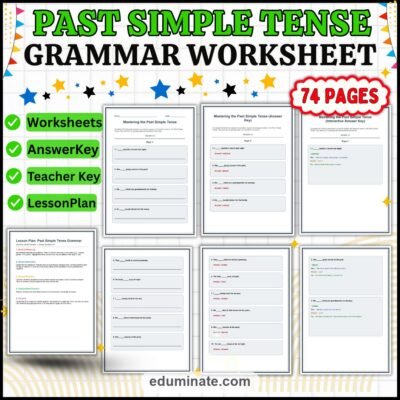
Two packs cover this area. The Past Tense Verbs Worksheet set has regular and irregular verb practice, multiple choice, negatives, questions and error correction, plus a teacher key and lesson plan. The Past Simple Irregular Verbs Worksheets set uses multiple choice, fill in the blank and sentence choice questions, with a plain answer key and a teacher key that explains every answer.
Past continuous: what was in progress
The past continuous describes an action that was in progress at a time in the past. It uses was or were plus the verb with -ing. Use “was” with I, he, she, it and singular nouns, and “were” with you, we, they and plural nouns.
- I was reading at four o’clock.
- The students were working quietly.
- It was raining all afternoon.
This tense often sets a scene: “The sun was shining and the team was warming up.” It also pairs with the past simple to show one action interrupting another.
Past continuous with past simple
Compare these two sentences:
- We were playing soccer when it started to rain.
- When the bell rang, we stood up.
In the first, playing was already in progress and the rain interrupted it. In the second, ringing came first and standing came after, so both verbs are past simple. Students often mix the two, so ask them to picture which action was already going on.
The word “while” often goes with the past continuous: “While I was cooking, my brother set the table.” The word “when” can go with either, depending on the meaning.
The Past Continuous and Past Simple Worksheets set offers 80 questions across multiple choice and fill in the blank sections, with a plain answer key, a detailed teacher key with reasoning and a one page lesson plan for grades 5 to 7.
Common mistakes to watch for
When you collect student work, look for patterns. These are common ones, with the fix:
- Missing -s with he, she, it: “He walk to school” should be “He walks to school.”
- Extra -s after does: “She does not walks” should be “She does not walk.”
- Missing helper in the continuous: “They playing” should be “They are playing.”
- Wrong past form: “She goed home” should be “She went home.”
- Doubled past marker: “Did he went?” should be “Did he go?”
- Wrong tense for the time word: “Yesterday I am reading” should be “Yesterday I read” or “Yesterday I was reading.”
Error correction is a useful task here. Give students a sentence with one mistake and ask them to say what is wrong, not just fix it.
Time words that help students choose a tense
Time words give clear clues. Teach them in groups:
- Simple present: every day, on Mondays, always, never, often.
- Present continuous: now, right now, at the moment, today.
- Past simple: yesterday, last week, two days ago, in 2020.
- Past continuous: while, at four o’clock yesterday, all afternoon.
Time words are a clue, not a rule. “Today” can go with several tenses, so students still need to read the whole sentence.
Using a worksheet in the lesson
One way to use a worksheet is in three steps. First, teach one tense with a few sentences on the board. Second, have students complete the multiple choice section, then check answers together and discuss the ones that caused trouble. Third, assign the fill in the blank or writing section for practice on their own.
When students are ready to mix tenses, put items from two packs together on one page. This asks them to decide, which is closer to real writing.
If you teach several tenses in one unit, the Verb Tense Worksheets Bundle gathers six worksheet packets in one download, covering past simple, past tense and present tense practice. It has 285 pages and is 30% off the separate prices.
Sample items for each tense
Use these as a quick check or as warm-up questions. Answers follow in brackets.
- Every morning, Lena (walk / walks) to the bus stop. [walks]
- Right now, the students (are working / work) quietly. [are working]
- Yesterday we (visited / visit) the science museum. [visited]
- She (was reading / read) when the lights went out. [was reading]
- Last week, he (buy / bought) a new notebook. [bought]
- The bus (stop / stops) at the corner every day. [stops]
After students answer, ask them to say which word gave the clue. For item 1 it is “every morning”. For item 2 it is “right now”. For item 3 it is “yesterday”. For item 4 the clue is the second action, the lights going out, which interrupted the reading. Item 5 has “last week” and item 6 has “every day”.
Writing practice with tenses
A worksheet checks form. Writing checks whether students can use it. Try these short tasks.
- Routine paragraph: write four sentences about what you do on a school day, using the simple present.
- Right now list: write three sentences about what is happening in the room at this moment, using the present continuous.
- Weekend report: write four sentences about last weekend, using the past simple.
- Scene setting: write two sentences that set a scene with the past continuous, then add one past simple sentence that interrupts it.
Mark only the tense in the first pass. Spelling and punctuation can wait for a second read, so students see a clear target.
Frequently asked questions
What order should I teach the tenses in?
One way to do it: simple present, present continuous, past simple, then past continuous. Each step builds on the one before it, and the earlier forms come back as students compare them.
Should I teach irregular verbs all at once?
A small group at a time works well. Pick four or five common verbs, practice them for a few days, then add more. Use the same verbs in speaking and writing so they stick.
Why does the -ing form need a helper?
The -ing form needs am, is, are, was or were in front of it. Without that helper the sentence is incomplete. Have students underline the helper and the -ing word in every example until it becomes a habit.
Do answer keys matter?
Yes. A key that explains the reasoning saves you time, and it lets students check their own work and learn from a wrong answer.