Theme Worksheets: How to Teach Theme in Grades 1 to 4
Theme worksheets give students a steady place to practice finding the message behind a story, and a good routine makes that practice much easier to run. This guide explains what a theme is, how to tell it apart from the main idea, and how to use passages with questions so students learn to prove their answer with the text.
What is the theme of a story?
The theme of a story is the big idea about life that the story leaves with the reader. It is a message that could apply to many people in many places, not only to the characters in one tale. Students often call it the life lesson or the moral.
A theme is almost never written out in the story. The author shows it through what the characters do, what they say, and what happens to them in the end. That is why theme feels harder than finding a detail. The reader has to put the clues together and decide what they add up to.
A theme is best written as a full sentence. The single words “honesty” or “teamwork” are topics. A theme says something about the topic, for example: “Telling the truth is hard, but it keeps trust strong.”
Theme vs main idea: how to explain the difference
Many students mix up these two ideas, so it helps to teach them side by side. The main idea tells what the text is mostly about. The theme tells what the text means beyond the plot. If you want a full lesson on the first one, our guide to what is the main idea covers it step by step, and the chart below shows how the two compare.
- Main idea: what happens or what the text explains, in the text’s own details.
- Theme: the lesson about life that a reader takes away from the story.
- Topic: one or two words that name the subject, such as “friendship” or “soccer.”
Here is a short example you can read aloud and then unpack with students.
Amir wanted to win the school spelling contest. He studied a few words each night, even when his friends were outside playing. On the day of the contest he missed one word and came in second. He smiled, shook the winner’s hand and went right back to his word list that evening.
- Topic: spelling, effort.
- Main idea: Amir studies hard for a spelling contest and keeps going after he comes in second.
- Theme: Hard work matters more than winning, so keep trying even when you do not come first.
Notice that the main idea mentions Amir, the contest and the second place. The theme could fit a hundred other stories. That is the test to teach: if you can lift the sentence out of this story and it still makes sense, it is a theme.
How to find the theme: a step by step routine
A routine matters more than any single worksheet. When students use the same steps every time, they stop guessing and start building an answer. Here is one way to do it.
- Read the whole passage first. Do not stop to name the theme halfway. A story can change direction near the end.
- Name the problem. What did the main character want, or what went wrong?
- Track what the character does. Underline actions and choices, not only feelings.
- Look at how it ends. What did the character learn, or what changed?
- Write the lesson as a sentence. Use a general word such as “people,” “friends” or “you” instead of the character’s name.
- Prove it. Point to two details in the text that support the sentence.
The last step is where most of the thinking happens. A student who can say “I know the theme is about patience because Maya waited for the seeds to grow and did not dig them up” is doing real text evidence work, and the answer is easy to check.
A sentence frame for beginners
Younger students and students who are new to theme can use a frame such as: “The author wants me to learn that ______ because the character ______.” The frame keeps the answer a full sentence and pushes students toward evidence. Remove it later, once writing a theme sentence feels natural.
Story theme examples to use on your anchor chart
A short list of common themes helps students see that the same idea shows up in many stories. Post a few on a chart and add new ones as you read. Below are examples with a small invented plot for each, which you can read aloud or adapt.
- Perseverance: A girl falls off her bike many times while learning to ride. She keeps getting back on until she rides to the end of the street. Theme: If you keep trying, you can learn hard things.
- Honesty: A boy breaks a window with a soccer ball and tells his neighbor right away. The neighbor thanks him for the truth. Theme: Being honest is the right choice, even when it is uncomfortable.
- Kindness: A student sees a classmate sitting alone at lunch and invites him to join. They end up sharing a table all year. Theme: Small acts of kindness can change someone’s day.
- Teamwork: Four students need to carry a heavy box of books to the library. None can lift it alone, but together they manage. Theme: Working together can solve a problem that one person cannot.
- Patience: A man plants a garden and waits for the tomatoes to ripen. He picks them too early at first and they taste sour. Later he waits, and they taste sweet. Theme: Good things take time.
- Responsibility: A student promises to water the class plant every Friday. One Friday she almost forgets, but she remembers and waters it before leaving. Theme: When you make a promise, you should keep it.
When you list themes this way, point out that a theme is a lesson about how to live, not a description of what happened. Ask students to say which sentence in each example is the plot and which is the theme.
Character traits help students reach the theme
A student who can describe a character well can usually describe the lesson well. If the character is brave, stubborn, careful or generous, the ending often shows whether that trait helped or hurt. Our character traits list gives a ready vocabulary that fits into step three of the routine above.
Using theme worksheets in the classroom
Theme worksheets are most useful when each one has a short reading passage, a few comprehension questions and a place to write evidence. That gives students something to read, something to answer and something to prove. Here are ways to fit them into your week.
Whole class first, then pairs, then alone
Start with a passage read aloud and answer the questions together on the board. Next, let pairs read a second passage and agree on the theme sentence before writing it. Finally, give students a third passage to complete on their own. Moving from shared to independent work lets you see who needs more support.
Daily warm up
Read one short passage and ask students to write a theme sentence on a half sheet. Collect them and read a few aloud without names. The class can vote on which wording is clearest and which uses the best evidence.
Literacy center
Place a passage, a pencil and a highlighter at a station. Students read, highlight two pieces of evidence, and then answer the questions. A teacher answer key lets students check their own work or lets you mark a stack quickly.
Homework or home practice
Printable passages travel well. A parent can read the story with a child, ask what the character wanted, and talk through the ending. The theme sentence can be as simple as one line at the bottom of the page.
Choosing theme worksheets by grade level
Theme is taught across the elementary grades, but the text and the questions change as students grow. Use the facts below to match a pack to your students.
- For first grade, the first grade reading comprehension passages include ten stories with questions and answer keys. A related option is the grade 1 reading comprehension packet, which has ten beginner friendly stories, thirty-one worksheet pages, a lesson plan and answer keys.
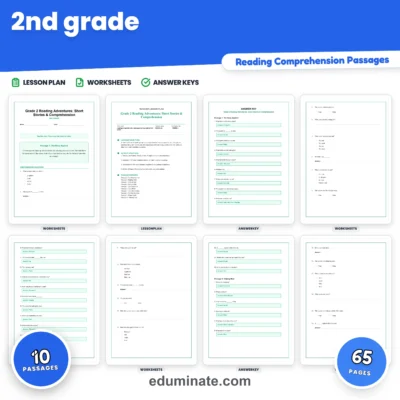
- For second grade, the second grade short reading passages come with ten stories, questions and an answer key.
- For third grade, the third grade reading comprehension passages offer ten stories with questions and an answer key.
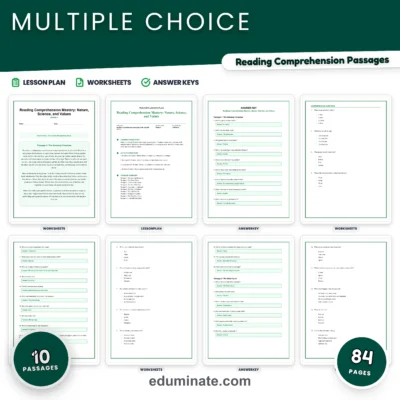
- For fourth grade, the fourth grade multiple choice reading passages cover ten topics and list moral themes among the skills students practice, with answer keys included.
- To cover grades 1 to 4 in one download, the Reading Comprehension Worksheets Bundle gathers ten reading packets, with multiple choice and informational text, in 657 pages.
When you pick a pack, read one passage yourself first. Ask whether the story has a clear problem, a choice and an ending, since those three parts are what students need to find a theme.
A sample lesson with one theme passage
Here is one way to teach a single passage from start to finish. It keeps the talk short and gives students many chances to point at the text.
- Read the passage aloud while students follow along on their own copy.
- Ask for a one sentence retelling. This separates the plot from the theme before the harder thinking begins.
- Have students underline the moment the character makes a choice.
- Ask what the character learned. Students answer in pairs.
- Build the theme sentence together on the board, replacing the character’s name with a general word.
- Students find two details that prove it and write them beside their sentence.
- Compare the sentence with the answer key and talk about any wording that differs.
The same lesson works with a story you invent on the spot. Tell a short tale about a student who forgets a library book and has to explain to the librarian. Ask what the character learned, and the class will find a theme such as “Owning up to a mistake is better than hiding it.”
Common mistakes students make with theme
Knowing the usual slips ahead of time makes it easier to correct them kindly. Here are the ones that come up most often in a classroom.
- Naming a topic instead of a theme. The answer “friendship” is a topic. Ask, “What does the story say about friendship?”
- Retelling the plot. The answer “Amir studied and lost” is a summary. Ask, “What can any reader learn from that?”
- Using a character’s name. A theme should work for people in general, so replace “Amir” with “people” or “you.”
- Choosing a theme with no evidence. Ask for two details from the text every time.
- Treating the theme as a command only. Both “Work hard” and “Hard work pays off” can work, but a full statement usually shows the reasoning better.
Frequently asked questions
Can a story have more than one theme?
Yes. A longer story may carry several messages, such as honesty and courage. For short passages, ask students to choose the one that has the strongest evidence in the text.
Is the moral of a story the same as the theme?
They are close. A moral is a lesson often stated at the end of a fable. A theme is a broader term that also covers messages that are only shown, never stated.
What if two students give different themes?
That can be fine. Ask each student to show the evidence. If the details support both sentences, both can stand. If one sentence has no support in the text, it needs to be revised.
Where do I start with students who struggle to find a theme?
Start with the problem and the ending. Ask what changed for the character, then ask what a reader could learn from that change. Use the sentence frame until the steps feel natural.