What Is an Inference? Examples and Activities for Kids
What is an inference? It is a conclusion a reader draws from clues in the text plus what the reader already knows. This page gives examples for kids and shows how an inference differs from a prediction. It also has sentence stems and classroom activities.
What is an inference
An inference is a conclusion about something the text does not say outright. Writers leave things unsaid all the time, and the reader fills in the gap. The reader builds the inference from two sources: clues in the text and background knowledge. If a character walks in from outside with a wet umbrella, the text may never say that it is raining. The reader puts the clue (wet umbrella) together with what they know (umbrellas get wet in rain) and infers that it is raining. To practice describing what a character is like, use our character traits list.
An inference is not a wild guess. It rests on evidence that a reader can point to.
Inference examples
Each of these inference examples was written for this article. Read the clue, think about what you know, and then read the inference.
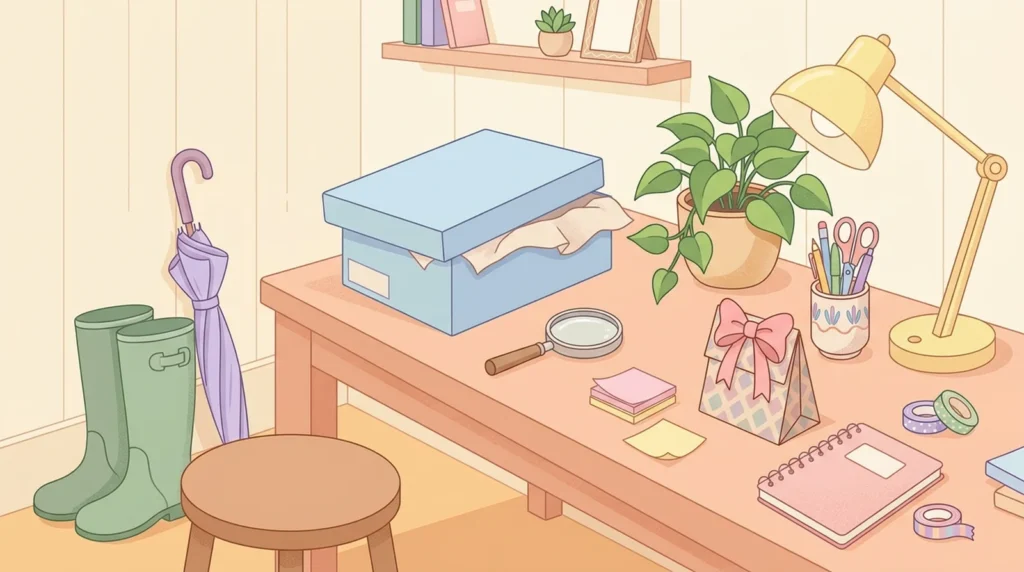
- Clue: Mia grabbed her umbrella and her boots. What I know: umbrellas and boots are for rain. Inference: it is raining, or it is about to rain.
- Clue: The lights were off, and the chairs were stacked on the tables. What I know: chairs are stacked when a room is cleaned or closed. Inference: the room is closed for the night.
- Clue: After the race, Sam’s cheeks were red and he kept wiping his forehead. What I know: people get hot and tired when they run hard. Inference: Sam is hot and tired.
- Clue: The cookie jar was empty, and there were crumbs on Leo’s shirt. What I know: crumbs come from eating cookies. Inference: Leo probably ate the cookies.
- Clue: Nora looked at the door, then at the clock, and tapped her foot. What I know: people do this when they are waiting. Inference: Nora is waiting for someone and is getting impatient.
The inference formula
The idea fits in one line: clues from the text + what I already know = inference. A three-column table makes the formula easy to use when students are working on their own.
| Clue from the text | What I know | Inference |
|---|---|---|
| Mia grabbed her umbrella and boots. | Those are for rain. | It is raining. |
| Sam kept wiping his forehead. | People do that when they are hot. | Sam is hot. |
| Nora tapped her foot. | People tap when they are impatient. | Nora is waiting. |
Making inferences step by step
Students can use the same steps each time when making inferences. This is how to make an inference in four steps:
- Read the sentence or passage carefully.
- Find the clues. Underline the words or details that stand out.
- Think about what you know. What do these clues remind you of from real life or from other reading?
- Make your inference and check it. Say it in one sentence, then go back to the text. Do the clues support it?
Here is the four-step routine applied to example 3. Read: After the race, Sam’s cheeks were red and he kept wiping his forehead. Clues: red cheeks, wiping his forehead. What I know: running hard makes people hot. Inference: Sam is hot and tired. Check: nothing else in the text says otherwise, so the inference stands.
A good inference stays close to the text. If a student says “Sam is sad,” ask which clue points to sadness. When no clue does, the idea is a guess that needs more evidence.
Inference vs prediction
The two are easy to mix up. An inference is about what is true or happening now. A prediction is about what will happen next. Both use clues.
| Inference | Prediction | |
|---|---|---|
| About | What is happening or true now | What will happen next |
| Based on | Clues plus what you know | Clues plus what you know |
| Example (text: Mia grabbed her umbrella and her boots.) | It is raining outside. | Mia will walk out and splash through the puddles. |
There is a third thing to keep apart from both: an observation. An observation is something you can see or read directly. Mia grabbed an umbrella and boots is an observation, because the text says it.
Drawing conclusions
Drawing conclusions is closely related to inferring. A conclusion is a bigger decision built from several inferences or details put together.
Take these details from a short text: Mia grabbed her umbrella. She pulled on her boots. The window was gray, and a steady tapping sounded on the roof. Each detail leads to a small inference. Together they support the conclusion that it is a rainy day and Mia is getting ready to go out in it.
Inference questions
Inference questions ask students to say what they think and to point to why. Teachers can ask them, and students can ask them of each other. Six useful stems:
- What clues tell you that this is happening?
- What do you think the character is feeling? What makes you think that?
- Why do you think the character did that?
- What can you tell about the place from the details in the text?
- What do you already know that helps you understand this part?
- Which words in the text support your idea?
Inference sentence stems and text evidence sentence starters
Sentence frames give students a way to start. These inference sentence stems state the idea:
- I can tell that ___ because ___.
- The clues ___ and ___ make me think ___.
- I know that ___, so ___.
- This makes me think ___.
- Based on ___, I infer that ___.
And these text evidence sentence starters show where in the text the clue came from:
- The text says ___, which shows ___.
- The author writes ___.
- According to the text, ___.
- One detail that supports this is ___.
- For example, the text says ___.
Inference anchor chart
Build the inference anchor chart with the class over a few lessons. Put three parts on it:
- The formula: clues from the text + what I know = inference.
- One worked example: for example, the umbrella and boots row from the table above, with the three parts in different colors.
- Sentence stems: two or three of the frames above, written large.
Leave a corner for sticky notes where students can add their own clue and inference from the day’s reading.
Inference activities
These inference activities use text and objects only.
Picture-less clue cards
Write three short clue sentences on a card, such as The windows were fogged up. There was a pot on the stove. The whole room smelled like onions. Students infer where the person is (a kitchen) and name the clue that helped most.
Mystery bag of three clues
Place three everyday objects in a bag, such as a toothbrush, a towel and a bar of soap. Students pull them out one by one and infer where the owner is going or what they are about to do.
What is in the box
Seal a small object in a shoebox. Students can shake the box, lift it and listen. They say what they noticed (observations) and then what they think is inside (inference). Open the box at the end.
Inference sticky notes during a read-aloud
Stop at a few places in a read-aloud. Students write an inference on a sticky note with the clue that led to it, and stick it on a class chart.
How to teach inference
When thinking about how to teach inference, go from easy to hard:
- A single sentence. Start with one clue sentence, like the umbrella example.
- A short paragraph. Give three or four sentences with more than one clue.
- A longer passage. Ask for inferences about a character, a place or a feeling.
Think aloud as you model: “The text says she grabbed her boots. Boots are for wet ground. I think it has rained.” Begin with everyday clues that children already know, such as a wet coat, a packed lunch or a closed door, before moving to clues in unfamiliar texts. As students gain confidence, ask them to name the clue first and the inference second, so the evidence always comes before the idea. Our post on reading comprehension strategies shows how inferring fits with other strategies like questioning and summarizing.
Practice material
Students need texts to practice on. These printable packs give them passages with questions and answer keys:
- First grade reading passages and questions: 62 pages, ten engaging stories.
- Second grade short reading passages: 65 pages, ten engaging stories.
- Third grade short passages: 65 pages, ten engaging stories.
- Fourth grade reading passages: ten passages across 63 pages, with text evidence questions.
- Fourth grade multiple choice passages: 84 pages across ten topics.
- Fifth grade informational text: 74 pages across ten informational texts, with text evidence and recall practice.
For more reading practice at grade 4, see our post on ELA practice for 4th graders.
Frequently asked questions
Is an inference the same as a guess?
Not quite. A guess can come from nowhere. An inference is based on clues in the text and on what the reader knows, and the reader can point to the evidence.
What grade learns inference?
Schools differ, so check your curriculum. For reference, the reading packs above are listed for grades 1 to 5.
Can an inference be wrong?
Yes. In the cookie jar example, the crumbs could have come from someone else. That is why readers check the inference against more of the text. If a new detail does not fit, the reader changes the inference.
What is the difference between an inference and a fact?
A fact is stated directly in the text. An inference is something the reader works out from the facts and clues. Mia grabbed her umbrella is a fact. It is raining is an inference.
Related resources
- Reading Comprehension Activities, First Grade Reading Passages and Questions
- Short Reading Passages, Second Grade Printable Pages, Questions and Answer Key
- Short Reading Comprehension Passages, Third Grade Questions and Answer Key
- 4th Grade Reading Passages with Questions, Passages with Answer Keys, Grade 4
- Grade 4 Reading Comprehension Multiple Choice, Fourth Grade Reading Passages
- Reading Comprehension Informational Text, Reading Passages and Questions