Reading Fluency Passages: How to Use Them in Class

Reading fluency passages give students short, repeatable texts to read smoothly, accurately and with expression, and a simple weekly routine makes them easy to run. This guide covers how to choose passages, three ways to practice them aloud, and how to keep track of growth without turning fluency into a race.
What reading fluency really means
Fluency is the ability to read a text with accuracy, at a comfortable pace and with expression. It sits between decoding words and understanding what they mean. A student who reads fluently does not have to stop and sound out every word, so more attention is free for meaning.
Each of the three parts matters on its own.
- Accuracy: reading the words correctly.
- Pace: reading at a speed that sounds like talking, neither rushed nor word by word.
- Expression: using the voice to show where sentences end, where a question is asked, and what the text feels like.
Speed alone is not fluency. A student who rushes through a page and misses words has not read it fluently. For that reason, the routine below focuses on smooth, careful reading, not on how fast a page can be finished.
What makes good reading fluency passages
Not every text suits fluency practice. The best passages share a few features, and checking them takes less time than it sounds.
Short enough to reread
Fluency grows through rereading, so a passage must be short enough that students will read it more than once without tiring. A page or less works well for most elementary students.
At the right level
For practice, students should be able to read most of the words correctly. If a student stumbles on many words, the text is too hard for fluency work and belongs in a teaching session with support. If every word is easy, the passage will not stretch the reader.
Clear sentences and a clear topic
Fluency is about reading smoothly, so tangled sentences or unclear topics get in the way. A passage with a simple story or one topic lets students focus on how it sounds.
Questions to check understanding
A fluent read means little if the reader does not understand the text. Comprehension questions after the reading keep the purpose clear: reading well means making sense of it.
Decodable text for early readers
Beginning readers need passages built from letter sounds they have been taught, so they can succeed without guessing from pictures. Our guide to decodable books explains what makes a text decodable and how to use one.
Three ways to practice with fluency passages
Having more than one way to read the same passage keeps practice fresh. These are three routines that need only a printed page and a pencil.
Repeated reading
In repeated reading, a student reads the same passage several times. After each read the student notices what went better. Here is one way to run it.
- The teacher or a partner models the passage with a clear, steady voice.
- The student reads it aloud once. Mark any words that were missed.
- Look at the marked words together and read them in isolation.
- The student reads the passage again, and then once more on another day.
Rereading works because each read is easier than the one before. Students can hear themselves improve, which builds confidence.
Partner reading
Pair students and give each pair one copy of the passage. One student reads a paragraph while the other follows with a finger. Then they switch. The listening partner can use a short checklist: Did the reader say the words correctly? Did the voice stop at periods? Did it rise at question marks? The partner should say one thing that sounded good before suggesting one thing to try again.
Echo reading and choral reading
In echo reading, the teacher reads one sentence with expression and students read the same sentence back. This is a gentle way to model phrasing for students who read in a flat voice. In choral reading, the whole group reads together, which supports students who feel nervous about reading alone.
Fluency practice that builds expression
Expression is the part of fluency that students enjoy most, and it is also the part that shows understanding. A student who reads a question with a rising voice has noticed the question mark. A student who slows down for a sad moment has understood the story.
Try these small activities with any passage:
- Mark the punctuation with a colored pencil, one color for periods, one for commas and one for question marks.
- Draw a slash wherever there should be a short pause, and read it again.
- Read a sentence in two ways, flat and then with expression, and ask which one sounds more like talking.
- Choose a favorite sentence and explain why it sounded best when read aloud.
Helping students who read word by word
Some students read each word as if it stood alone, with a pause after every one. The sentence loses its sound and often its meaning. A few small supports can help.
- Read in phrases. Show students how to group words that belong together, such as “on the table” or “in the garden,” and read each group in one breath.
- Use a reading card. Slide a plain index card under the line being read to keep the eyes from jumping around.
- Model first. Read the sentence aloud, then ask the student to read it back the same way.
- Reread the sentence. When a sentence sounded choppy, ask the student to read it again as if talking to a friend.
Be patient with this. Moving from word by word reading to smooth phrasing takes many short sessions, and each reread is a small step.
Reading fluency passages for fiction and nonfiction
Students should practice fluency with both stories and informational texts, because the two sound different when read aloud. A story has dialogue, feelings and a plot, so the voice can change. An informational text has more factual words and often longer sentences, so the voice stays steadier and the reader must be careful with unfamiliar terms.
Before reading an informational passage, preview the harder words. Write two or three on the board, say them together and use each in a sentence. Students then meet them on the page already familiar, and the read goes more smoothly.
Choosing reading fluency passages by grade
Here are packs from our shop that pair short passages with questions and answer keys. Each fact below comes from the product description.
Kindergarten and first grade
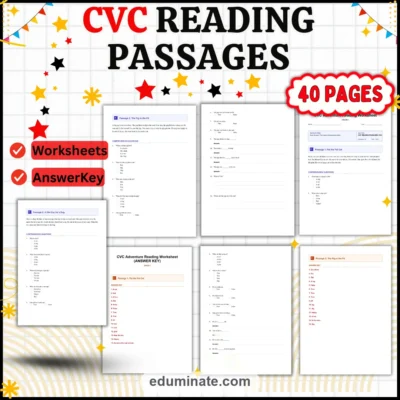
- The Decodable CVC Reading Passages pack has ten short vowel stories, 150 comprehension questions across thirty student worksheet pages, and ten pages of teacher answer keys.
- The First Grade Reading Comprehension Activities pack includes ten stories with questions and answer keys.
Second and third grade
- The Second Grade Short Reading Passages pack has ten stories with questions, and sentence fluency is listed among the skills students practice.
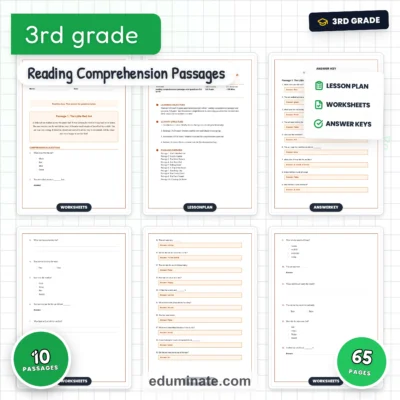
- The Third Grade Short Reading Comprehension Passages pack has ten stories with questions and an answer key, with sentence fluency listed as well.
Upper elementary
- The Multiple Choice Reading Comprehension pack has eleven detailed texts with multiple choice questions and complete answer keys.
One download for several grades
- The Reading Comprehension Worksheets Bundle collects ten reading packets for grades 1 to 4 in 657 pages.
Tracking fluency growth without a stopwatch race
Many teachers want to see progress without making students feel ranked against each other. These methods work with any passage and do not depend on a benchmark number.
- Keep a private record for each student. Mark missed words on a copy of the passage during each read, then compare the first and last read of the week.
- Use a short checklist. Rate accuracy, pace and expression as “needs practice,” “getting there” or “smooth.” Look at the same three items each time.
- Record and listen back. If your school allows audio, a student can listen to an early read and a later read of the same passage and name what changed.
- Ask a comprehension question. After each reading, ask for one fact from the text. Students who understand what they read are reading with purpose.
If you do use a timer, keep it as a private tool for the teacher. Compare each student only with their own earlier reads, and let a student see the result only when it will be encouraging.
Fluency practice at home
Families can support fluency with very little equipment. Send one passage home for the week and offer a few simple instructions.
- Read the passage aloud first, so the child hears how it sounds.
- Let the child read it back, and give help with any word that stops the reading.
- Praise something specific, such as a sentence that sounded like talking.
- Read it once more on another evening and ask one question about what happened.
Reading together is meant to be warm, not tense. A parent who stays calm and encouraging gives a child more than any score could.
A weekly routine that fits one passage
One passage can anchor a full week of practice. Here is a sample plan you can change to fit your schedule.
- Day one: Model the passage. Echo read it together. Teach any tricky words.
- Day two: Partner reading. Each partner reads once and gives one piece of kind feedback.
- Day three: Independent reread. Mark the punctuation and read with expression.
- Day four: Answer the comprehension questions, going back to the text for proof.
- Day five: Final read to the teacher or a partner. Compare it with the first read.
Frequently asked questions
How often should students practice with fluency passages?
Short and regular is better than long and rare. A few reads of one passage across the week gives students the repetition they need without wearing the text out.
Should fluency passages have questions?
Yes. Questions remind students that the goal is understanding, and they give you a quick way to check that a smooth read also made sense.
What if a student reads fast but misses words?
Slow the pace on purpose. Ask the student to read to a partner who marks missed words, then reread aiming for accuracy first. Pace will settle once the words are secure.
Can I use fluency passages at home?
Yes. A parent can listen to one read each evening, say one thing that sounded good, and ask a question about the text.