Electricity and Circuits Worksheet Ideas for Grades 2 to 5
An electricity and circuits worksheet is most useful when it sits beside a hands-on build. This guide covers the ideas students need, safe low-voltage activities with a battery and a bulb, and how reading passages on static electricity and energy fit into the unit.
Start with what electricity is
Electricity is a form of energy that comes from the movement of tiny charged particles. Students do not need the full physics. A clear starting idea is enough: electric current is a flow of charge, and it needs a path to flow along.
Everyday examples help students see that electricity is already around them. A lamp, a tablet, a refrigerator and a classroom projector all use it. Ask students to list a few and to say where each one gets its electricity: a wall plug, a battery or both.
A word about safety first
Set two rules before any activity. They are simple, and they matter.
- Only use small batteries, such as AA or D cells, for classroom builds.
- Never touch a wall outlet, an electrical cord or an appliance plug as part of an experiment. Wall electricity is far stronger than a battery and can cause serious harm.
Add a third rule for building: never connect the two ends of a battery with only a wire. The wire can get hot. Every circuit should have a bulb or another part in the path.
What a simple circuit needs
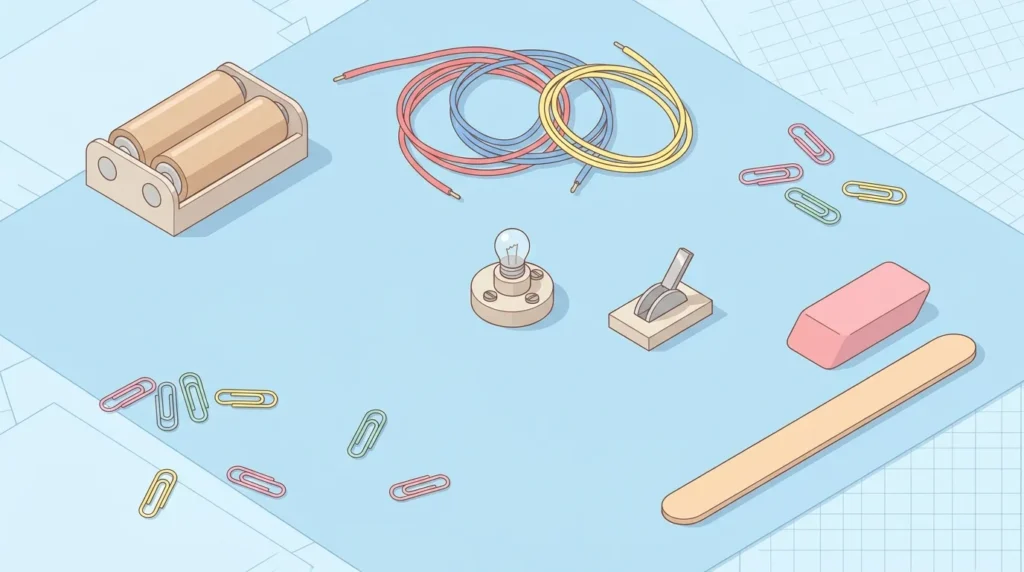
A simple circuit is a complete loop that lets current flow. It has a few basic parts:
- A source of energy: a battery.
- Wires: to carry the current.
- A load: a part that uses the energy, such as a small bulb.
- A switch: an optional part that opens or closes the loop.
A short worksheet can ask students to label these parts on a diagram, and then to trace the path of the current with a colored pencil from one end of the battery, around the loop and back to the other end.
Open and closed circuits
In a closed circuit, the loop is complete and the bulb lights. In an open circuit, there is a gap somewhere, so the current cannot flow and the bulb stays off. A switch is a tool for making and breaking that gap.
Ask students to predict before they build. Show a diagram with a break in the wire and ask, “Will the bulb light? Why or why not?” Then let them test it. The prediction step turns a simple build into a real investigation.
An electricity and circuits worksheet to go with a build
Here is a short record sheet students can complete while they work with a battery, a bulb and wires. It also works as a plan for your own electricity and circuits worksheet.
- Draw the circuit you plan to build, using lines for wires.
- Predict: will the bulb light? Circle yes or no.
- Build it and test it.
- Record what happened in a full sentence.
- If the bulb did not light, write one thing you changed to fix it.
The last step is the most valuable. Students often find a loose wire or a battery turned the wrong way. Troubleshooting is a real part of how circuits are built, and it is good for students to practice it.
Conductors and insulators
Some materials let current flow easily, and others do not.
- Conductors let current flow. Metals are good conductors.
- Insulators block the flow of current. Rubber, plastic, glass and wood are good insulators.
A simple testing activity: leave a gap in the circuit and place different objects across the gap to see whether the bulb lights. Give students a list of items to test, such as:
- a metal paper clip;
- a coin;
- a piece of aluminum foil;
- a rubber eraser;
- a plastic spoon;
- a wooden craft stick.
The paper clip, coin and foil are metal, so the bulb should light. The eraser, spoon and craft stick should not light it. Ask students to record each result in a table and then sort the items into conductors and insulators.
Follow up by asking why wires are metal inside but covered in plastic or rubber outside. The metal carries the current, and the covering keeps it from reaching a person or another wire.
Series circuits in brief
Older students can try a series circuit, where all parts sit on one path. In a series circuit with two bulbs, the same path runs through both. If one bulb is removed or breaks the loop, both go out, because the path is broken.
Ask students to compare a circuit with one bulb and one with two. They may notice that the bulbs in the two-bulb circuit look dimmer. Let them describe what they see before offering the idea that the battery’s energy is now shared along the path.
Static electricity
Static electricity is a different kind of electricity: charge that builds up on an object instead of flowing through a circuit. Rubbing certain materials together can move tiny charged particles from one to the other, leaving each with a charge.
A classic demonstration: rub a balloon on a wool cloth, then hold the balloon near tiny scraps of paper on a table. The scraps jump toward the balloon. Ask students to sketch a diagram of what they saw and to write one sentence about why it happened.
Static electricity is also behind the small shock you may feel after touching a metal doorknob in dry weather, and it is related to lightning, which is a very large spark of static electricity in the sky.
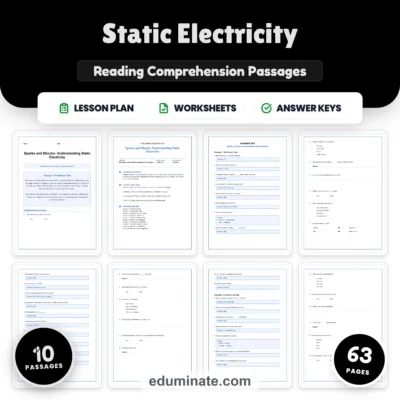
For reading practice on this topic, the Static Electricity Worksheets packet has 10 texts, tasks and answer keys across 63 pages for grades 3 to 7, covering electron transfer, electric charges and lightning.
Electricity in the world: batteries, cars and power plants
After students understand a circuit on the table, show where the same ideas appear in larger systems.
Batteries and electric cars
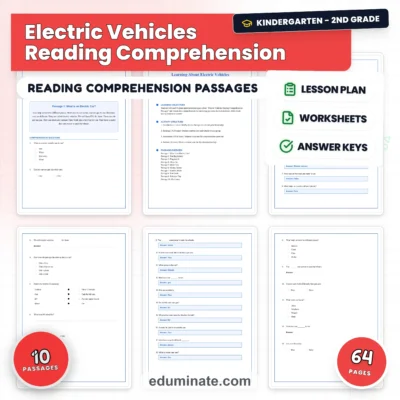
An electric car runs on battery power. For younger readers in kindergarten to grade 2, the Electric Cars Reading Comprehension packet has 64 pages and 10 passages introducing electric cars, battery power, charging plugs, clean air and quiet motors, with answer keys.
Where electricity comes from
Electricity for homes and schools is made at power plants and from other sources of energy. A few packets let students read about different energy sources in their own words:
- The Wind Power Worksheets packet has 10 passages across 63 pages with text dependent questions, a structured lesson plan and answer keys for grades 2 to 8.
- The Solar Energy Worksheets packet has 63 pages exploring quantum dots, hydrogen generation, perovskite minerals and renewable energy.
- The Renewable Energy Worksheets on waste to energy has 72 pages across ten passages on municipal waste combustion, steam power generation, pollution scrubbers and global recycling, with answer keys.
These passages pair well with a circuit unit. A student who has lit a bulb with a battery can then ask where the power for a whole building comes from.
A broader science set
If you want one download that covers several elementary science topics, the Science Worksheets Bundle has nine reading packets with elementary science passages and questions, 553 pages in all. It is a good place to look when your science plan covers more than electricity this term. If matter is next on your list, our guide to states of matter makes a natural next topic.
A simple unit plan
Here is one way to spread the topic over a week. Adjust it to fit your class.
- Day one: talk about everyday electricity, set the safety rules and label the parts of a circuit.
- Day two: build a closed circuit with a battery, wires and a bulb. Fill in the record sheet.
- Day three: test conductors and insulators and sort the results.
- Day four: try static electricity with a balloon and paper scraps, then read a short passage.
- Day five: read about an energy source and write a short paragraph on where electricity comes from.
Leave time at the end for questions. Students usually ask about lightning, power outlets and batteries, which is a good sign that the unit has caught their attention.
Questions to ask while students build
A good build is full of small questions. Ask these as you walk around the room:
- Where does the current start, and where does it end?
- What happens if we take one wire away?
- Which parts of your circuit are metal?
- What did you change when the bulb did not light?
Students who can answer these in their own words understand the circuit, not only the steps to build it.
When the bulb will not light
Every class meets a circuit that does not work. Turn it into a short checklist that students can use on their own:
- Check that the wire ends touch the metal parts of the battery and the bulb.
- Check that the bulb sits firmly in its holder.
- Look for a gap in the loop, such as a switch left open.
- Try a fresh battery, since the first one may be used up.
- Make sure the loop is complete from one end of the battery to the other.
Post the checklist where groups can see it. Students then learn that a circuit that fails is a puzzle to solve and not a reason to stop.
Vocabulary for an electricity unit
A short word bank helps students write clearly. Add these terms to the board: circuit, current, battery, bulb, switch, conductor, insulator, open, closed, static. Ask students to write a one-line meaning for each, using their own words, and to use at least four of them in a paragraph that explains how a lit bulb works.
Writing about what you found
End the build with a short written explanation. A frame can help students who find it hard to start: “We built a circuit with a battery, wires and a bulb. When the loop was closed, the bulb… When we opened the switch, the bulb…” Then ask for one more sentence about something that surprised them. A short written account turns a hands-on lesson into something students can look back on.
Frequently asked questions
What is a simple circuit?
A complete loop made of a battery, wires and a part such as a bulb. Current flows around the loop when it is closed.
What is the difference between conductors and insulators?
Conductors, such as metals, let electric current flow through them. Insulators, such as rubber, plastic, glass and wood, do not.
Is it safe for students to build circuits?
Yes, with small batteries such as AA or D cells and with clear rules. Students should never use wall outlets, cords or plugs for an experiment.
What is static electricity?
Electric charge that builds up on an object, often by rubbing two materials together. It stays in place until it jumps to another object, as in a small spark.