Number Flashcards: Printable Sets and Ways to Use Them
FreeTry a printable pack for free first. No card needed.See free packs
Number flashcards are cards that show one number each, so young children can look at it, say it and match it to a group of objects. A good set uses big, clear digits, runs from 1 to 20, and leaves room for hands-on counting with blocks, buttons or counters. They suit toddlers who are starting to count, preschoolers and kindergartners who are learning to recognize numbers.
Ideas for what to do with a set:
- Hold up a card and ask the child to say the number.
- Lay out three cards and ask the child to touch the one you name.
- Match each card to a pile of counters.
- Put the cards in order from 1 to 10, then from 1 to 20.
- Play a memory game with two copies of the same page.
- Hide one card and ask which number is missing.
The sections below explain what to look for in a set, how to teach the teen numbers, and which printable sets are available.

In this article (9 sections)
What makes a good set of number flashcards
Children do not need fancy cards. They need cards that show the number clearly. Check these points before you print.
- Large digits. The number should be the biggest thing on the card. Decorations belong at the edges.
- Consistent digit shapes. A child who sees the 4 in three different styles may think they are three different numbers. Some variety is fine, and a few styles help, but the shapes should stay easy to read.
- The range you need. Many sets stop at 10. If your children are ready, 1 to 20 gives them the teen numbers, which are harder.
- Cards that print one page at a time. You will not use the whole set in one week. Pages that work alone let you print only what the group needs.
- Space for hands-on work. Cards with only a digit leave room for real objects. Cards with pictures help a child match a number to a group right on the card.
Teaching number recognition step by step
Number recognition means seeing a written number and knowing its name. It comes before more advanced math, and it takes many short rounds.
Start small
Begin with 1 to 5. Show one card at a time, say the number, and let the child repeat it. After a few days, lay out three cards and ask, “Can you touch the 3?” This builds recognition without pressure.
Add counting
Put a card on the table and ask the child to count out that many buttons. Counting objects one by one connects the number name to a quantity. Keep objects the same size so children can compare piles.
Move to 10, then 20
Add numbers in small groups. When children reach the teens, point out the pattern: thirteen, fourteen, fifteen and so on. The teen numbers are often the hardest, since the names do not always match the digits as clearly as the numbers 20 and above. Practice them in short rounds across several weeks.
Add number words
Some cards print the word under the digit, such as “five” or “twelve.” Use them with children who are starting to read. A child who can match “seven” to 7 is making a first link between math and reading.
Games that work with number flashcards
Number hunt
Hide cards around the room, one at a time. Call out a number and let the child find it. This game uses movement, so it suits children who cannot sit for long.
Match and count
Give each child a handful of counters and three cards. The child picks a card, says the number and counts out that many counters. A partner checks the count.
Order the line
Mix up the cards 1 to 10 and ask the child to line them up. For a harder round, remove one card and ask which number is missing. Ordering tasks support the idea that numbers go up by one each time.
What comes next
Show a card, such as 6, and ask, “What number comes after?” Then ask, “What comes before?” Children who can do this are building a mental number line.
Memory
Print two copies of the same page. Cut the cards apart and turn them face down. Children flip two cards at a time to find a pair. It also works with a card and a matching group of dots, if you draw the dots yourself.
Printable number flashcards
The Eduminate sets below are all PDFs for Pre-K. Each file has a name page, many card pages with four cards on each, and a thank you page. The product pages say the files are A4 and print on US Letter with “Fit to page.” Use them at home or in one classroom.
- Kindergarten Number Flashcards 1-20 has 192 cards on 48 card pages (50 pages in the PDF) and costs $6.99. The digits are thick and rounded with small stars, dots or flowers around them, and one page prints the word under each digit.
- Counting Flashcards 1-20 has 196 cards on 49 card pages (51 pages) and costs $6.99. The cards carry no counting pictures, only the digit, so you can add blocks, counters or buttons from your own shelf.
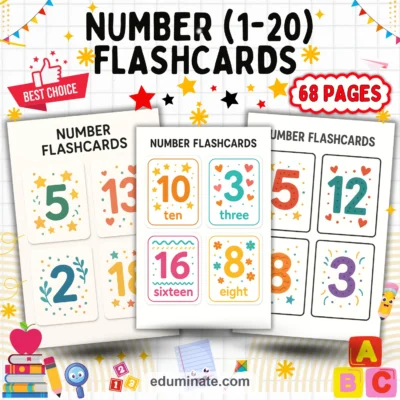
- Printable Number Flashcards 1-20 has 264 cards on 66 card pages (68 pages) and costs $7.99. Some cards use a plain black digit and others use color, so children see the same number in different looks.
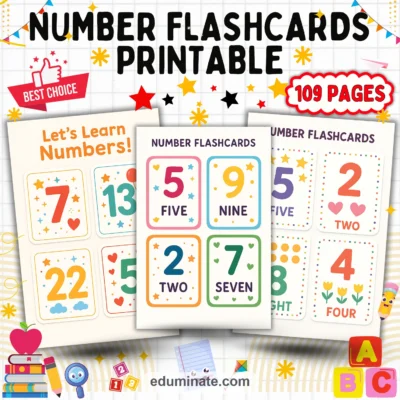
- Number Flashcards Printable has 428 cards on 107 card pages (109 pages) and costs $11.99. It mostly covers 1 to 10, and some cards show a digit with that many pictures, such as stars or hearts. A few cards have a short line under the number for writing.
For a first purchase, the 192-card Kindergarten set at $6.99 is a good starting point for 1 to 20. If your focus is counting with real objects, the Counting Flashcards set leaves the cards clean for that purpose. If you want cards with built-in counting pictures and writing lines, look at the 428-card set.
The Number Flashcards Bundle gathers five of these sets in one download, with 346 pages in total. The separate prices add up to $41.95 and the bundle costs $31.46, a saving of 25%. It suits a teacher who wants variety, or who wants one set for the classroom and one for home.
Using number flashcards in math centers
A center works best when the task is clear and children can do it without you. Here are three setups.
- Counting station. A tray of counters, a small dish and a stack of cards. A child draws a card and counts that many counters into the dish.
- Order station. A bag of cards 1 to 10 and a strip of paper. Children place the cards in order along the strip.
- Partner quiz. One child shows a card and the other names it. They switch after five cards.
Change the cards every week or two. Print only the pages you need so the center stays fresh. Our guide to number recognition worksheets has paper practice to pair with the cards when children are ready to write.
Tips for printing and storing
Printable flashcards cost little and you can reprint a page when one gets worn.
- Print on card stock if you have it. Plain paper works, but cards last longer when thicker.
- Laminate the cards you use daily.
- Cut along the borders with a paper trimmer. Cutting is a good fine motor task for older children.
- Keep each range in a small bag or an envelope: 1 to 5, 6 to 10, 11 to 20.
- Write the range on the outside so a helper or a substitute can find the right bag.
Where number flashcards fit in a week
Short rounds beat long sessions. Five minutes at the start of math time is enough. Here is a sample week for a preschool or kindergarten group.
- Monday: show the cards 1 to 5 and say each number together.
- Tuesday: count objects to match three cards.
- Wednesday: play the number hunt with cards 1 to 10.
- Thursday: order the cards, then remove one and find the missing number.
- Friday: review by playing memory with two copies of one page.
Keep the pace gentle. A child who still mixes up 6 and 9 needs more time with those two, not a faster pace. Pair the digit with an object count each time, and the number will start to stand for something real.
Frequently asked questions
What age are number flashcards for?
The sets above are for Pre-K, so they suit toddlers who like to name things, preschoolers and early kindergartners. Children usually start with 1 to 5 and add more as they gain confidence.
How many cards should I show at once?
Start with one or two. When a child names them easily, add a third. Showing too many at once makes the task feel like a test.
Should I teach the digit or the number word first?
Start with the digit and the spoken name. Add number words once a child knows many digits and has started to read.
Do I need to laminate them?
No, though laminated cards last longer when many hands use them. Printing on card stock is a lighter option.