Healthy Food Coloring Pages: Free and Printable Sets
Healthy food coloring pages are printable line drawings of fruits, vegetables and other everyday foods that children color while they learn the names of the foods. They suit preschool to second grade, and the best sets use large, simple shapes, a short caption such as Eat Healthy, and plenty of pages so every child can choose a favorite.
Here is what you can find in these sets:
- Single fruit and vegetable characters such as broccoli, apple, carrot and avocado.
- Pages that group two to four foods around a banner like Healthy Food.
- Bowls of salad, watermelon slices, bananas, pears and strawberries.
- Outline lettering that children color along with the picture.
- A welcome page with name, date and class lines, and a coloring tips page.

In this article (10 sections)
Free healthy food coloring pages
Most people who search for this topic want a free download, and we have two free packs. A free pack takes an email address, which opens a free account and keeps the file in My Library.
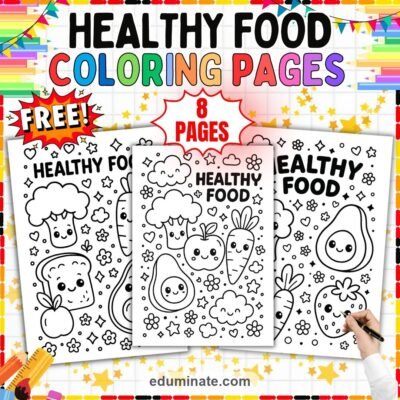
- The Free Healthy Food Coloring Pages pack is an 8 page PDF for all grades. It has 4 coloring pages with broccoli, apple, carrot, avocado, toast and strawberry characters, each with a Healthy Food banner. The other pages are a welcome page with name, date and class lines, a coloring tips page, a thank you page and a terms page.
- The Free Healthy Eating Coloring Pages pack is a 16 page PDF for Pre-K to 2nd grade. It has 12 coloring sheets with garden vegetables, orchard fruits and short messages such as Eat Healthy.
Both free packs print on US Letter with Fit to page, according to their product pages. They are a good way to test the style with a class before you decide on a larger set.
What the paid packs add
A free pack gives you a handful of pages. If you want one page for every child with no repeats, or a month of nutrition activities, the paid sets hold far more. The three packs below show the same friendly style, with a smiling face on each fruit or vegetable, simple doodles such as flowers, stars and clouds, and a short caption on many pages. All three list all grades, and each A4 file prints on US Letter with Fit to page.
- The Healthy Food Coloring Pages 100 Pack has 100 pages and costs $11.99. Page one is a welcome sheet and page two lists coloring tips. The rest show a different mix of characters, including broccoli, apple, avocado, carrot, strawberry, tomato and pear, with two to four foods on most pages.
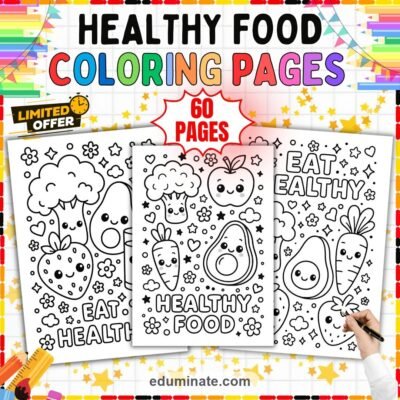
- The Fruits and Vegetables Coloring Pages 60 Pack has 60 pages and costs $7.99. Characters include broccoli, carrot, apple, avocado, pineapple, pear, tomato, cabbage, a slice of bread and a glass of smoothie. It also comes with a separate 8 page preview file.
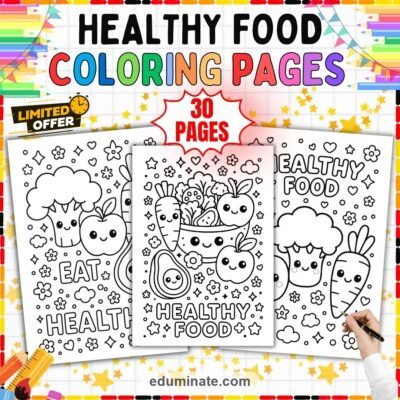
- The Healthy Eating Coloring Pages 30 Pack has 30 pages and costs $4.99. It covers vegetables such as broccoli, carrot, avocado, tomato and a bowl of salad, and fruits such as apple, pear, watermelon, banana and strawberry.
All three paid packs in one download
The Healthy Food Coloring Pages Bundle holds all three paid packs, 190 pages in three PDF files, for $19.98. The packs add up to $24.97 when bought separately, so the bundle saves $4.99, or 20 percent. It lists all grades. The 100 page pack alone already gives a class of 25 four pages each, so the bundle makes most sense for a school, a daycare or a teacher who runs a nutrition unit every year.
Classroom uses for healthy food coloring pages
Start a nutrition unit
Hand out a page on the first day and ask children to name each food as they color it. The pages carry the food names in simple pictures, so children who do not yet know the word can learn it from their neighbor. Our guide to healthy eating activities for preschoolers has more ideas to pair with the pages.
Snack time and morning tubs
Put a few pages in a tub with crayons for children who arrive early. A calm, short task helps them settle while you finish setting up.
Early finishers
A child who finishes a reading or math task early can take a page from the basket, color it and add it to a class gallery. Because the pages work on their own, you do not need to explain anything. A large pack helps here, since an early finisher can pick a new page each time without repeating one.
Sort by color
Ask children to color a fruit or vegetable in its real color, then line up the finished pages by color on the board. Count how many are red, orange, yellow and green. Older children can write a number sentence, such as 4 red plus 3 green equals 7 foods.
Food groups talk
Give each child two pages and ask them to sort the foods into fruits and vegetables. Some foods surprise children, because a tomato grows like a fruit but often sits with vegetables in the kitchen. Let them argue it out, then tell them the answer. Keep the talk simple and positive, with no lectures about what not to eat.
Writing prompts
- Write the name of your favorite fruit and describe its color.
- Name two vegetables you would put in a salad.
- Describe a healthy snack you could pack for school.
- Write a short sentence that starts with the words I like to eat.
A class display that grows
Pick one page per child and ask each to color it carefully, then add their name and a sentence about the food. Pin the pages along a hallway under a heading such as Our Class Garden. Families who visit can see what the children have learned, and children enjoy finding their own page. If you use the 100 page pack, give every child a different page so the wall shows a wide mix of foods rather than the same few.
Using the pages at home
Parents can use the same pages to make mealtimes calmer. Print a page, ask your child to color the food that is on tonight’s table, and talk about its color and shape. Children who are fussy about vegetables often take more interest when they have colored the broccoli first. Keep the talk light, and let the child decide whether to taste it.
Fine-motor and focus tips
- Ask younger children to color the big food first, then the doodles around it.
- Show how to color a carrot in long strokes that follow its shape.
- Suggest light colors first, then darker ones on top, as the tips page in each pack explains.
- Offer thick crayons to children still building their grip, and colored pencils to those who want careful work.
- Let children fill in the lettering last, as a small goal at the end.
A simple 20 minute plan
- Spend three minutes asking which fruit or vegetable each child ate this week.
- Hand out a page. Children color for ten minutes.
- Ask each child to say the name of their food and its color to a partner.
- Finish with a five minute gallery walk, where children look at three pages and say one thing they like.
Which page for which age
Preschool and kindergarten
Choose pages with one or two big foods. Accept any colors, since a purple carrot is still a carrot.
First and second grade
Children can color a full page of four foods and fill in the lettering. Ask them to add a sentence about their favorite food at the bottom.
Frequently asked questions
Are there free healthy food coloring pages?
Yes. We have two free packs, one with 8 pages and one with 16 pages. Each takes an email address, which opens a free account and keeps the file in My Library.
What is the difference between the free and paid packs?
The free packs hold 4 and 12 coloring pages. The paid packs hold 30, 60 and 100 pages, so they suit a whole class, a long unit or repeated use through the year.
What grades do the packs suit?
The 8 page free pack and the three paid packs list all grades, and the 16 page free pack lists Pre-K to 2nd grade. In practice the pages suit preschool to second grade best.
Do the foods have faces?
The paid packs and the 8 page free pack show smiling food characters. The 16 page free pack describes cheerful cartoon fruits and vegetables.