Plant Life Cycle Worksheets for Grades K-8
FreeTry a free printable first: Back to School Reading Comprehension Passages and Worksheets for Grades 1-5Get it free
Plant life cycle worksheets work best when students read about each stage and then answer questions that make them explain it. The packs below cover seeds, sprouts, roots, leaves, flowers and seed spreading, with versions for kindergarten up to grade 8, and each one has an answer key.
These are the stages and ideas most plant units cover:
- A seed with a seed coat and a tiny embryo inside.
- Germination, when the root and then the shoot push out.
- A seedling that needs light, water, air and soil.
- A grown plant with roots, stem and leaves.
- Flowers and pollination.
- Fruit and seeds, and the ways seeds travel.

In this article (9 sections)
What plant life cycle worksheets should include
A life cycle is a sequence, so the best pages ask students to put things in order and to say what happens between one stage and the next. Younger students need clear pictures and short sentences. Older students can handle terms such as germination, photosynthesis and transpiration and can explain why a plant needs each part. A page that only asks students to label a diagram can be useful, but reading and writing about each stage helps them remember it longer.
The packs on our site are reading packs with questions, rather than cut and paste sequencing sheets. If you want a sorting task, you can make one in a minute: write each stage on a card, mix the cards and ask students to put them in order, then read the matching passage to check.
Plant life cycle worksheets by grade
We read every product page below. All three are PDFs priced at $7.99. The grades 1 to 5 and grades 5 to 8 pages say their A4 files print on US Letter with Fit to page.
Kindergarten to grade 2
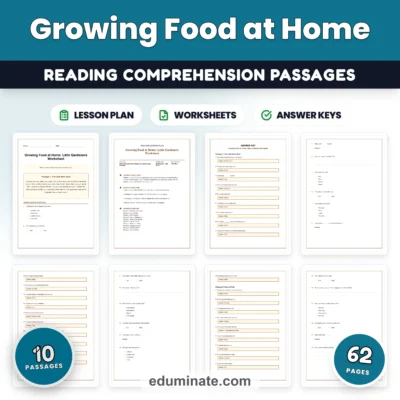
The Growing Food at Home Reading Comprehension Passages and Questions pack for grades K to 2 has 62 pages. Its ten passages start with a child planting a bean seed and follow the sprout through sun and rain, tomatoes, carrots that grow underground, a kitchen garden, garden helpers such as earthworms and ladybugs, and pulling weeds. The text uses short sentences and controlled vocabulary for emerging readers. Question sheets use multiple choice, true or false and word matching, and the pack has a 21 page answer key and a one page lesson plan.
Grades 1 to 5
The Growing Vegetables Reading Comprehension Passages and Questions pack has 63 pages for grades 1 to 5. It begins with a story about planting a first seed in a windowsill container, then covers garden tools, what plants need, whether a vegetable is a root, leaf or stem, the tomato plant, helpful and harmful garden bugs, healthy soil, a community garden, how plants make food and keeping soil strong. Students answer multiple choice, true or false and vocabulary matching items. It includes a 22 page answer key and a one page lesson plan.
Grades 5 to 8
The Plant Life Cycle Worksheets, Plant Growth Reading Passages and Questions pack is listed for grades 5 to 8 and has 64 pages: a 41 page worksheet, a 22 page answer key and a one page lesson plan. Its ten passages cover germination, photosynthesis, root systems, pollination, soil, deciduous and evergreen trees, desert plant adaptations, seed dispersal, carnivorous plants, and transpiration with the water cycle. Each passage has twenty questions in multiple choice, true or false, fill in the blank, matching and short answer formats. The page says the pack suits reading groups, morning work, homework, sub plans and early finisher tubs.
Nine plant packs in one download
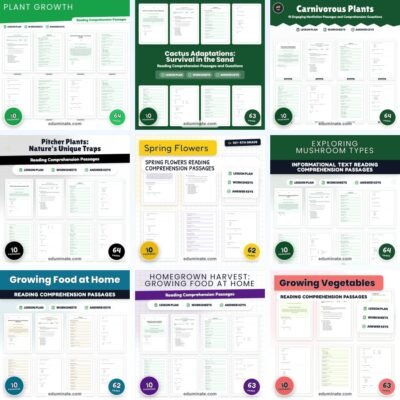
The Plants Worksheets Bundle holds nine reading packets and 569 pages for kindergarten to grade 8. Besides the three packs above it includes cactus, carnivorous plants (two packs), flowers and mushrooms. The separate prices come to $71.91, and the bundle costs $50.34, which saves $21.57 or 30 percent. A bundle is useful for a school that wants one science library for several grades, or for a homeschool family with children of different ages.
A bean seed lesson that goes with the worksheets
Growing something is the easiest way to make the cycle real. This plan needs a clear cup or jar, paper towel, water and a few dried beans.
- Day 1: Wet a folded paper towel and slide it inside a clear jar. Push a bean between the glass and the towel. Students draw the seed and write one sentence on what they see.
- Days 2 to 7: Look at the jar each day. Students draw what changed, such as a split seed coat, a root or a shoot.
- Day 8: Read a matching passage, such as The Little Bean Seed in the K to 2 pack or the germination passage in the grade 5 to 8 pack, and answer the questions.
- Day 9: Move the best seedling to soil in a small pot. Students predict what will grow next.
- Later: Keep a short log of height and leaf count every few days.
Students who draw the seed each day have their own evidence to use when they answer the questions. Wash hands after handling soil, and let students keep their own jar if the class can spare a window ledge.
Ideas for centers and early finishers
- Sequencing cards: write the stages on index cards and ask students to arrange them and read them aloud.
- Draw and label: students draw one stage and label the parts they know.
- Compare two cycles: set a plant cycle beside an animal cycle. Our butterfly life cycle guide has a clear set of stages that students can compare with the stages of a bean plant.
- Seed hunt: collect safe seeds from fruit at lunch, sort them by size and guess how each one might travel.
- Write a diary: a seed writes a diary entry for each stage, in the first person.
Teaching tips for each stage
Seeds and germination
Cut open a soaked bean and let students look at the seed coat and the tiny plant inside with a magnifying glass. Ask what the seed needs to start growing. Let them predict before you reveal, then test with two jars, one with water and one dry.
Growing plants
Ask students to set up a fair test with two pots in different places, one in a bright window and one in a dim cupboard. The what plants need passage in the grades 1 to 5 pack ties directly to this test.
Flowers and seeds
Take students outside, or bring in a flower, and find the parts. After the pollination passage, ask students to explain in two sentences how pollen moves from one blossom to another. Seed dispersal makes a good discussion, since seeds travel by wind, water or by hooking on to fur and clothing.
Vocabulary to teach
Keep a word wall with simple meanings. For younger classes: seed, root, stem, leaf, flower, fruit, sprout. For older classes add germination, photosynthesis, chlorophyll, pollination, dispersal and transpiration. Ask students to use each new word in a spoken sentence before they write it, since a word they have said once is easier to write.
Planning a garden unit
A plant unit is easier to plan when you work backward from the harvest. For a kindergarten class, the goal can be as simple as growing one bean plant per child and drawing it at four stages. For grades 3 to 5, the goal can be a fair test, such as comparing growth in light and in shade, with a table of measurements and a short report. For grades 6 to 8, students can connect the readings on photosynthesis and transpiration to what they see in the pots, and explain a difference in growth using evidence.
Whatever the grade, pair each hands-on day with a reading day. The reading gives the words, and the pots give the proof. If a plant dies, keep it. A failed seedling is a useful data point, and students can reason about what went wrong using the passage on what plants need.
Finally, leave time for sharing. Students can present their jar or pot in two minutes, using three vocabulary words from the passages. Listeners ask one question each. This simple routine builds speaking skills and keeps the unit moving.
Frequently asked questions
Which pack is best for kindergarten?
The Growing Food at Home pack is listed for grades K to 2 and uses short sentences with controlled vocabulary.
Do the packs have answer keys?
Yes. The K to 2 pack has a 21 page answer key, and the grades 1 to 5 and 5 to 8 packs each have a 22 page answer key. Each also has a one page lesson plan.
Are these cut and paste life cycle sheets?
No. They are reading passages with question pages. For a sequencing task, make simple stage cards yourself and use the passages to check the order.
What does the bundle add?
The bundle holds nine packs and 569 pages, so you get cactus, carnivorous plant, flower and mushroom reading as well as the three growth packs, for less than the separate prices.