Ecosystem Worksheet Ideas for Elementary Science Class
An ecosystem worksheet works best when it asks students to look at how living and nonliving things in one place depend on each other. This guide explains the key ideas, offers classroom activities from sorting to food chains, and shows how to use reading passages on habitats, deserts and rainforests.
What an ecosystem is, in plain words
An ecosystem is a community of living things and the nonliving things around them, all interacting in one area. A pond is an ecosystem. So is a forest floor, a patch of desert or a grassy field behind the school.
Two groups make up every ecosystem:
- Living things: plants, animals, fungi and tiny organisms such as bacteria.
- Nonliving things: sunlight, water, air, soil, rocks and temperature.
Students often name the animals first. Nudge them to notice that a pond also needs sunlight and water, and that a desert has its own rules about heat and dryness. Every part has a role, and a change to one part can affect the others.
What a good ecosystem worksheet asks students to do
Not every page on this topic teaches the same thing. A useful ecosystem worksheet gives students a real thinking task. Look for pages that ask students to:
- sort items into living and nonliving groups;
- name the role of a plant or animal in a food chain;
- explain how one change in an ecosystem affects another part;
- use details from a short text to support an answer.
Be careful with pages that only ask students to copy a definition. Copying does not show whether a student can use an idea. A short question such as “What would happen to the frogs if the pond dried up?” shows much more.
Living and nonliving things
Start with a sorting activity. Give students a list of items and ask them to place each one in the right group.
- Living: a tree, moss, a mushroom, a fish.
- Nonliving: a rock, a puddle, sunlight, sand.
Some items spark good talk. A fallen leaf was once part of a living tree, but it no longer grows. A seed is small and quiet, but it is alive, because it can grow into a plant. Let students argue their case. The talking is where the learning happens.
Then ask what the living things need from the nonliving ones. A plant needs sunlight, water and air. A fish needs water. Drawing a simple line from each living thing to what it needs makes the links easy to see.
Producers and consumers
Next, look at how living things get their energy. This is the idea behind producers and consumers.
- Producers make their own food. Green plants do this using sunlight, water and air.
- Consumers get energy by eating other living things.
Consumers come in a few kinds:
- Herbivores eat plants. A rabbit eating clover is an example.
- Carnivores eat other animals. A hawk eating a mouse is an example.
- Omnivores eat both plants and animals. A bear that eats berries and fish is an example.
A short sorting task helps here. List five living things and ask students to label each as a producer, an herbivore, a carnivore or an omnivore. Then ask them to explain one choice aloud.
Decomposers: the clean-up crew
Decomposers break down dead plants and animals and return nutrients to the soil. Fungi and bacteria are the main decomposers. Without them, dead leaves and logs would pile up, and the soil would not be refilled with the nutrients that plants need.
A simple observation shows the idea. Collect a few fallen leaves from different places and compare them. A fresh green leaf is whole and firm. An old leaf from the ground is thin and brittle, and a very old one has crumbled almost to soil. Ask students what they think happened to it over time.
Food chains inside an ecosystem
A food chain shows how energy moves from one living thing to the next. It starts with the sun and a producer, and each arrow points toward the one that gets the energy.
Here are two examples to put on the board:
- Grass, then a grasshopper, then a frog, then a snake.
- A water plant, then a snail, then a fish, then a heron.
Ask students to read each chain aloud, saying “is eaten by” at every arrow. Then ask which link is the producer, which links are consumers, and what would happen to the others if the first link disappeared. Our detailed guide to the food chain goes through more examples and activities.
A food chain is a simple model. In real life, most animals eat more than one kind of food, so the chains cross and join into a food web. Introduce the web once students are comfortable with a single chain.
Habitats and biomes
A habitat is the place where a plant or animal lives and finds what it needs. A habitat is one part of an ecosystem. A biome is a very large region with a similar climate and similar kinds of plants, such as a desert, a grassland or a rainforest.
To compare habitats, ask students to fill in a short chart with three headings: how warm it is, how much water there is, and what plants grow there. Then ask how a desert plant would do in a rainforest. The answer shows why living things are suited to where they live.
Animal habitats reading passages
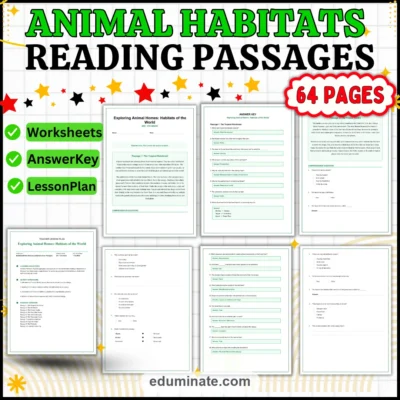
When students need more than a short talk, reading passages give them facts to work with. The Animal Habitats Worksheets set is a 64 page packet with 10 passages exploring biomes around the globe, with questions and an answer key.
Desert ecosystem passages
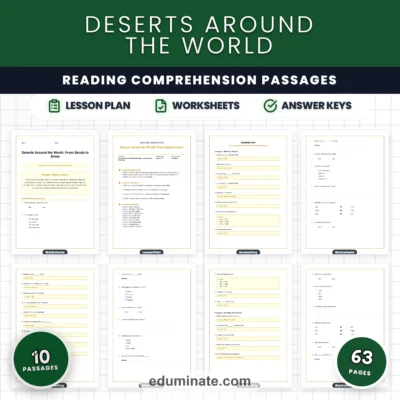
A desert is a good ecosystem to study, because the limits are so clear. The Desert Worksheets packet has 63 pages and 10 reading comprehension passages for grades 3 to 7, exploring the Sahara, the Gobi, desert adaptations, oases and cold deserts, with answer keys. Ask students which facts show how a plant or animal copes with dry conditions.
Rainforest ecosystem passages
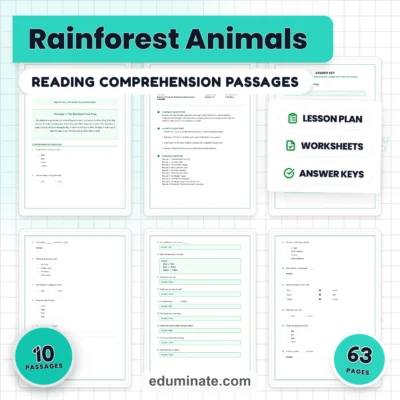
A rainforest is a very different place. The Rainforest Animals Reading Comprehension packet has 10 passages over 63 pages for grades 1 to 5, covering sloths, toucans and jaguars. For slightly older readers, the Jungle Animals Reading Comprehension packet has 10 passages over 63 pages for grades 2 to 6, exploring rainforest layers, sloths, jaguars and macaws.
Put a desert passage and a rainforest passage side by side and ask students to list what is the same and what is different. Both places have producers, consumers and decomposers, even though the plants and animals are very different.
Plants in the ecosystem
Plants sit at the base of most food chains, so it makes sense to give them their own attention. The Plants Worksheets Bundle has nine reading packets in one download, covering plant life cycles, cactus, carnivorous plants, mushrooms and growing food at home. Use the cactus packet beside a desert lesson, and the mushroom packet when you talk about decomposers.
The Animal Worksheets Bundle has seventeen reading packets in one download, covering animal habitats, bats, beavers, camels, migration, rainforest, reptiles and endangered animals. It is a wide set when your ecosystem unit will visit several habitats over the term.
Balance and change in an ecosystem
An ecosystem stays steady when its parts stay in rough balance. Plants grow, animals eat them, and decomposers return nutrients to the soil. When something changes, the effects spread.
Give students a short cause and effect task. For example:
- A long dry season dries up the pond.
- The water plants die back.
- The snails have less to eat.
- The fish have less to eat as well.
Ask students to describe the chain of events in their own words. Then ask what might help the pond recover, such as rain returning. The goal is to see that every part is linked, not to memorize a list.
A schoolyard ecosystem walk
You can study a real ecosystem without leaving the school grounds. Mark a small square of grass or soil with string. Give students a magnifying glass and a recording sheet.
- List the living things you can see, such as grass, clover, moss or small insects, without touching them.
- List the nonliving things, such as soil, stones, water and sunlight.
- Write one sentence about how two of those things depend on each other.
Ask students to leave the spot as they found it. Back in class, compare lists across groups. Different patches will show different plants, and that leads to useful talk about why.
Writing about an ecosystem
Finish a unit with a short piece of writing. A paragraph with a clear topic sentence, two or three supporting facts and a closing sentence is enough. Offer a frame such as: “A pond ecosystem has living and nonliving parts. The living parts include… The nonliving parts include… They depend on each other because…”
The same passages that students read for facts can also serve as models of informational writing, so point out how each paragraph sticks to one idea.
Comparing two ecosystems
A comparison task asks students to use what they know instead of repeating it. Choose two places, such as a desert and a rainforest, and give students a chart with these rows:
- How much water is there?
- How warm is it?
- Which producers grow there?
- Which consumers live there?
- What breaks down dead material?
Ask students to fill in the chart from the passages they have read, and then to write two sentences that start with “Both ecosystems…” and “One difference is…”. The frame keeps the answer short and gives each student something specific to say.
Questions to ask while students read
Reading passages work best with a purpose. Before students start, give them one or two questions to hold in mind. Here are some that suit any ecosystem text:
- Which living things does the text name, and which nonliving things does it name?
- What does each living thing eat, or how does it get energy?
- Which detail in the text shows how a plant or animal is suited to its home?
- What would change if one part of this ecosystem were removed?
Ask students to point to the sentence that supports each answer. Pointing to evidence is a habit worth building, and it makes the answers easier to check.
Vocabulary to teach along the way
Keep a short word list on the board and add to it as the unit moves on: ecosystem, habitat, producer, consumer, decomposer, food chain, adaptation, climate. Students can write each word with a one-line meaning in their own words, and a short example sentence. Return to the list at the end of the unit and ask students to use at least three of the words in a paragraph.
Frequently asked questions
What is the difference between a habitat and an ecosystem?
A habitat is the place where one kind of plant or animal lives. An ecosystem includes all the living and nonliving things in an area and how they interact. A habitat is one part of an ecosystem.
What are the main parts of an ecosystem?
Living things such as plants, animals, fungi and bacteria, and nonliving things such as sunlight, water, air, soil and temperature.
What do decomposers do?
Decomposers break down dead plants and animals and return nutrients to the soil, where plants can use them again.
How can I teach ecosystems without a field trip?
Study a small patch of schoolyard, bring in a few leaves and stones for observation, and use short reading passages on habitats, deserts and rainforests to bring other places into the room.