Food Chain for Kids: Producers, Consumers and Examples
A food chain shows the path of food and energy in nature, from a plant to the animals that eat it and the animals that eat those animals. This guide covers the parts of a food chain, the roles of producers, consumers and decomposers, examples from five habitats and simple ways to teach it.
Food chain
Every living thing needs energy. Plants get theirs from sunlight. Animals get theirs by eating. A food chain puts these links in order, so you can see how energy moves from one living thing to the next.
Here is a short one: grass, then a rabbit, then a fox. Grass makes its own food. The rabbit eats the grass. The fox eats the rabbit. Each link depends on the one before it, which is why the picture is called a chain.
What is a food chain
If a student asks what is a food chain, a good food chain definition is this: a food chain is a line of living things in which each one is food for the next, showing how energy passes along. It starts with a living thing that makes its own food and ends with a living thing that is not usually eaten by anything else.
We draw a food chain with arrows. The arrows point from the living thing that is eaten to the living thing that eats it. In grass, then rabbit, then fox, the arrow goes from the grass to the rabbit, and from the rabbit to the fox. This surprises many students, because they expect the arrow to point from the hunter to its prey. Say it this way: the arrow means “gives energy to.”
Parts of a food chain
Every food chain has the same basic roles. Here they are in order:
- The sun. Nearly all food chains begin with energy from the sun.
- Producers. Plants, algae and some tiny living things use sunlight to make their own food. That process is called photosynthesis.
- Primary consumers. These eat producers. They are herbivores, animals that eat plants.
- Secondary consumers. These eat primary consumers. They may be carnivores (animals that eat other animals) or omnivores (animals that eat both plants and animals).
- Tertiary consumers. These eat secondary consumers.
- Decomposers. Fungi and bacteria break down dead plants and animals and return nutrients to the soil.
A consumer is any living thing that cannot make its own food and has to eat something else. The words primary, secondary and tertiary mean first, second and third. They count the steps away from the producer.
Secondary consumers in a food chain
Secondary consumers in a food chain are the second group of eaters. In the grass, rabbit and fox chain, the fox is the secondary consumer. An animal like a frog that eats insects is also a secondary consumer, because insects that eat plants are the primary consumers. When you label secondary consumers in food chain diagrams, ask which animal eats the plant-eater.
Some animals are omnivores, so they can fill different roles. A bear that eats berries is acting as a primary consumer. When it eats a fish, it is acting as a secondary or a tertiary consumer, depending on what the fish ate.
A tertiary consumer in a food chain
A tertiary consumer in a food chain eats secondary consumers. Look at this chain: grass, then a grasshopper, then a frog, then a snake, then a hawk.
- Grass is the producer.
- The grasshopper is the primary consumer, because it eats grass.
- The frog is the secondary consumer, because it eats the grasshopper.
- The snake is the tertiary consumer, because it eats the frog.
- The hawk eats the snake, so it is the fourth consumer. Some books call this a quaternary consumer.
An animal at the very top, with no natural predators in its habitat, is called an apex predator. In this chain, the hawk sits at the top.
Decomposers
Decomposers sit outside the line, but the chain would not work without them. When a plant or animal dies, fungi and bacteria break it down. The nutrients go back into the soil, and plants can use them again. Mushrooms are one kind of fungus, and you can often see them growing on dead logs.
Food chain examples
Different habitats have different chains. These food chain examples come from five places. Each one shows the roles in order, from producer to the animals at the top.
Ocean food chain
The ocean food chain starts with phytoplankton. These are tiny floating living things that make food from sunlight, and they are the producers. Tiny animals called zooplankton eat them. Small fish eat the zooplankton, larger fish such as tuna eat the small fish, and a large shark may eat the tuna.
Phytoplankton, then zooplankton, then small fish, then tuna, then shark.
Desert food chain
A desert food chain has to work with little water. In the deserts of North America, desert grasses and shrubs produce seeds. A kangaroo rat eats the seeds, a rattlesnake eats the kangaroo rat, and a hawk may eat the rattlesnake.
Desert grass seeds, then kangaroo rat, then rattlesnake, then hawk.
Rainforest food chain
A rainforest food chain can be short and still be interesting. Rainforest trees grow leaves all year, and a sloth eats those leaves. In the rainforests of Central and South America, a large bird called the harpy eagle hunts sloths.
Tree leaves, then sloth, then harpy eagle.
Tundra food chain
A tundra food chain is built on small plants. The tundra is a cold, treeless region, and its producers are low plants such as grasses, sedges and mosses. A small rodent called a lemming eats them. An Arctic fox hunts lemmings.
Tundra grasses and mosses, then lemming, then Arctic fox.
Food chain coral reef
On a coral reef, the producers include algae. A parrotfish scrapes algae from the reef and eats it. A grouper, which is a larger fish, eats smaller fish such as the parrotfish. Sharks that live on the reef eat larger fish such as groupers.
Algae, then parrotfish, then grouper, then reef shark.
Notice what all five have in common. Each starts with a producer, and each has only a few links. Food chains are usually short, because some energy is used up at each step, and less is left to pass on.
Food chain vs food web
Real habitats are more tangled than any single chain. A grasshopper may be eaten by a frog, but it may also be eaten by a bird or a lizard. A hawk may eat snakes, mice and other birds. When you draw all of these links together, the picture looks like a net. That picture is called a food web.
Here is the food chain vs food web comparison in two lines:
- A food chain follows one path of energy, from one living thing to the next.
- A food web combines many food chains in a habitat and shows how they connect.
A food web is a better model of real life. A food chain is a better starting point for students, because it is easy to read. A common order is to teach chains first and move to webs once the roles and arrows make sense.
What happens if one link is missing
This is a good thinking question for older students. If something happens to the producers, the primary consumers lose their food. If something happens to a predator at the top, the animals it eats may become more numerous. Because every living thing in a habitat is connected to others, a change in one place can affect the rest.
Try this with a chain from the examples above. Remove one link and ask students to predict what happens above it and below it. There can be more than one reasonable answer, and the discussion is the point.
Ways to teach a food chain
Paper chain links
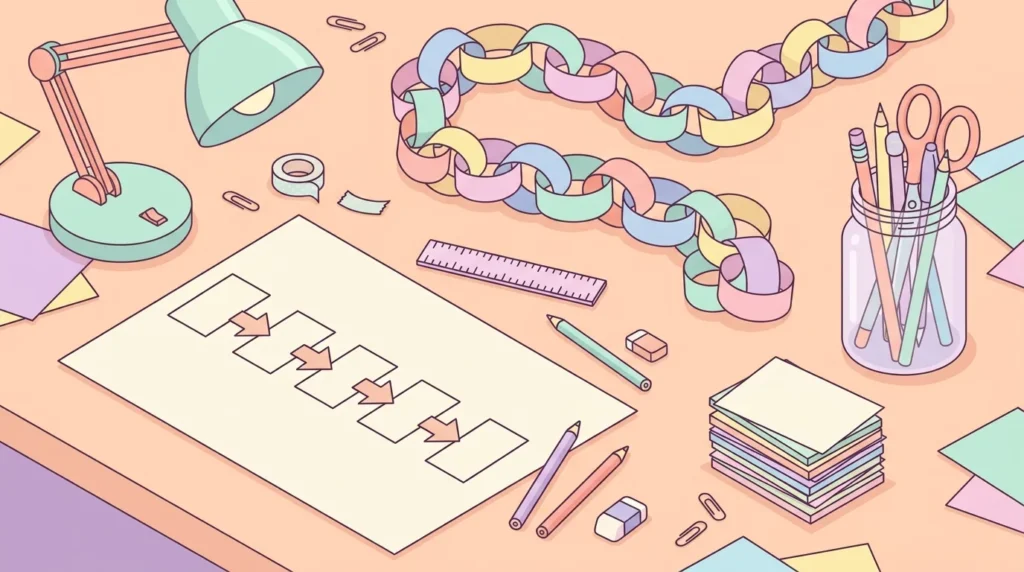
Cut strips of paper. On each strip, write the name of one living thing in a chain, such as grass, grasshopper, frog. Loop the strips through each other and tape them, in order, from the producer to the top consumer. The result is a food chain students can hold up. Add a strip that says sun at the start.
Arrow direction practice
Write each chain on a line of the board with the arrows missing. Students come up and draw the arrows, and then explain what each arrow means. Ask them to finish the sentence: “The arrow points to the living thing that gets the energy.”
Role sort cards
Write the names of living things on index cards, and put the role names (producer, primary consumer, secondary consumer, tertiary consumer, decomposer) on a second set. Students match each living thing to its role for a chosen habitat. Include one omnivore and discuss why it can fit in more than one role.
Build a chain for a habitat
Give small groups a habitat name, such as desert or ocean, and a pile of word cards that includes some that do not belong. Groups choose the cards that fit, put them in order and write a sentence that explains each link. Groups can then compare their chains and see which ones link up into a food web.
Practice material
Reading about habitats gives students more food chains to build. The animal habitats reading passages are a 64-page packet for grades 3 to 5 with 10 passages that explore biomes around the globe. For the ocean, the ocean animals reading passages are a 63-page packet for grades 2 to 4 built around ten marine stories and 200 questions. The tide pools reading passages cover marine ecosystems in 10 passages across 72 pages for grades 2 to 8, with text-dependent questions, a lesson plan and answer keys.
On land, the deserts reading passages explore the Sahara, the Gobi, desert adaptations, oases and cold deserts in 63 pages for grades 3 to 7. The rainforest animals reading passages cover sloths, toucans and jaguars across 63 pages for grades 1 to 5. To go further into how living things depend on each other, the symbiotic relationships reading passages teach mutualism, commensalism and parasitism, with questions and answer keys, across 62 pages for grades 3 to 7.
Life cycles are another way to look at the same habitats, and the post on the butterfly life cycle shows how to teach stages in order. When students read about a habitat, the reading comprehension strategies post has habits that help them pull out the facts they need.
Simple food chain for kids
Here is a food chain for kids in four short steps. Read it left to right: sun, then grass, then a grasshopper, then a frog.
- The sun gives energy to the grass.
- The grass is the producer. It makes its own food.
- The grasshopper is a consumer, because it eats the grass.
- The frog is also a consumer. It eats the grasshopper.
A consumer is an animal that has to eat other living things for food, because it cannot make its own. Producers are plants. Consumers are animals. Decomposers are mushrooms and bacteria that break down what is dead.
Consumer animals examples
| Role | What it eats | Examples |
|---|---|---|
| Primary consumer | plants | rabbit, cow, zebra, grasshopper, sloth |
| Secondary consumer | plant-eaters | fox, frog, small lizard, owl that eats mice |
| Tertiary consumer | secondary consumers | snake that eats a frog, hawk that eats a snake |
The same animal can sit in different places in different chains. An owl that eats a mouse is a secondary consumer. If the owl eats a snake that ate the mouse, it is a tertiary consumer.
Frequently asked questions
Do the arrows in a food chain point to the eater or the food?
They point to the eater. The arrow shows the direction the energy moves, so it goes from the living thing that is eaten to the living thing that eats it.
Is a decomposer part of the food chain?
Decomposers are usually shown beside the chain or at the end of it. They break down dead plants and animals and return nutrients to the soil, so the producers can use them again.
Can an animal be in more than one food chain?
Yes. Most animals eat more than one kind of food, and most are eaten by more than one kind of animal. That is why many chains join together into a food web.
What grade learns about food chains?
The reading packs listed below cover grades 1 to 8. Younger students can start with a three-link chain and arrow practice. Older students can work with consumer levels and food webs.
Is a sloth a producer, consumer or decomposer?
A sloth is a consumer. It eats mostly leaves, so it is a primary consumer. It cannot make its own food like a producer, and it does not break down dead things like a decomposer.
What is a consumer in a food chain for kids?
A consumer is any animal that gets its energy by eating. A rabbit that eats grass is a consumer, and so is the fox that eats the rabbit.