Alliteration Examples: Easy Sentences, Poems and Activities
These alliteration examples show how a repeated starting sound can make a line fun to say and easy to remember. You will find sentences, tongue twisters, poem lines, everyday phrases and a few tricky cases where the letter and the sound do not match.
What is alliteration
Alliteration is the repetition of the same beginning sound in words that sit close together. In “Kind Kira kept the cold cups in the cupboard,” nearly every important word starts with the same k sound. Read it aloud and you can hear the pattern straight away.
Two points are worth saying plainly before the lists begin:
- Alliteration is about sounds, not letters. The sound has to match, even when the spelling does not.
- The words do not have to touch. Small words such as a, the and of can sit between them without breaking the pattern.
Alliteration belongs to a group of devices that writers use to play with language. If you want to see it next to similes, idioms and the rest, our guide to figurative language examples puts all of them side by side. This post stays with alliteration and goes deeper into one device.
Alliteration examples in a sentence
Alliteration in a sentence is the easiest place to start. Here are twelve alliteration examples for students. In each one, the repeated sound is named at the end so students can check their ears against the answer.
- The busy bees buzzed beside the blue bucket. (b)
- Sam’s sister sewed six silly socks. (s)
- Two tall trees tilted toward the tent. (t)
- Fresh flowers filled the foggy field. (f)
- Rain rattled the roof of the red room. (r)
- Green grass grew in the grand garden. (g)
- Kind Kira kept the cold cups in the cupboard. (k)
- Dark dust drifted down the dim driveway. (d)
- The wind whistled while we waited. (w)
- Mia made a mighty mess of the muddy mat. (m)
- Pam painted a perfect picture of the pink planet. (p)
- Little Lena left a long letter on the ladder. (l)
Notice that none of these sentences repeats the sound in every single word. Words like the, of and a stay quiet, and that is normal. Most examples have three or more words that share the sound, and the stronger words in the sentence carry it.
Examples of alliteration with tricky sounds
This is where students most often slip. Alliteration follows the sound at the start of a word, so the first letter can mislead. Four cases are worth teaching one at a time.
Same letter, different sound
Cat and city both start with c, but cat begins with a hard k sound and city begins with an s sound. They do not alliterate. In the same way, goat and giraffe both start with g, yet the first has a hard g and the second has a j sound.
Different letters, same sound
Cat and kite start with different letters and the same k sound, so they alliterate. City and silly work together too, because both start with the s sound. Shoe and sugar are another pair: the sh sound is spelled differently, but it is the same sound.
Silent letters
The first letter of knight is silent, so the word starts with the n sound. That means knight, night and nine all alliterate. The same goes for wrist and rabbit, which both start with r.
Letter pairs that make one sound
Phone starts with the f sound, so it alliterates with fish and fun. Whale and wind both start with the w sound, because the h in whale does not add its own sound. Reading each sentence aloud, rather than silently, is the quickest way to catch these.
A short sentence for practice: “Nine knights needed a night’s rest.” The words nine, knights, needed and night’s all start with the n sound, even though one of them is spelled with a k.
Vowel alliteration
Words that start with vowel sounds can alliterate as well, but it is easier to get wrong because a single vowel letter makes several sounds. The short e sound, for example, appears in every, empty and elbow. A sentence that works: “Ellie’s elbow knocked every empty egg carton off the shelf.”
Compare that with the words apple, ape and arm. All three start with the letter a, but they start with three different sounds, so they do not alliterate. Start students with consonant sounds first, and bring in vowel sounds once the idea is secure.
Tongue twisters
Tongue twisters are alliteration with a challenge attached, which is why students like them. Three traditional ones:
- Peter Piper picked a peck of pickled peppers.
- She sells seashells by the seashore.
- Red leather, yellow leather.
The second one is a good sound lesson. She starts with the sh sound, while sells starts with the s sound, so the line mixes two different sounds that are close together. That mix is what makes it hard to say fast. In the first line, every p word starts with the same sound, so it is a cleaner example of alliteration.
Students can write their own twisters too. Pick one sound, list ten words that start with it, and then build a line with at least four of them. Here is one made up for this post: “Brave Brian brought blue bananas to the big barn.”
Alliteration in poetry and alliteration poems
Poets reach for alliteration because it gives a line a pattern the ear can follow. Here is a short poem written for this post. Read it aloud and listen for the s and w sounds.
- Silver snow slipped slowly down,
- Soft and still on sleepy town.
- Windows winked with warm, white light,
- While wind went whispering through the night.
The first two lines lean on the s sound and the last two lean on the w sound. Ask students to underline every word that carries each sound and then say how many they found. The first line has four s words (silver, snow, slipped and slowly), which makes a good check.
Published poets use the same tool. Edgar Allan Poe wrote “And the silken, sad, uncertain rustling of each purple curtain” in “The Raven,” where the s sound runs through silken and sad. Alfred, Lord Tennyson wrote “The moan of doves in immemorial elms, / And murmuring of innumerable bees,” where the m sound repeats through moan, immemorial, murmuring and innumerable. Both lines are old enough to be in the public domain, so students can read them in full from the original poems.
Not every poem uses alliteration, and a poem does not need it to be good. When a student finds it in a poem, the useful next question is why the writer might have wanted that sound there.
Alliteration in names and everyday phrases
Students meet alliteration long before they learn the word. It shows up in phrases they already say:
- busy as a bee
- safe and sound
- wild and wonderful
- dead as a doornail
- cool as a cucumber
- tried and true
- pretty please
- last but not least
Some of these are also similes, because they compare with the word as. That is fine: a phrase can use more than one device at once. Business names use the pattern too. Coca-Cola, Krispy Kreme and Best Buy all repeat their first sound, and the repetition makes the name stick.
A good class task is to collect alliterative phrases from home. Students bring in a few, and the class sorts them by sound and checks each one by saying it aloud.
Why writers use alliteration
Alliteration does a few jobs, and students can learn to name them:
- It gives a line a rhythm, which is why it turns up in tongue twisters, slogans and poems.
- It draws the eye and the ear to certain words, so the reader pays more attention to them.
- It can set a mood. A run of soft s and w sounds can feel quiet, while a run of hard k and t sounds can feel sharper.
The mood point is a matter of reading, not a fixed rule, so let students argue for what they hear. Two readers can disagree and both be right as long as they point to the words.
Alliteration, consonance and assonance
These three terms get mixed up because they all deal with repeated sounds. Here is the difference in one line each:
- Alliteration repeats the sound at the start of words: “Dark dust drifted down.”
- Consonance repeats a consonant sound anywhere in the words, often in the middle or at the end: “He crept past the dusty, rusty chest” repeats the st sound in past, dusty, rusty and chest.
- Assonance repeats a vowel sound: “Slow clouds rolled over the old road” repeats the long o sound in slow, rolled, over, old and road.
For most upper elementary students, alliteration is enough. The other two terms can wait until the class is comfortable with the first.
How to teach alliteration
These are some ways to do it. Choose what suits your class.
Sound sort
Write words on index cards, including a few traps such as cat, city, knight, phone and shoe. Students sort the cards by starting sound, not starting letter, and then explain any card that surprised them. The sort brings out the sound-versus-letter idea better than a definition does.
Sentence ladder
Give students a sound and ask for a two-word phrase, then a four-word phrase, then a full sentence, all with that sound. The ladder is gentle for students who find a blank page hard, because each rung only adds a little.
Read-aloud hunt
While reading a poem or a picture book aloud, ask students to raise a hand when they hear a repeated starting sound. Then write the words on the board and ask which sound it was. Choose a text with strong sound patterns, such as a poem full of s or w sounds.
Partner twisters
Pairs write a tongue twister, swap with another pair and try to read it without a stumble. If a line has a word that does not fit the sound, the listeners point it out. That job of finding the odd word out is good practice for spotting sounds.
Practice material for alliteration
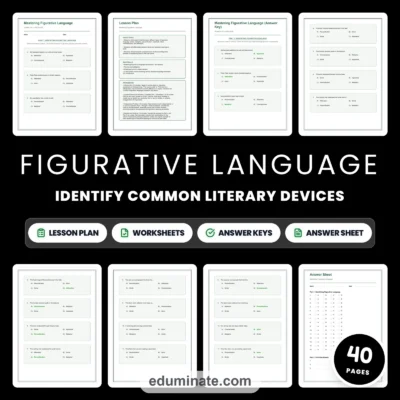
Once students can hear the pattern, written practice helps it settle. The alliteration and onomatopoeia worksheet set is a 40 page resource for grades 3 to 5, with a lesson plan, a student worksheet, an answer key and an answer sheet.
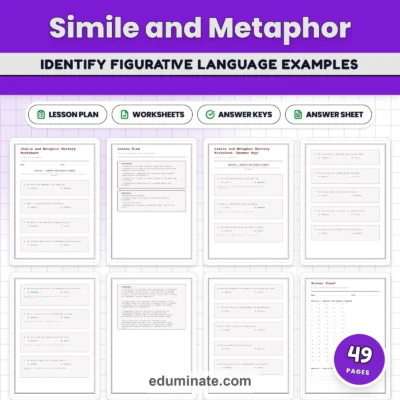
For a wider figurative language unit, the figurative language worksheets bundle has three packets: similes and metaphors, a wider set that includes personification and idioms, and alliteration and onomatopoeia. It runs 129 pages for grades 3 to 8. Older students can use the figurative language packet for middle school, which has 40 pages for grades 6 to 8, with a lesson plan, an answer key and 70 questions across 6 sections. The simile and metaphor worksheets are for grades 5 to 8, with identification, true or false, fill in the blank, meaning and short answer sections, plus an answer key and a lesson plan.
If you would rather have every grammar and ELA packet in one place, the complete grammar bundle has 32 packets and 1527 pages for grades 2 to 8.
Frequently asked questions
What is alliteration in simple words?
It is when two or more words close together start with the same sound, as in “big blue balloon.” Say it aloud and the repeated sound is easy to hear.
Does alliteration have to use the same letter?
No. It has to use the same sound. Knight and night alliterate even though one starts with k, and cat and city do not, even though both start with c.
How many words do I need for alliteration?
At least two words that start with the same sound. Most examples that students write use three or four, and the words are usually close together.
Do names count as alliteration?
Yes, when the first sounds match. Coca-Cola and Krispy Kreme are names that do this. The sounds have to match, so a name can only alliterate when its parts start with the same sound.