Personification Examples: 35 Sentences Sorted by Use

These personification examples show how a writer can give human actions and feelings to things that are not human, with more than 30 sentences sorted by what the thing is doing. After the sentences you will find lines from poems and stories described in plain words, ways to teach the device and a short practice set with answers.
What is personification?
Personification is a figure of speech in which a writer gives a human quality to something that is not human. The thing might be an object, a force of nature, a place or an idea. It might whisper, wander, groan, sulk or wait, even though a whisper or a sulk belongs to a person.
Here is a short personification definition students can copy into a notebook: personification gives human actions, feelings or speech to a non-human thing.
A quick example: “The wind whispered through the grass.” Wind cannot whisper, because whispering needs a mouth and a voice. The writer uses the human word to help the reader hear a soft, low sound. If you want to see how personification sits beside similes, metaphors, idioms and the other devices, our guide to figurative language examples puts them side by side. This post stays with one device so you can go deeper.
How to spot it
Ask two questions. First, is the subject of the sentence a non-human thing? Second, is it doing something only a person does? If both answers are yes, the sentence is personification.
Personification examples in sentences
The personification examples in sentences below are grouped by the kind of thing being described. Each one ends with the human action in brackets, which is the part students should learn to find. Feel free to copy any of them onto cards or slides.
Weather and nature
- The wind whispered through the tall grass. (whispered)
- The sun smiled down on the picnic tables. (smiled)
- Thunder grumbled across the sky. (grumbled)
- Storm clouds marched over the hills. (marched)
- Snow tucked the garden in for the night. (tucked in)
- The river wandered lazily to the sea. (wandered)
- The moon watched over the quiet town. (watched)
- Waves chased each other up the beach. (chased)
- Rain tapped on the window, asking to come in. (asking)
Objects and machines
- The old stairs groaned under our weight. (groaned)
- My alarm screamed at me this morning. (screamed)
- The car coughed twice and refused to start. (coughed, refused)
- The laptop sighed and went to sleep. (sighed)
- The door slammed shut as if it were angry. (angry)
- The kettle muttered on the stove. (muttered)
- The vacuum cleaner gobbled up the crumbs. (gobbled)
- The pencil raced across the page. (raced)
- The school bell called everyone back inside. (called)
Places and time
- The city never sleeps. (sleeps)
- The empty house waited for someone to come home. (waited)
- Night crept over the valley. (crept)
- Dawn tiptoed into the room. (tiptoed)
- Winter bit at our fingers. (bit)
- The old bridge stood proud above the river. (proud)
Food and household things
- The cookies begged to be eaten. (begged)
- The soup bubbled and gossiped on the stove. (gossiped)
- The cake in the window winked at us. (winked)
- My bed was calling my name. (calling)
- The suitcase yawned open on the floor. (yawned)
Feelings and ideas
- Fear crept up behind him. (crept)
- Opportunity knocked on her door. (knocked)
- Hunger gnawed at his stomach. (gnawed)
- Curiosity tugged at her sleeve. (tugged)
- Joy skipped through the hallway. (skipped)
- Silence filled the room and held its breath. (held its breath)
That makes 35 sentences. Notice that some of the same human verbs, such as skipped and crept, can be reused for very different subjects. That is a useful point for students who are stuck. A small stock of human verbs goes a long way.
Personification examples in poems and stories
Teachers often ask for examples of personification that come from real writing, not only from worksheets. Poets use personification to make an abstract idea feel close, and story writers use it to give a setting a mood. Short descriptions, in our own words, are enough to show students what to look for. Read the original poems aloud in class and let students find the lines themselves.
Personification in poems
- In Emily Dickinson’s poem “Because I could not stop for Death,” Death is a polite driver who stops his carriage for the speaker and takes her on a slow ride. Death cannot drive, so the poem treats an idea like a person.
- In Emily Dickinson’s poem about a railway train, the train is described like a hungry animal that laps up the miles and licks up the valleys. Trains do not eat or drink, but the words make the machine feel alive.
- In John Keats’s poem “To Autumn,” the season is addressed like a person who rests in the middle of the harvest work. Autumn has no hands or lap, yet the poem pictures it settled among the crops.
Personification in poems is often easy to find because the human verb sits near a very un-human subject. Ask students which word in the line is the human one.
Personification in stories
In prose, personification often appears in the scene setting. A writer might say that the house “creaked a warning” before a character enters, or that the sea “swallowed the last of the light.” The reader learns the mood without being told.
The picture-book classic The Little Engine That Could is a slightly different case. The small train engine thinks and speaks, which makes it a character with human traits. We cover that difference next.
Personification or a talking character?
Students often ask whether a talking toy or a thinking train counts. The short answer is that it can, but the cleanest examples are single lines inside an otherwise ordinary text, such as “the wind whispered.” In a story where a toy or an engine talks all the way through, the writer has created a character who behaves like a person, and teachers sometimes call that anthropomorphism. Both ideas give human traits to non-human things, so they are close cousins.
For a class activity, stick with the single-line kind. It is easier to find, easier to mark and easier to write.
How to teach personification
Here is one way to do it. Start with a single sentence on the board, ask what the thing is doing and then ask whether it could really do that. Keep the questions short and let students answer out loud before anyone writes.
Circle the human verb
Give pairs of students five sentences from the lists above. They circle the verb or adjective that belongs to a person and write the non-human subject beside it. A sentence such as “The kettle muttered on the stove” gives them kettle and muttered.
Rewrite it literally
Next, students rewrite the sentence with no personification. “The kettle muttered on the stove” becomes “The kettle made a low bubbling noise on the stove.” Putting both versions side by side lets students see what the human word added.
Sort the cards
Write a mix of personification and ordinary sentences on cards. Students sort them into two piles and defend the tricky ones. “The dog barked at the mail carrier” is ordinary because a dog really barks. “The doorbell shouted at the dog” is personification because a doorbell cannot shout.
Write your own
Give each student an object from the room and one human verb to pair with it. A stapler might “bite” and a window might “watch.” Ask them to build a full sentence and then add a second sentence that says what happened next.
Ready-made practice
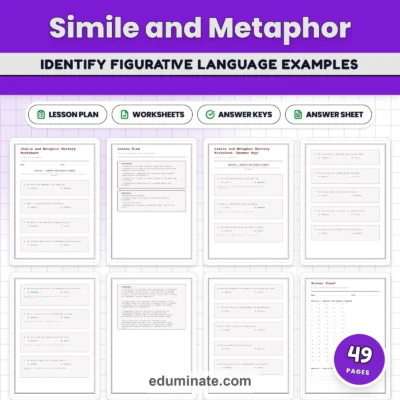
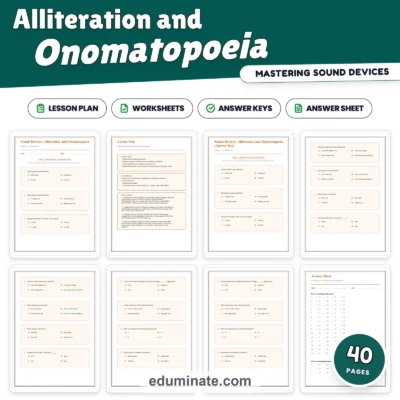
If you would rather not build every card yourself, a printable pack can carry some of the work. The Figurative Language Worksheets packet for grades 6 to 8 is a 40 page PDF with a lesson plan and answer key, and students work through 70 questions across 6 sections. Younger classes may prefer the Alliteration and Onomatopoeia Worksheets, a 40 page set for grades 3 to 5. For simile and metaphor practice next to it, there is the Simile and Metaphor Worksheets set, which has a full answer key and lesson plan.
The Figurative Language Worksheets Bundle holds three packets: similes and metaphors, a wider set with personification and idioms, and alliteration and onomatopoeia. It covers 129 pages. If you want every grammar and ELA packet in the shop in one download, the Complete Grammar Worksheets Bundle has 32 packets with answer keys.
Personification practice set with answers
Use this as a quick check. The first six items ask students to decide whether a sentence is personification. The last two ask them to write.
Questions
- The flowers nodded their heads in the breeze. Personification or not?
- The flowers were red and yellow. Personification or not?
- The oven groaned as it cooled. Personification or not?
- The dog barked at the mail carrier. Personification or not?
- Winter refused to leave. Personification or not?
- My bike is faster than yours. Personification or not?
- Rewrite without personification: “The mountain stood guard over the village.”
- Finish the sentence with a human verb: “The rusty gate ____ when I pushed it.”
Answers
- Personification. Flowers do not nod their heads like people.
- Not personification. It only describes color.
- Personification. An oven makes a noise, but groaning is a human sound of effort.
- Not personification. Dogs really bark.
- Personification. Winter cannot refuse anything.
- Not personification. It compares speed and gives no human trait to the bike.
- Answers will vary. One option: “The mountain rose above the village.”
- Answers will vary. Good choices include complained, groaned and protested.
Frequently asked questions
What is personification in simple words?
It is when a writer gives a human action or feeling to something that is not a person, such as “the sun smiled.”
How is personification different from a metaphor?
A metaphor says one thing is another thing, as in “The classroom was a zoo.” Personification keeps the thing as itself but gives it a human trait, as in “The classroom groaned at the noise.” Some lines can do both.
Does personification only appear in poems?
No. It shows up in stories, speeches and everyday talk. People say that a computer “is being stubborn” without thinking about it.
Can an animal be personified?
Only when it is given human traits it does not have. “The cat smiled” works as personification, while “the cat purred” does not, because a cat really purrs.