Alphabet Flashcards: How to Use Them in Class and at Home
FreeTry a printable pack for free first. No card needed.See free packs
Alphabet flashcards are cards that show one letter each, so young children can learn to name and recognize all 26 letters through short, repeated practice. They suit preschool, pre-K, kindergarten and first graders who are still building letter knowledge, and the best sets show a large uppercase letter beside its lowercase partner on a clean card with nothing else competing for attention.
Here are the main ways teachers use a set of letter cards:
- A five minute flash drill at morning meeting, one card at a time.
- Matching games where uppercase cards are paired with lowercase cards.
- A pocket chart sort that small groups can run on their own.
- An alphabet line across the top of a whiteboard or bulletin board.
- A small take-home set for extra practice with a parent.
In this article (9 sections)
What to look for in a set of alphabet flashcards
Not every card set helps equally. Before you print or buy, check four things.
- Both letter forms on each card. When a child sees the uppercase and lowercase letter together, there is nothing to flip over, and the link between the two forms builds with every drill.
- A clear, large letter. Small letters or crowded art make cards hard to read from the back of a rug.
- Few distractions. Some sets add a picture for each letter. Pictures are useful later for letter sounds, but for pure letter recognition a plain card keeps the child looking at the letter shape.
- A size that is easy to cut and handle. Several cards per page means one print run gives you a full class set.
Free alphabet flashcards
Many families search for free alphabet flashcards. At the time of writing, we do not have a free alphabet flashcard pack. If you need cards today, write one letter on each of 26 index cards, uppercase on top and lowercase below it. That takes about twenty minutes, and children can help by tracing the letters in marker. Our shop does have free packs on other topics, and a free pack takes an email address, which opens a free account and keeps the file in My Library.
Alphabet flashcard sets compared
The set most teachers start with is the Alphabet Flashcards Printable PDF. It has 103 pages and costs $11.99. Every card has a large uppercase letter on top and the matching lowercase letter beneath it. The cards sit on a clean white background with a colored border and small accents such as stars and flowers. There are no pictures of objects, animals or people on any card, so the only thing to learn on each card is the letter. The preview pages show four cards on each page, in several color styles, with red, orange, teal, green, blue, yellow and purple letters. It lists grades Pre-K to 1st, and the A4 file prints on US Letter with Fit to page.
Two other packs work well beside it:
- The Alphabet and Number Posters pack has 43 pages and costs $5.99. It has 41 black and white posters for tracing letters and the numbers 0 to 9, with dashed lines and starting guides. Use it when children are ready to move from naming letters to writing them. It lists Pre-K to 1st grade and prints on US Letter with Fit to page.
- The Sight Words Flashcards pack has 70 pages and costs $8.99, with 4 to 12 word cards on each page. It lists kindergarten to 1st grade, and it is the natural next step once a child knows most letters.
Getting four flashcard sets in one download
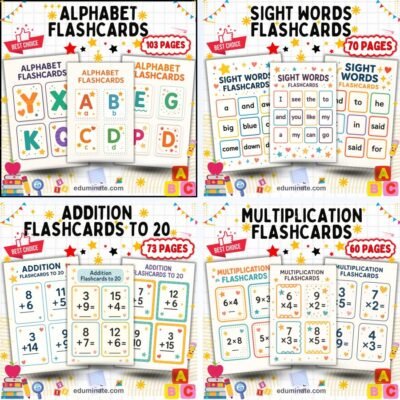
The Alphabet Flashcards PDF Bundle holds four sets in one download: the 103 page alphabet cards, the 70 page sight words cards, 73 pages of addition flashcards and 60 pages of multiplication fact flashcards. That is 306 pages in all for $28.47, while the four packs add up to $37.96 when bought separately, so you save $9.49, or 25 percent. The bundle lists Pre-K to 4th grade, so one purchase can cover a school year of flashcard routines as children move from letters to words to number facts.
Ways to use letter cards in class
The five minute flash drill
Hold up one card at a time and ask the class to name the letter together. Keep the pace steady and move on quickly, because a drill works best when it is short and happens every day. When the class is confident, let a child hold the cards and lead. Children who can name every card can try the lowercase side only, or a mixed pile of both forms.
Letter matching
Print two copies of the same color style. Cut the cards apart, then make one pile of uppercase letters and one of lowercase. Children match each pair and say the letter name as they place it. This works in pairs at a center and needs no help from the teacher once the routine is set.
The pocket chart sort
Mix a handful of cards in a pocket chart and ask a small group to sort them. You can sort by uppercase and lowercase, by color of the border, or by letters in a child’s name. Start with six or eight letters, then add more as the group gets confident.
An alphabet line
Pin all 26 cards in order along a bulletin board or whiteboard ledge. Point to each letter during the morning routine, and invite a child to be the pointer. Seeing the full alphabet every day helps children learn the order, and it gives them a reference to check when they write.
Take-home practice
Send home a small set of the letters a child finds hard. Parents can run a two minute drill in the car or while dinner cooks. Keep the set small, perhaps five letters, so the task feels easy to finish.
Games that need nothing else
- Memory match. Lay out eight cards face down, four uppercase and four lowercase, and let children turn two at a time to find a pair.
- Letter hunt. Hide five cards around the room and ask children to find them, then name each one.
- Name builder. Give a child the cards for the letters in their own name and ask them to put the cards in order.
- Mystery letter. Hold a card behind your back and give clues, such as one straight line and two short lines. Children guess the letter.
- Trace and say. Place a card beside a blank page. The child names the letter, then writes it.
Tips for younger learners
Do not start with all 26 letters. Teach five or six at a time, and add new ones only when the earlier ones come quickly. A child who knows the letters in their own name already has a good start, so begin there. Pair the cards with plain movement: ask children to trace the letter in the air, or write it in a tray of sand or salt. Cutting the cards apart is also good fine-motor work for older preschoolers, and our guide to alphabet tracing worksheets shows how to follow naming practice with writing practice.
Keep sessions short. Three to five minutes of drill is plenty for a four year old. Praise effort rather than speed, and put aside the cards a child already knows so the pile in their hand always holds letters worth practicing. When a letter keeps slipping, say its name, show where it starts, and come back to it the next day.
Getting the cards ready
Ordinary copy paper works, but a heavier paper lasts longer in a busy center. If you can, laminate the sheets before you cut them, then round the corners so small hands are not scratched. Store each color style in its own zip bag or envelope, and label the bag so a helper can find it. Print one master set for the teacher and keep a second set for children to handle, so the master stays in good shape for the next class.
Frequently asked questions
What grades are alphabet flashcards for?
The 103 page set lists Pre-K to 1st grade. Preschoolers use the cards to learn letter names, kindergarteners use them to speed up recall, and first graders who need extra support can use them beside a phonics lesson.
Do the cards show uppercase and lowercase letters?
Yes. Each card in the alphabet set shows the large uppercase letter and the matching lowercase letter on the same card.
Do the cards have pictures?
No. They carry only the letter and a few simple accents such as stars and flowers. That keeps attention on the letter shape, which fits programs that teach letters before letter-picture links.
Can I print them on US Letter paper?
The product page says the A4 file prints on US Letter with Fit to page. Print one page first to check that the cards come out at the size you want.