Figurative Language Examples: Types, Idioms and Practice

Figurative language examples show students how a writer can say something without meaning the words exactly as they are written, and this guide gives clear ones for each kind. It also covers a list of idioms with meanings, sound words, an anchor chart and four ways to practice.
Figurative language examples
Literal language says exactly what it means. Figurative language uses words in a way that goes beyond their plain meaning, so the reader has to picture or interpret what is being said. Here is a pair of sentences:
- Literal: She ran very fast.
- Figurative: She ran like the wind.
Nobody thinks the runner is made of air. The second sentence gives a stronger picture than the first. That is what figurative language does: it adds color, humor or feeling, and it helps a reader see an idea in a new way.
Types of figurative language
There are many kinds. These seven make a good starting set:
- Simile: compares two different things using like or as.
- Metaphor: says one thing is another to make a comparison.
- Personification: gives human actions or feelings to something that is not human.
- Hyperbole: a deliberate exaggeration that is not meant literally.
- Idiom: a phrase whose meaning is different from the meanings of its words.
- Alliteration: words close together that begin with the same sound.
- Onomatopoeia: a word that imitates a sound.
Similes and metaphors are easy to confuse with each other, and the post on simile vs metaphor sorts them out. The rest of this guide covers the other five.
Personification examples
Personification gives human actions to things that are not human. These personification examples each give a human action to something that cannot do it:
- The wind whispered through the tall grass.
- The old car coughed and then refused to start.
- The door groaned as it opened.
- The flowers nodded in the breeze.
- The stars winked at us from the dark sky.
A quick check: ask whether a person could do that action, and whether the thing in the sentence really can. A wind cannot whisper the way a person does, so the sentence is personification.
Personification is easy to mix up with plain description. “The wind blew hard” describes what wind really does, so it is literal. “The wind howled” gives the wind a voice, so it is figurative. Ask students to find the verb in each sentence and decide whether that verb belongs to a person, a thing or both. They can then write their own, starting with a classroom object, such as “The pencil sharpener groaned.”
Hyperbole examples
Hyperbole is deliberate exaggeration. The writer does not expect anyone to take it literally. The reader understands that the point is how strong the feeling or the size is.
- I have told you a million times to close the door.
- This backpack weighs a ton.
- I am so hungry that I could eat the whole cafeteria.
- She has a mountain of homework tonight.
- It took forever for the bus to come.
Hyperbole often relies on extreme words and numbers, such as million, forever, ton and mountain. Students can underline the word that stretches the truth in each sentence. It also helps to point out that hyperbole can make a sentence funny, dramatic or emphatic, depending on the topic.
These hyperbole examples can be turned into a quick game: ask students to say what the real, smaller fact probably is. The bus was probably late, not gone for all of time.
What is an idiom
An idiom is a phrase whose meaning is not the meaning of its words taken one by one. If you put the words together literally, you get the wrong idea. Idioms have to be learned as whole phrases, because the individual words will not give the meaning away.
Take “a piece of cake.” The words name a slice of dessert, but the idiom means something is very easy. “The spelling quiz was a piece of cake” does not mean the quiz was made of cake.
When a student meets an idiom in a story, a few steps can help. First, ask whether the literal meaning makes sense in the sentence. If it does not, look at the sentences around it for clues. Then say what the phrase must mean in plain words. A student who reads “Leo was under the weather and stayed home” can see that Leo is not standing in rain. The clue is that he stayed home, which points to feeling sick.
Common idioms
Idioms examples are easier to remember when each one comes with a plain meaning. Here is a list of idioms with their plain meanings:
- Under the weather: feeling a little sick.
- Spill the beans: to reveal a secret.
- Break the ice: to start a conversation so people feel more at ease.
- Hit the books: to study hard.
- Once in a blue moon: very rarely.
- Cost an arm and a leg: to be very expensive.
- Bite the bullet: to face something unpleasant with courage.
- Beat around the bush: to avoid saying something directly.
- Cut corners: to do a job in the quickest or cheapest way, often with lower quality.
- Back to square one: to start again after a plan did not work.
- Burn the midnight oil: to work late into the night.
- Get cold feet: to become too nervous to go through with something planned.
Pick two or three idioms a week and use them in sentences. A good routine is to have students write what the idiom says word for word on one line and what it means on the next line. Add a note when students have seen the idiom in their reading.
Alliteration examples
Alliteration is the repeating of the same beginning sound in nearby words. It is about sounds, not letters. That difference matters:
- Knight and nest alliterate, because both start with the n sound, even though one starts with the letter k.
- Phone and fancy alliterate, because both start with the f sound, even though one starts with the letters ph.
- Cat and city start with the same letter but do not alliterate, because cat starts with a k sound and city starts with an s sound.
Here are five alliteration examples to read aloud:
- The wild wind whipped the window.
- The busy bakers baked big batches of bread.
- A fancy phone fell from the floor.
- Seven slippery stones sank slowly.
- The knight nodded at the neat nest.
Reading them aloud lets students hear the repeated sound. Alliteration is common in names, titles and slogans, so students can look for it on book covers and in the headlines they see. To write their own, they choose one starting sound, list five words that begin with it, and build a sentence from the list.
Onomatopoeia examples
Onomatopoeia is a word that sounds like the thing it names. Here are five onomatopoeia examples in sentences:
- The bees buzzed around the flowers.
- The door slammed shut with a loud bang.
- Raindrops went pitter-patter on the roof.
- The eggs sizzled in the pan.
- The boxes fell to the floor with a thud.
Some sound words are repeated or joined, as in pitter-patter and tick-tock. Others are single words, such as buzz and thud. Ask students to say each word aloud in a way that matches the sound, because the sound is the point.
A list of onomatopoeia words
This list of onomatopoeia words gives twelve to start with: buzz, bang, splash, sizzle, crash, hiss, thud, click, boom, drip, crunch and pop. Students can add words from their own reading and sort them by the kind of sound: water, impacts, food or machines.
Figurative language anchor chart
A figurative language anchor chart gives students one place to look when they meet a phrase they do not understand. Build it with the class, a row at a time, as each type is taught. Each row can have three parts:
- The name of the type, for example personification.
- A one-line meaning in the class’s own words.
- One example, ideally one the students found or wrote.
Keep the wording short, since students will read the chart from their seats. Use one color for the type names and another for the examples so that the rows are easy to scan. Leave extra room on the chart. When a student finds a new example in a book, the example goes on a sticky note under the right row.
Ways to practice
Sort sentence cards by type
Write one example sentence on each card and give a small set to each group. Groups sort the cards under headings such as personification, hyperbole, idiom, alliteration and onomatopoeia. Ask them to explain how they decided.
Literal or figurative
Read two sentences that use the same words in different ways, and ask students to say which one is literal. For example: “She hit the books after dinner” and “She hit the books off the shelf with her elbow.” The first is an idiom for studying. The second is literal.
Rewrite a plain sentence
Give a plain sentence, such as “The storm was loud,” and ask students to rewrite it using one chosen type. One student might write “The thunder grumbled like an old engine.” Others might choose hyperbole or onomatopoeia.
Find examples in a read-aloud
Choose a short passage and read it aloud. Students raise a finger or jot a note when they hear figurative language. Afterward, they name the type and say what the words really mean. The ideas in the post on reading comprehension strategies pair well with this kind of read-aloud.
Practice material
The Figurative Language Worksheets Bundle is for grades 3 to 8. It holds three packets: similes and metaphors, a wider set with personification and idioms, and alliteration and onomatopoeia. It has 129 pages and is 20% off the separate prices.
The packets that cover one area at a time are:
- For grades 6 to 8, the Figurative Language Worksheets packet for middle school has 40 pages, a lesson plan and an answer key. Students work through 70 questions across 6 sections.
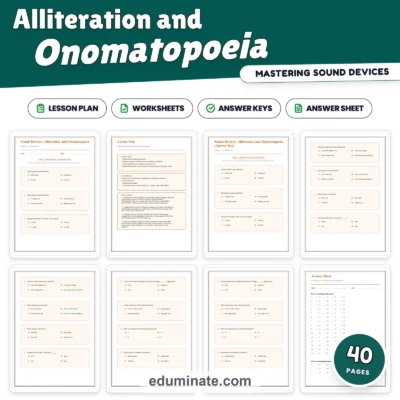
- For grades 3 to 5, the Alliteration and Onomatopoeia Worksheets set has 40 pages, with a lesson plan, student worksheet, answer key and answer sheet.
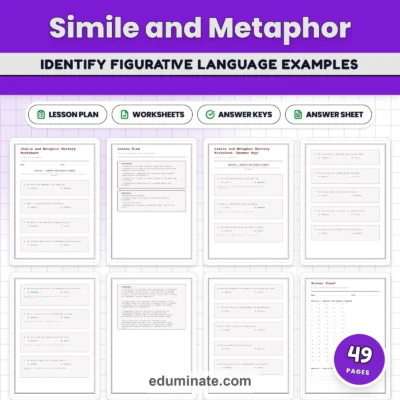
- For grades 5 to 8, the Simile and Metaphor Worksheets have identification, true or false, fill in the blank, meaning and short answer sections, plus a full answer key and lesson plan.
Teachers who want every grammar and ELA packet in one download can look at the Complete Grammar Worksheets Bundle. It has 32 packets covering punctuation, nouns, verbs, word study, voice, reported speech, figurative language and the parts of speech, in 1527 pages at 35% off the separate prices.
Frequently asked questions
Is an idiom a metaphor?
Not exactly. Many idioms began as picture-like phrases, but an idiom is a fixed phrase whose meaning cannot be worked out from its words. A metaphor says one thing is another to make a comparison, and the writer can build a new one on the spot.
Can a sentence use two kinds of figurative language?
Yes. “The thunder grumbled like an old engine” uses personification, because thunder cannot grumble, and a simile, because it compares thunder to an engine with the word like.
Is hyperbole the same as lying?
No. A lie is meant to be believed. Hyperbole is meant to be understood as an exaggeration, and both the writer and the reader know the words are not literal.
What grade learns figurative language?
The packs mentioned here cover different ranges. The alliteration and onomatopoeia set is for grades 3 to 5, the simile and metaphor set is for grades 5 to 8, the middle school packet is for grades 6 to 8, the figurative language bundle is for grades 3 to 8, and the full grammar bundle covers grades 2 to 8.