Hyperbole Examples: 40 Sentences for Class, by Use
These hyperbole examples show how a writer stretches the truth on purpose to make a point, with 40 sentences sorted by the situation they describe. You will also find tall tales and poems described in plain words, a few ways to teach the device and a short practice quiz with answers.
What is hyperbole?
Hyperbole is a figure of speech that exaggerates on purpose. The writer says something is bigger, faster, hotter, older or more extreme than it could really be. The goal is to add emphasis or humor, not to fool anyone.
The word is pronounced hy-PER-buh-lee, with four syllables and a silent final e. Say it aloud once with the class and the spelling makes sense.
Here is a definition that fits on an anchor chart: hyperbole is a deliberate, obvious exaggeration used to stress a point. If you want to see hyperbole beside similes, metaphors, idioms and personification, our guide to figurative language examples compares all of them. This post stays with hyperbole and goes deeper.
A simple test
Ask two questions. Could this really be true? Would the speaker and the listener both know it is not literal? If the answers are no and yes, it is hyperbole. “I have a ton of homework” passes the test, since nobody believes the homework weighs two thousand pounds.
Hyperbole examples in sentences
The hyperbole examples in sentences below are grouped by what the speaker is exaggerating. Each group is a handy set for cards, bell ringers or a slide. The exaggerated part is explained in brackets.
Hunger and food
- I’m so hungry I could eat a horse. (an impossible amount of food)
- I’m starving. (hungry, but not close to starving)
- This sandwich is bigger than my head. (size)
- The cake was so sweet it made my teeth ache for a week. (effect)
- She drank a gallon of water after the race. (amount)
- That soup was hot enough to melt a spoon. (heat)
Size, weight and amount
- My backpack weighs a ton. (weight)
- I have a million things to do today. (number)
- Her suitcase was the size of a house. (size)
- He has a mountain of homework. (amount)
- The line stretched all the way to the moon. (length)
- There must be a billion stars out tonight. (number)
- That book is as thick as a brick wall. (thickness)
Time and waiting
- I have been waiting here forever. (time)
- The movie lasted a hundred years. (length)
- I’ll be back in two seconds. (speed)
- This clock must be broken, because the minute hand has not moved in an hour. (time)
- It took ages to find my other shoe. (time)
- The test went on for a thousand years. (length)
Weather
- It’s so hot the sidewalk could fry an egg. (heat)
- It was so cold my words froze in the air. (cold)
- It’s raining buckets out there. (amount of rain)
- The wind blew so hard it nearly carried my hat to the next state. (strength)
- The fog was so thick you could cut it with a knife. (thickness)
- I think we got a foot of rain in ten minutes. (amount)
Feelings and effort
- I’m so embarrassed I could die. (feeling)
- I’m dying of boredom. (feeling)
- She was so happy she could fly. (feeling)
- I’d give anything for a nap. (desire)
- I’m so tired I could sleep for a week. (tiredness)
- My brain is fried after that test. (tiredness)
Speed and skill
- She runs faster than lightning. (speed)
- He is so strong he could lift a car. (strength)
- That joke was so old it had dust on it. (age)
- Her handwriting is so small you need a microscope. (size)
- The bus zoomed past at the speed of light. (speed)
- I’ve told you a million times to close the gate. (number)
Notice that numbers such as a million, a billion and a thousand are common tools of hyperbole. So are words such as forever, always and never.
Everyday sayings
- It cost an arm and a leg. (price)
- Everyone and their cousin was at the game. (crowd)
- I could do this in my sleep. (ease)
Hyperbole in literature, poetry and tall tales
Writers have used exaggeration for a very long time, and good examples of hyperbole turn up in plays, poems and folk tales. Short descriptions in our own words show students that hyperbole belongs to books and poems, not only to jokes at lunch.
Hyperbole in poetry
- In Shakespeare’s play Macbeth, the guilty Macbeth asks whether all the oceans could wash the blood from his hand. He then says his hand would rather turn the seas red. The size of the claim shows how heavy his guilt feels.
Hyperbole in poetry usually comes with big images such as seas, mountains and stars. Ask students which image is the impossible one and what feeling it carries.
Hyperbole in tall tales
Tall tales are close to a whole genre of exaggeration. In the stories told about Paul Bunyan, the lumberjack is so huge that his footprints are said to have turned into lakes. In stories about Pecos Bill, the hero is said to have ridden a tornado as if it were a horse. These details are not meant to be believed. They are meant to make the hero larger than life.
Asking students to invent a tall-tale hero is a lively way to finish a unit. The only rule is that each sentence must be bigger than the last.
Hyperbole vs understatement
Hyperbole has an opposite called understatement. Hyperbole makes something sound bigger than it is. Understatement makes something sound smaller than it is. After a blizzard that has closed the roads, someone might say, “It is a bit chilly out there.” That is understatement, and it often sounds dry or funny.
A short pair makes the difference clear. “I’m so hungry I could eat a horse” is hyperbole. “I could use a snack” said by someone who has not eaten all day is understatement. Both are on purpose, and neither is a lie.
It also helps to separate hyperbole from a plain mistake. A student who writes “There were 5,000 people in our class” by accident has made an error. A student who writes it as a joke, knowing the class holds twenty-five, has used hyperbole. The difference is intent.
How to teach hyperbole
Here is one way to do it. Keep the lesson light, since the device is meant to be fun.
Literal or exaggerated?
Read a sentence aloud and ask students to hold up a card: true or exaggerated. Mix real statements (“My bag has three books in it”) with hyperbole (“My bag has a hundred books in it”). The quick pace keeps everyone involved.
Turn it down
Give students a hyperbole and ask them to rewrite it as a plain sentence. “I’m so tired I could sleep for a week” becomes “I am very tired.” Then ask which version they would rather read in a story and why.
Turn it up
Reverse the exercise. Hand out dull sentences such as “The line was long” and ask students to stretch them: “The line was so long it had its own weather.” The best versions are specific and a bit absurd.
Find it in a text
Give pairs a short passage and ask them to underline any line that could not be literally true, then explain what feeling or fact it stresses. Poems and tall tales are good sources.
Ready-made practice
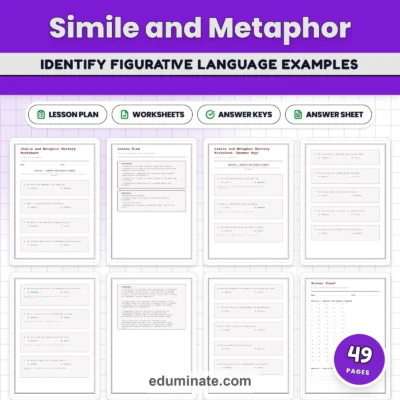
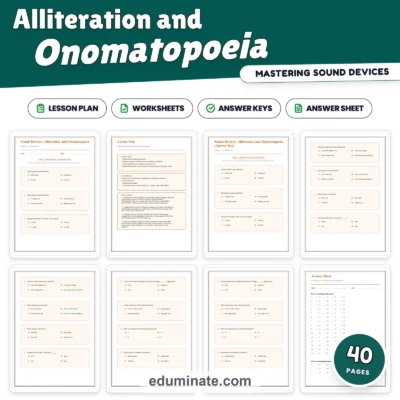
If you want printable support, the Figurative Language Worksheets packet for grades 6 to 8 is a 40 page PDF with a lesson plan and answer key. Students work through 70 questions across 6 sections. The Simile and Metaphor Worksheets have identification, true or false, fill in the blank, meaning and short answer sections, plus a full answer key and lesson plan. For grades 3 to 5, the Alliteration and Onomatopoeia Worksheets set is 40 pages with a lesson plan, student worksheet, answer key and answer sheet.
The Figurative Language Worksheets Bundle gathers three packets, covering similes and metaphors, personification and idioms, and alliteration and onomatopoeia, in 129 pages. These packs cover other devices, so use them alongside the hyperbole sentences in this post. The Complete Grammar Worksheets Bundle holds 32 packets if you want the whole grammar and ELA set in one download.
Hyperbole practice quiz with answers
Use these as a short check. Items 1 to 6 ask whether the sentence is hyperbole. Items 7 and 8 ask students to write.
Questions
- I have told you a million times. Hyperbole or literal?
- I have told you twice. Hyperbole or literal?
- She is so tall she touches the clouds. Hyperbole or literal?
- The lunch line had twenty students in it. Hyperbole or literal?
- This bag weighs a ton. Hyperbole or literal?
- It was raining hard all afternoon. Hyperbole or literal?
- Rewrite as a plain sentence: “I’m so tired I could sleep for a year.”
- Write a hyperbole about a long walk to school.
Answers
- Hyperbole. A million times is a deliberate exaggeration.
- Literal. It gives a small, real number.
- Hyperbole. No one can touch the clouds.
- Literal. It is a plain count.
- Hyperbole. A bag cannot weigh a ton.
- Literal. Hard rain is a normal description.
- Answers will vary. One option: “I am very tired.”
- Answers will vary. One option: “The walk to school took so long that my shoes wore out on the way.”
Frequently asked questions
What is hyperbole in simple words?
It is a big exaggeration used on purpose, such as “I’m so hungry I could eat a horse.” Everyone knows it is not meant literally.
Is hyperbole the same as lying?
No. A lie tries to make someone believe something false. With hyperbole, the speaker and the listener both know the statement is stretched.
How is hyperbole different from a simile?
A simile compares two things using like or as. Hyperbole exaggerates. A line can do both: “He runs like lightning” is a simile that also exaggerates his speed.
What is the opposite of hyperbole?
The opposite is understatement, which makes something sound smaller or milder than it really is.