Insect Worksheets for Grades 1 to 6: Reading and Science
FreeFree printable for this topic: Bat Conservation Reading Comprehension Passages and Printable Science PacketGet it free
Insect worksheets give students a close look at how insects live, grow and help the world around them, usually through short nonfiction passages followed by questions. They suit grades 1 to 6, and the best sets pair clear science reading with an answer key, a few question styles and a lesson plan so you can teach a full unit without extra prep.
Here are the topics you can cover with the packs below:
- The butterfly life cycle, from egg to caterpillar to chrysalis to adult.
- Ant colonies, with tunnels, jobs and shared work.
- Honey bees, hive roles and how pollination works.
- The difference between an insect and a spider.
- Helpful insects such as ladybugs, and why we need insects at all.

In this article (9 sections)
What to look for in insect worksheets
A worksheet set earns its place when it teaches both science and reading. Check four things.
- Real nonfiction passages. Students should read facts, not just color or match pictures.
- A range of question types. Multiple choice, true or false and vocabulary tasks test the same passage from different angles.
- An answer key. It saves time and lets students self-check.
- A lesson plan. It tells a new teacher or a substitute how to run each passage.
Every single pack below includes all four, and each lists an A4 file that prints on US Letter with Fit to page.
Insect worksheet packs compared
- The Insects Worksheets: Reading Comprehension Passages pack has 64 pages and costs $7.99. It lists grades 1 to 5. It has 10 passages, with a 41 page worksheet, a 22 page answer key and a one page lesson plan. The passages cover the butterfly, busy ants, the ladybug, honey bees, grasshoppers and crickets, the question of whether a spider is an insect, the praying mantis, fireflies, the dragonfly and why we need insects. It is the widest single pack, so start here for a general insect unit.
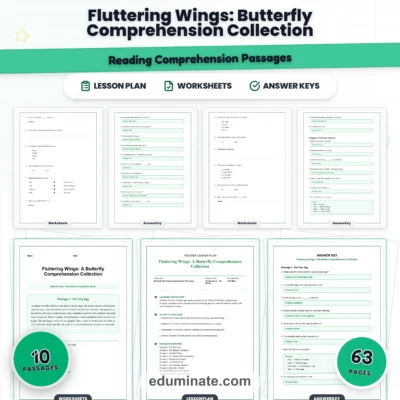
- The Butterfly Reading Comprehension Passages pack for grades K to 5 has 63 pages and costs $7.99. It has 10 passages and 40 worksheet pages, plus a lesson plan and a 22 page answer key. The passages follow the tiny egg, the hungry caterpillar, colorful wings, metamorphosis inside the chrysalis, camouflage, monarch travel over long distances and the differences between butterflies and moths.
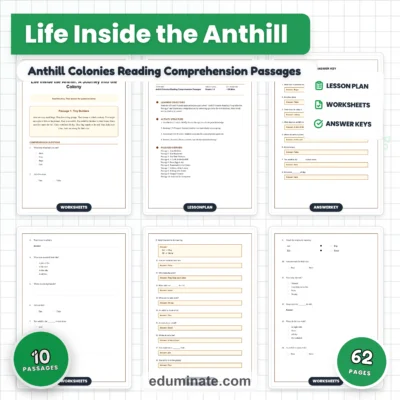
- The Ants Worksheets: Anthill Colonies pack has 62 pages and costs $7.99. It lists grades 1 to 5, with ten ant stories, 40 student worksheet pages, a lesson plan and a 21 page answer key.
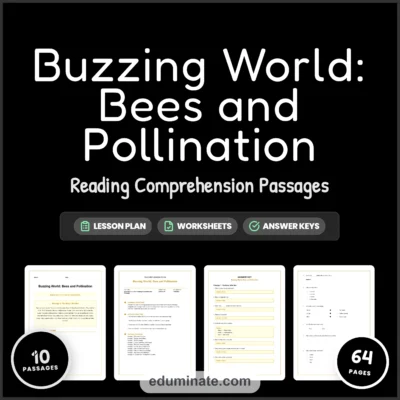
- The Bees and Pollination Reading Comprehension Passages pack has 64 pages and costs $7.99. It lists grades 2 to 6. Its ten passages explore worker bees, honey production, hive family structure, flower nectar, how bees communicate, solitary bees, crop pollination and pollinator habitat loss. It has 40 worksheet pages and a 23 page answer key.
The insects reading bundle
The Insects Reading Comprehension Bundle holds nine reading packets in one download: 570 pages in 27 PDF files, for grades K to 6, at $50.34. The nine are beekeeping, bees, ants, bees and pollination, honey production, insects, two butterfly packs and spider webs. Bought one by one they add up to $71.91, so the bundle saves $21.57, or 30 percent. It makes sense for a school science team or a teacher who wants a full year of insect units across several grades. For a single class unit of two or three weeks, one or two single packs are enough.
How to teach an insect unit
Start with what children already know
Ask the class to name an insect and one thing it does. Write the answers on the board. Then ask whether a spider belongs on the list. The question hooks students, and the Insects pack has a passage that answers it by comparing six legs with eight legs.
Read one passage a day
Each pack has ten passages, which fits a two week unit well. On day one, read the passage aloud while students follow along. Ask them to underline one new word. Then let them answer the questions alone or in pairs. Check the answers with the key at the end of the lesson.
Use the questions to teach evidence
Ask students to point to the sentence that supports each answer. This habit of finding text evidence helps in every subject, and the nonfiction format makes it easy to practice. For true or false questions, ask students to fix a false statement so that it becomes true.
Build a life cycle chart
After the butterfly passages, give students a paper plate or a plain sheet and ask them to draw the four stages in a circle: egg, caterpillar, chrysalis and adult. Add an arrow between each stage and a short sentence. Then compare the butterfly cycle with a bee or an ant, and ask which stages are the same.
Take the lesson outdoors
If the weather allows, take a short walk around the school grounds with a notebook. Ask students to look under leaves and along fences for insects. They sketch what they see and count legs and body parts. Insects have six legs and three body sections, so students can check each find against what they read. Remind children to watch quietly and leave the insects where they are.
Words worth teaching in a science unit
An insect unit is a good moment to build science vocabulary. Write a word wall before you start and add to it each day. Useful words include egg, larva, chrysalis, adult, colony, hive, nectar, pollen, antenna and thorax. Ask students to use each new word in a spoken sentence before they write it. The passages repeat many of these terms, so children meet the same word in different settings, which helps it stay in memory. Keep the wall low enough for children to read it while they work, and let them add a drawing next to any word they find hard.
Supporting different readers
A mixed class often holds students who read well above and well below grade level. The packs list a wide grade range, so you can choose a level to fit. Read aloud for the whole class on day one, then let strong readers work alone while you sit with a small group. Children who find reading hard can listen to the passage first, answer the multiple choice questions orally, and write only one answer. Strong readers can write a short summary of the passage in two sentences, or find the sentence that gives the best reason for a true or false answer. Using the same passage for everyone keeps the class discussion shared, even when the tasks differ.
Which pack for which grade
Grades 1 and 2
Choose the Insects pack, the Ants pack or the Butterfly K to 5 pack. Read the passage together and let children answer in pairs. Draw the life cycle as a class.
Grades 3 to 5
Any of the packs fits. Ask students to work alone, then compare answers with a partner. The Bees and Pollination pack, which lists grades 2 to 6, suits strong readers in this range.
Grade 6
Only the Bees and Pollination pack and the bundle list grade 6. Use the topics of crop pollination and habitat loss to start a discussion about how people and insects depend on each other. This links well to our guide on ecosystem worksheets, where students look at food webs and shared habitats.
Early finishers and extension
- Write a short fact card about one insect, with a drawing.
- Compare two insects in a table: legs, wings, food and home.
- Write three questions about an insect that the passage does not answer.
- Draw a food web that includes a plant, an insect and a bird.
- Make a class book called Why We Need Insects, with one page from each child.
Frequently asked questions
What grades do the insect worksheets suit?
The Insects pack and the Ants pack list grades 1 to 5. The Butterfly pack lists grades K to 5. The Bees and Pollination pack lists grades 2 to 6. The bundle lists grades K to 6.
Do the packs include answer keys?
Yes. Each single pack lists an answer key, and the lesson plan comes in the same download.
Are these worksheets or reading passages?
They are both. Each pack has ten nonfiction passages with question pages. The questions use multiple choice, true or false and vocabulary tasks.
Which pack should I try first?
For a general insect unit, the Insects pack gives the widest range of topics in one download. If your class loves butterflies or bees, pick the pack on that topic instead.