Healthy Habits Posters for Classroom and Home
Healthy habits posters work when each habit gets a big picture and a short phrase that children can read from across the room. The sets below show habits such as wash hands, brush teeth, drink water and get enough sleep, and every page is ready to print and hang.
These are the habits most classroom health posters cover:
- Eating: fruits and vegetables, a healthy breakfast, plenty of water.
- Body care: brushing teeth and washing hands.
- Rest: enough sleep.
- Movement: exercise, an active game, time outside.
- Mind: reading books and staying positive.
In this article (11 sections)
- What makes a healthy habits poster work
- Healthy Habits Posters: the main set
- Healthy Habits Flashcards: the card version
- Six poster and card sets in one download
- Free options for health topics
- Where to put healthy habits posters
- Classroom activities with the posters
- Teaching tips for habits
- Making the posters last
- Working with families
- Frequently asked questions
What makes a healthy habits poster work
A poster fails when children walk past it without seeing it. Three things help. First, put it where the habit happens: the wash hands poster goes next to the sink, and the sleep poster goes in the reading corner or in a bedroom at home. Second, keep the words short, since a child who is just learning to read can manage “Drink Water” but not a paragraph. Third, change it often. A new poster each week gives you a reason to talk about health again, and children enjoy finding the same habit in a different picture the next time.
Healthy Habits Posters: the main set
The Healthy Habits Posters pack costs $7.99 and is listed for all grades. It is a single PDF of 64 pages: a name page, 60 poster pages, and two closing pages with a thank you note and copyright information. The pages are A4 and print on US Letter with Fit to page.
The product page describes the poster pages like this:
- Every page has a bold Healthy Habits heading and five or six large picture panels, each with a drawing and a short phrase.
- Food and drink habits: Eat Fruits and Veggies, Eat Healthy, Eat Breakfast and Drink Water.
- Body care: Brush Teeth, Wash Hands and Wash Fruits and Vegetables.
- Rest and movement: Get Enough Sleep, Exercise, Be Active and Play Outside.
- Mind: Read Books, Stay Positive and Spend Time Outside.
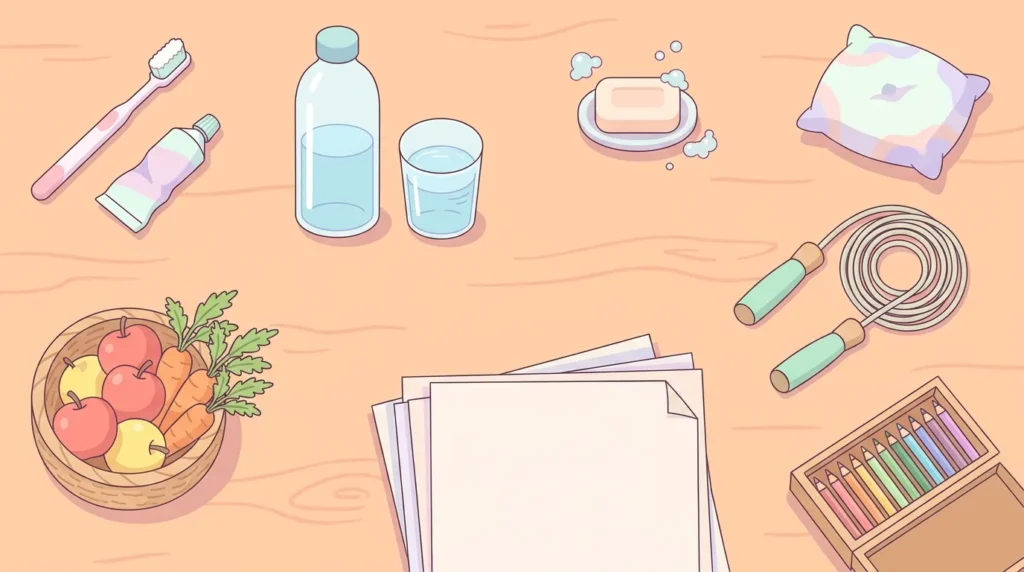
- The drawings include a jump rope, a water bottle and glass, a toothbrush with toothpaste, soapy hands, a pillow, a ball and an open book. Some pages have a sun for Stay Positive.
- Heading, colors and border style change from page to page.
Each panel has its own border, so you can leave the page whole as a poster or cut the panels apart for cards.
Healthy Habits Flashcards: the card version
If you prefer small cards for circle time, the Healthy Habits Flashcards pack costs $5.99, has 40 pages and is listed for all grades. It has a name page, 37 pages of habit cards and two closing pages. Most pages hold nine cards in three rows. The habits include Eat Vegetables, Eat Fruit, Drink Water, Brush Your Teeth, Wash Your Hands, Get Enough Sleep, Exercise, Play Outside, Read Books, Stay Positive, Be Kind, Limit Screen Time and Spend Time with Family. The A4 pages print on US Letter with Fit to page.
The two packs overlap, so most classrooms need only one to start. Choose the posters for walls and boards, and choose the flashcards for sorting games and small groups.
Six poster and card sets in one download
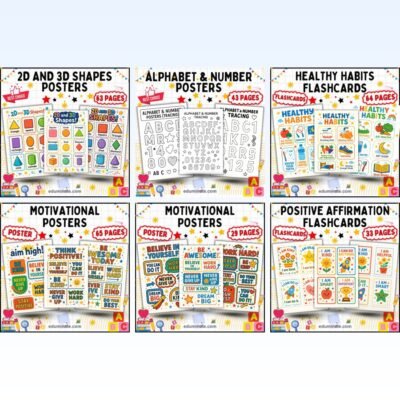
The Classroom Posters Bundle includes the Healthy Habits Posters along with shapes posters (63 pages), alphabet and number posters (43 pages), two motivational poster sets (65 and 29 pages) and positive affirmation cards (33 pages). It has 297 pages for preschool to grade 3. The separate prices add up to $38.94, and the bundle costs $27.26, so you save $11.68, or 30 percent. This is a handy choice when you are decorating a whole room for the year.
Free options for health topics
If you only want something to color today, we also have two free coloring packs on health topics: Free Healthy Eating Coloring Pages, with 16 sheets, and Free Handwashing Coloring Pages, with 8 pages. A free pack takes an email address, which opens a free account and keeps the file in My Library. The paid posters add something different: a full set of 60 poster pages that you hang rather than color, with the habit already written on every panel.
Where to put healthy habits posters
- Sink area: the Wash Hands page.
- Reading corner: Read Books and Get Enough Sleep.
- Lunch area: Eat Fruits and Veggies and Drink Water.
- Door or hall: Exercise, Be Active and Play Outside.
- Home bathroom: Brush Teeth.
- Bulletin board: several pages together for a health unit.
Classroom activities with the posters
Habit of the week
Choose one habit each Monday and hang the poster. Read the phrase together, and ask children what they do at home for that habit. On Friday, ask them to show with a thumb up or down whether they managed it during the week. Keep this light, since the goal is awareness rather than a score.
Point to the habit
Ask children to point to the habit they did this morning. A child who brushed teeth points to the toothbrush, a child who ate breakfast points to the fruit. This works well for young learners and English learners, since they can answer without speaking.
Draw and write
Use a poster as a prompt for a drawing or a short writing task. Younger children draw their favorite habit and dictate a sentence. Older children write three sentences about how the habit helps the body. The poster supplies the words, which makes spelling easier.
Sorting cards
Cut panels apart from the posters or print the flashcards. Make four labeled areas on the table: food and drink, body care, rest and movement, and mind. Children place each card in the right area and say why. Some cards could go in two areas, such as Spend Time Outside, which gives a good chance for a talk.
Class habit chart
Make a simple table with five habits and the days of the week. Children place a sticker or a tick when they have done a habit at home, such as drinking water or reading a book. Check the chart on Friday and talk about the habit that was hardest to keep.
Teaching tips for habits
Children copy what they see adults do, so a short demonstration beats a long speech. Show how to wash hands for the time it takes to say the alphabet slowly, and let each child try at the sink. Brushing teeth works well as a demo with a model mouth or a cardboard drawing. Pair the demonstration with the matching poster so that the picture and the action stay together in memory.
Keep the tone positive. Avoid scare talk about illness, and focus on what each habit helps children do: run faster, think clearly, play for longer. Health topics also touch family life, so avoid asking children to report what their family eats or whether they own certain items. Invite them to share what they like instead.
Making the posters last
- Print on slightly thicker paper if the poster will hang for weeks.
- Laminate the pages near the sink so they survive splashes.
- Print two copies of favorite pages, one to hang and one to cut for cards.
- Store the rest in the PDF and print a new page whenever you need one.
If your class also works on early reading, a page with a poster beside a tracing page makes a good pairing. See our alphabet tracing worksheets guide for ideas that suit the same age group.
Working with families
Healthy habits start at home, so it helps to share a page with families. Print a single poster page, such as the sleep and water page, and send it home with a short note asking children to hang it in a place they pass every day. Keep the note friendly and avoid advice on what families should buy or eat. Habits like sleep, water and play look different in each home, and the poster only gives a shared picture to talk about.
Some teachers also send home a small set of cards cut from a flashcard page and ask each child to pick one habit to try for a week. At the end of the week, children bring back a drawing of how it went. This small exchange gives the class a common topic and gives parents an easy way to take part without extra work.
For a school health day, display one poster per table and ask children to visit each table and tell a partner one thing they already do. The posters hold the words, so even a child who is shy about speaking has something to point to.
Frequently asked questions
How many poster pages are in the pack?
The PDF has 64 pages in total. That is a name page, 60 poster pages and two closing pages. Each poster page has five or six picture panels.
Can I use the pages as cards?
Yes. Each panel has its own border, so you can cut the panels apart and use them as small cards. You can also keep a page whole and hang it as a poster.
What grades are they for?
The poster and flashcard packs are listed for all grades. The bundle is listed for preschool to grade 3.
Can I print only some of the pages?
Yes. Every page stands alone. The product pages say the A4 files print on US Letter with Fit to page.