Earth Day Reading Comprehension: Passages for Grades K-8
FreeFree printable for this topic: Free Earth Day Coloring Pages (16 Printable Caring for Nature Sheets)Get it free
Earth Day reading comprehension gives students a short nonfiction text about caring for the planet, then asks questions that send them back to the passage for proof. A good set covers a few connected topics, such as recycling, pollution and gardening, and suits more than one reading level. The packs below run from kindergarten to grade 8, and every one lists answer keys.
Ideas you can build an Earth Day week around:
- Recycling and reuse: what goes in which bin and why it matters.
- Pollution: air, noise and water, and what people do to reduce it.
- Composting and gardening, from worms to seed growth.
- Protecting wildlife, with a focus on endangered animals.
- Greener travel, such as bike lanes and electric vehicles.
In this article (12 sections)
- Start with the free Earth Day coloring pack
- What is inside the reading packs
- Earth Day and recycling
- Pollution and climate
- Composting, gardening and growing food
- Wildlife and greener travel
- An Earth Day week plan
- Using passages in centers and for early finishers
- Choosing by reading level
- Discussion prompts for after reading
- Linking Earth Day to math and writing
- Frequently asked questions
Start with the free Earth Day coloring pack
If you want something to hand out today, the Free Earth Day Coloring Pages pack has 16 simple sheets about caring for nature, with flowers, trees, a watering can and a recycling bin. A free pack takes an email address, which opens a free account and keeps the file in My Library. It makes a calm first activity before a reading lesson, because children can talk about what they are coloring.
The paid Earth Day Coloring Pages pack goes further. It has 50 pages in all, with 46 coloring sheets on recycling, clean air, tree planting, wildlife and water, and costs $6.99. Choose it when you want a full week of coloring, or enough pages for a whole class to take home. If your class also enjoys plant pictures, our flower coloring pages guide has ideas that carry over.
What is inside the reading packs
According to their product pages, each reading pack has 10 passages, around 40 worksheet pages with questions, a lesson plan and answer keys, all in one printable PDF. Page counts are between 62 and 74 because the keys are counted in. Questions include recall, vocabulary and short written answers, so students practice more than finding a single sentence.
Earth Day and recycling
| Pack | Grades | Pages | Price |
|---|---|---|---|
| Earth Day Worksheets | 3 to 5 | 64 | $7.99 |
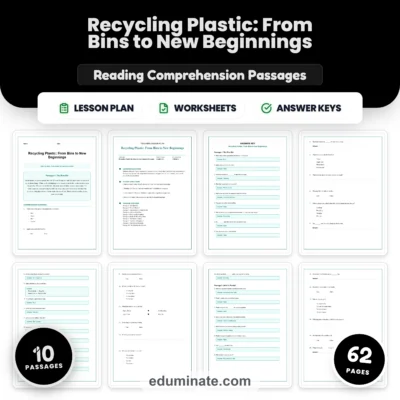
| Recycling Reading Passages | 2 to 6 | 62 | $7.99 |
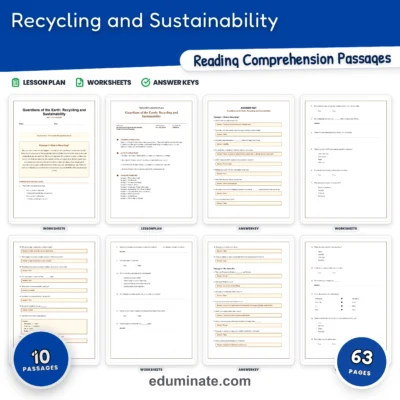
| Recycling Worksheets | 3 to 5 | 63 | $7.99 |
The Earth Day Worksheets pack is the closest match to the holiday, and its passages cover environmental stewardship and recycling. The two recycling packs overlap in topic, so most classes only need one. Pick the grade 2 to 6 pack if you teach a mixed group, and the grade 3 to 5 pack if everyone is at the same level.
Pollution and climate
| Pack | Grades | Pages | Price |
|---|---|---|---|
| Air Pollution Worksheets | 4 to 7 | 63 | $7.99 |
| Noise Pollution Worksheets | 2 to 8 | 69 | $7.99 |
| Clean Water Technology Reading Comprehension | 3 to 7 | 65 | $7.99 |
| Climate Worksheets | 5 to 8 | 74 | $8.99 |
Noise pollution is a good entry point for younger students, since its passages begin with everyday loud sounds. The Air Pollution pack includes a passage about buildings that clean the air. The Climate Worksheets pack is the largest in this group, with 200 questions and 50 worksheet pages, and it suits grades 5 to 8.
For a bigger purchase, the Pollution Worksheets Bundle holds 11 packs and 716 pages for $58.43, covering pollution, recycling and composting. It costs far less than buying that many packs one by one.
Composting, gardening and growing food
| Pack | Grades | Pages | Price |
|---|---|---|---|
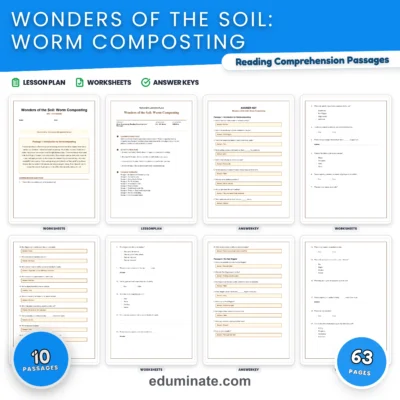
| Composting Worksheets | 3 to 5 | 63 | $7.99 |
| Gardening Reading Comprehension | 2 to 6 | 63 | $7.99 |
| Farming Worksheets | 3 to 6 | 63 | $7.99 |
| Permaculture Reading Comprehension | 6 | 63 | $7.99 |
The Composting pack covers soil science and worm bins, which pairs well with a classroom compost jar. The Gardening pack starts with seed growth and garden insects. The Farming pack has hydroponics questions, and the Permaculture pack is written for 6th grade with ecological design passages.
Wildlife and greener travel
- The Endangered Animals Worksheets pack has 63 pages for kindergarten to grade 2 and costs $7.99. It is the youngest reading pack here, with simple sentences and sight words.
- The Bike Highways Reading Comprehension pack has 63 pages for grades 3 to 5 and costs $7.99.
- The Electric Vehicles Reading Comprehension pack has 64 pages for grades 1 to 5 and costs $7.99.
These three suit a lesson on ways people can lower their effect on the planet, either by protecting animals or by choosing cleaner ways to travel.
An Earth Day week plan
Monday and Tuesday: read and annotate
Give each student one passage. Ask them to circle three new words and underline one fact they want to share. Students then answer the first half of the questions and mark where each answer appears.
Wednesday: pairs and discussion
Pairs swap passages and explain the main idea in two sentences. A simple discussion prompt helps: what is one thing our class could change this week?
Thursday: finish and check
Students finish the questions and check them with the answer key. The key makes it easy for a substitute to run this day.
Friday: take action
Turn reading into something real. Sort the classroom recycling, plant seeds in paper cups, or plan a schoolyard clean-up. Students write one sentence about what they did and which passage it connects to.
Using passages in centers and for early finishers
- Place one passage and its questions at a reading center, with the answer key in a folder at the teacher desk.
- Keep the coloring sheets in a bin for early finishers.
- Pair a younger reader with an older one, using a grade 2 to 6 pack, and let them take turns reading paragraphs aloud.
- Send a passage home for family reading, and ask students to teach one fact at the table.
Choosing by reading level
Earth Day is taught in every grade, so one pack rarely fits a whole school. A quick guide, using the grades each page lists:
- Kindergarten to grade 2: Endangered Animals Worksheets, plus the coloring packs.
- Grades 2 to 5: Recycling Reading Passages, Recycling Worksheets, Gardening, Composting, Electric Vehicles and Bike Highways.
- Grades 3 to 7: Earth Day Worksheets, Air Pollution, Clean Water Technology and Farming.
- Grades 5 to 8: Climate Worksheets, and Permaculture for 6th grade.
If you are planning for a whole school, pick one theme such as recycling and give each grade the pack that fits it. Children in different rooms then share a topic they can talk about at lunch or on the way home.
Discussion prompts for after reading
- What is one habit from the passage that your family could try this week?
- Which fact in the text changed how you think about the topic?
- How would you explain this idea to a younger student in two sentences?
- What is one question the passage did not answer?
Let students answer in pairs first and then share with the group. Quiet students speak more easily after they have rehearsed with a partner. Write the best questions on the board, and use them as research tasks for early finishers.
Linking Earth Day to math and writing
Earth Day passages give you easy data for a short math task. Ask students to count how many items the class recycles in a day, record the numbers on a chart and add them up by Friday. Older students can find the average per day. For writing, ask students to compose a short letter to the school about one change they would like to see, using one fact from their passage as support. Both tasks give the reading a purpose beyond the worksheet.
Frequently asked questions
Which pack should I choose for a grade 2 class?
The Endangered Animals Worksheets (kindergarten to grade 2), Recycling Reading Passages (grades 2 to 6) and Noise Pollution Worksheets (grades 2 to 8) all include grade 2 in their listed range.
Is there a free Earth Day option?
Yes, a free coloring pack with 16 sheets. It takes an email address, which opens a free account and keeps the file in My Library.
Do the reading packs include answer keys?
Yes. Each reading pack lists answer keys and a lesson plan inside the PDF.
Can I use these outside April?
Yes. Recycling, pollution, composting and gardening fit science units at any time of the year, so you can use them in spring or at the start of a new term.