Color Flashcards for Preschool: Printable Sets and Games
FreeTry a printable pack for free first. No card needed.See free packs
Color flashcards (also called colors flashcards printable sets) teach young children to name colors by showing one clear color and its word on each card. The best sets use a large patch or shape in one color, print the color word on the same card, and repeat the basic colors many times in different styles. Preschool and kindergarten children learn fastest when they handle the cards, so choose a set you can print, cut apart and use in short games.
Here is what to look for in a good set, and how the cards are used:
- One big color shape per card, so the color is the first thing a child sees.
- The color word printed on the card, so children start to link the word to the color.
- The basic colors repeated often: red, orange, yellow, green, blue, purple and pink.
- A few extra colors, such as brown, black, white and gray, for children who are ready.
- Four cards per page, so cutting takes minutes and the cards stay a handy size.
In this article (10 sections)
Are there free color flashcards?
At the time of writing, we do not have a free color flashcards pack. A quick home version is easy: cut a sheet of paper into eight cards, color a big patch on each with a crayon and write the color word beneath it. We do have free packs on other topics, and a free pack takes an email address, which opens a free account and keeps the file in My Library. The printable sets below save you the cutting and drawing, and they give you hundreds of cards in one PDF.
The two color flashcard sets
Both sets are single PDFs for preschool and kindergarten, listed as Pre-K, and both product pages say the A4 files print on US Letter with Fit to page.
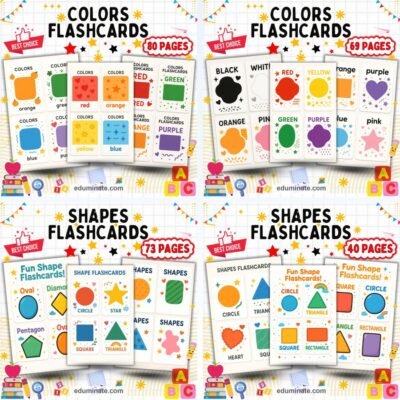
- The Colors Flashcards for Kindergarten PDF has 268 cards. The PDF has 69 pages: a name page with lines for name, class and date, 67 card pages with four cards each, and a thank you page. It costs $7.99. Each card shows one color shape, such as a heart, star, circle, square, oval, rounded blob or leaf, with the color word on the same card. The basic colors are red, orange, yellow, green, blue, purple and pink, and extras include black, white, brown, gray, teal and aqua.
- The Colors Flashcards: 312 Easy Printable Color Cards Set has 312 cards. The PDF has 80 pages: a name page, 78 card pages with four cards each, and a thank you page. It costs $9.99. Each card shows a big patch of color and the color word. Beyond the basics, it adds neutral colors, such as white, gray, black, gold and silver, and extra names, such as teal, lime, navy, magenta, peach, lavender and coral. It also has rarer names, such as indigo, maroon, tan, khaki, turquoise, amber and azure.
The first set is the easier start for the youngest children, because the shapes are bold and the colors are mostly basic. The second suits a classroom that wants a long run of cards, with plenty of extra names for children who already know the basics.
Colors and shapes bundle
If you also teach shapes, the Colors and Shapes Flashcards Bundle holds four flashcard sets in one download: the two color sets above and two shape sets. That is 262 pages in four PDF files for $24.72, which is 25% off the $32.96 you would pay one by one. It saves money for a preschool teacher who is building both a color center and a shape center. For a closer look at the shape sets, see our guide to shapes flashcards.
Both sets also fit preschool color activities in a kindergarten center, since the cards come in one PDF and can be shared across a table.
How to prepare the cards
- Print the pages you need. You do not have to print the whole file, and a few pages are enough for a first week.
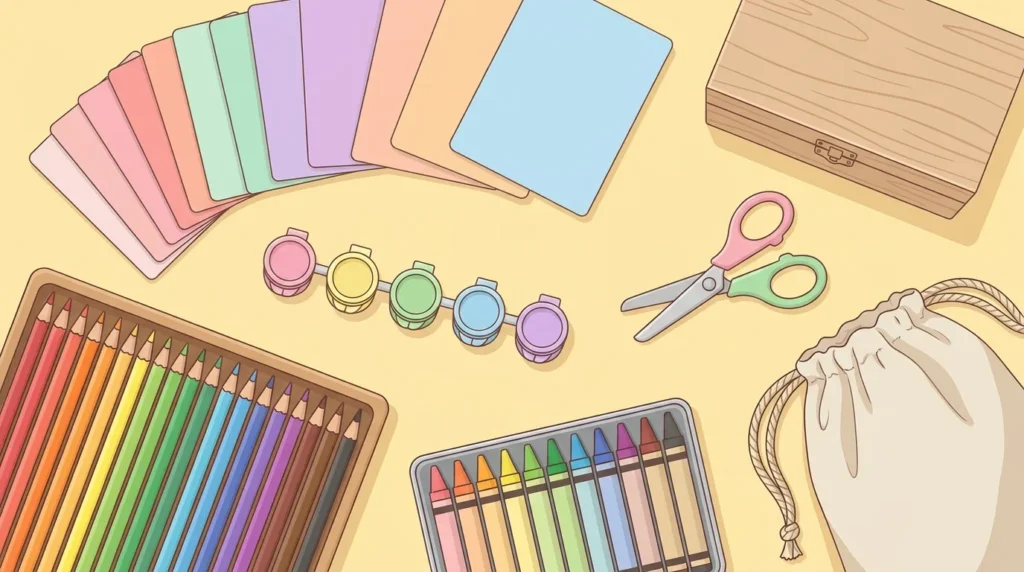
- Cut the four cards apart along the edges. A paper trimmer saves time, and a small group of older children can help.
- If you can, laminate the pages before cutting, or glue them to thin card. Cards will last longer with little hands.
- Store them in a small bag or box, one color family at a time.
Games that teach color names
Short matching games work better than long drills. Two to five minutes is enough for a three or four year old.
- Point to it. Lay out four cards and say a color. The child touches the matching card.
- Which one is red? Show two cards and ask which one is red. This is the easiest game, and it is a good first step.
- The missing card. Show four cards, ask the child to close their eyes, then hide one under a cup. Ask which color is missing.
- Color hunt. Hold up a card and ask the child to find something in the room that matches. Bring it back and place it beside the card.
- Memory pairs. Print two copies of the same page and cut both. Turn the cards face down and take turns finding pairs.
- Warm and cool sort. For children who know the basics, sort the 312-card set into two piles, warm colors and cool colors.
Using the cards in a classroom
Color center
Set out a tray of cards, a basket of colored objects such as blocks and pom poms, and let children match each object to a card. Rotate the objects every week.
Circle time
Hold up one card and ask the class to name the color together. Then ask a child to find something in the room with that color. This takes a few minutes, and it helps shy children join in.
Transitions
Hold up a card at the door. Children whose shirt, shoes or backpack has that color line up first. Use a different card each time.
English learners
Because every card pairs a color with its word, the cards give children who are learning English a clear picture and a printed word to match. Say the word aloud as you show the card, and ask the child to repeat it.
Color words and early reading
Every card in both sets prints the color word next to the color, so the cards also work as simple color words practice for children who are starting to read. Try this short routine with a child who is ready.
- Show a card and say the color. The child repeats it.
- Cover the word with your finger and ask the child to name the color.
- Uncover the word and run your finger under it as you say it again.
- Over several days, ask the child to try reading the word before they look at the color.
Keep each session to three or four cards. When a child gets a card right three times in a row, set it aside in a “known” pile and add a new one. A growing pile is a small win that children enjoy seeing.
Tips for different ages
- Age 2 to 3. Start with three colors only: red, yellow and blue. Say the name every time you show the card.
- Age 4. Add the other basic colors, and play matching and color hunt games.
- Kindergarten. Ask children to read the color word on the card, and try the extra colors from the larger set.
If a child keeps mixing up the same colors after plenty of practice, mention it to the family. It is a small thing to raise, and a doctor or school nurse can check.
Tracking progress
You do not need a test to see how a child is doing. Keep a simple chart with the child’s name down the side and the colors across the top. Once a week, show each color card and put a tick when the child names it without help. After a month you will see which colors need more games, and you can pull those cards out for a few extra rounds. Share the chart with families so they can play the same games at home.
Frequently asked questions
What age are color flashcards for?
Both sets are listed for Pre-K and describe children in preschool and kindergarten who are learning color names. Younger children can use the cards with an adult.
How many cards are in each set?
The Colors Flashcards for Kindergarten PDF has 268 cards on 67 card pages. The 312-card set has 312 cards on 78 card pages.
Which set should I start with?
Start with the 268-card set if your children are learning the basic colors. Choose the 312-card set if you want many extra color names and a larger supply.
Can I print the cards on US Letter paper?
Yes. Both product pages state that the A4 files print on US Letter with Fit to page.