Shapes Flashcards: Printable Cards and Ways to Use Them
FreeTry a printable pack for free first. No card needed.See free packs
Shapes flashcards are cards that each show one big shape, so young children can name it, find it in the room and match it with other cards. The best sets start with the circle, square, triangle and rectangle, then add oval, star, heart and diamond. They suit preschool and kindergarten, and they work in short rounds of two or three minutes.
Ideas for using a set:
- Hold up a card and ask the child to say the shape.
- Lay out four cards and ask the child to touch the one you name.
- Sort the cards into piles by shape and count each pile.
- Walk around the room with a card and find something with the same shape.
- Play a memory game with two printed copies of the same page.
- Use one page as a warm-up at the start of math time.
Below you will find what to look for in a set, how to teach shapes in a sensible order, a few games, and the card sets we offer.

In this article (10 sections)
What to look for in shapes flashcards
Some teachers call them shape cards, and the two names mean the same thing.
Many sets look alike at first glance. A few details decide whether a set works well in a real classroom.
- Big, clear shapes. A child at the back of a circle should be able to see the shape. Thick edges and solid color help.
- The name on the card. Cards that print the shape name give early readers a word to match. Cards without a name are good for pure picture matching.
- Variety in color and pattern. If the circle is always red, a child may think a blue circle is something else. Seeing a shape in many colors and fills teaches that color does not change the shape.
- A range of shapes. The four basic shapes come first. Oval, star, heart, diamond and pentagon give older children more to learn.
- Pages that print alone. You only need a page or two at a time.
The order to teach shapes
Most children know the circle first, then the square. The triangle and rectangle take longer, and the rectangle is often confused with the square. Here is a gentle order.
- Circle and square. They look very different, so children can tell them apart quickly.
- Triangle. Point out the three sides and three corners.
- Rectangle. Compare it to the square: both have four corners, and the rectangle has two long sides and two short sides.
- Oval, star and heart. These feel familiar from everyday life.
- Diamond and pentagon. Add these when the first group is solid.
Teach one or two new shapes a week, and keep earlier ones in the rounds for review. A child who can name the triangle on Monday may forget it by Friday without a brief reminder.
Games to play with shapes flashcards
Shape hunt
Give each child a card and ask them to find something in the room with the same shape. A round clock, a square window, a rectangular door, a triangular sail on a toy boat. Children enjoy showing what they found, and the hunt teaches them that shapes exist all around us, not only on paper.
Touch the shape
Lay out four cards. Say a shape name and ask the child to touch the matching card. Then switch roles and let the child call a name for you to touch. Children love being the teacher.
Sorting piles
Mix several pages of cards together, cut apart. Ask children to sort them into piles by shape. Then count each pile. This game ties shape recognition to counting and gives you a quick check on who confuses the square with the rectangle.
Memory
Print two copies of one page. Cut the cards apart and turn them face down. Children flip two cards at a time to find a pair. Start with six cards and add more as they get better.
Shape trail
Tape cards to the floor in a line. Call out a shape and let children hop or step to that card. It is a good movement break, and it works well for children who need to be active.
Printable shapes flashcards
Both sets below are PDFs for Pre-K. Each file has a name page, many card pages with four cards on each, and a thank you page. The product pages say the files are A4 and print on US Letter with “Fit to page.” You can use them at home or in one classroom.
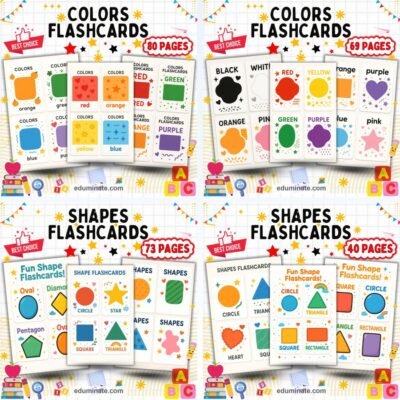
- Printable Shapes Flashcards has 152 cards on 38 card pages (40 pages in the PDF) and costs $5.99. It covers the four basic shapes plus oval, star, heart, diamond, pentagon, rhombus, crescent and semi-circle. Some shapes are filled with stripes, dots, waves or stars.
- Shapes Flashcards has 284 cards on 71 card pages (73 pages) and costs $8.99. It has the four basic shapes plus oval, star, heart, diamond and pentagon, with a few odd shapes such as a trapezoid and a rounded rectangle. The shapes appear in stripes, dots, waves, stars and flowers.
Both product pages mention that a few cards carry spelling slips in the shape name, and that a few cards show a smiling face on the shape. Look through the preview pages on the product page before you print, and pick the pages you like. Since each page prints on its own, it is easy to leave out any you do not want.
The smaller 152-card set at $5.99 is a good first set for the four basic shapes and a few extra. The 284-card set gives more repetition, which helps when you teach a large group or run centers for several weeks.
The Colors and Shapes Flashcards Bundle includes both of these shapes sets and two colors flashcard sets, so four PDFs and 262 pages in all. The separate prices add up to $32.96 and the bundle costs $24.72, a saving of 25%. It suits a teacher who wants to teach colors and shapes together.
Using shapes flashcards in math centers
Here are three setups that need little preparation.
- Matching station. Two copies of one page, cut apart. Children match pairs and say the shape name out loud.
- Real object sort. A tray with cards for circle, square, triangle and rectangle, plus a basket of small items such as a button, a block, a lid and a ruler. Children place each item under the card with the matching shape.
- Draw it. A child takes a card, names the shape, and draws it on a whiteboard or paper. Drawing builds fine motor control and helps the child remember how many sides the shape has.
When children are ready to move beyond cards, our guide to shapes worksheets for kindergarten has paper tasks that build on what the cards teach.
Talking about sides and corners
Naming a shape is the first step. The next step is to describe it. Cards give a good prompt for simple talk.
- “How many sides does the triangle have?” Children count with a finger along each edge.
- “Does the circle have corners?” Let them feel with a fingertip.
- “How is the square like the rectangle? How is it different?”
- “What do you see in the room that has four corners?”
Counting sides ties shapes to math language. It also gives you a way to check understanding without a worksheet.
A sample week
- Monday: show the circle and square cards, name them, and find them in the room.
- Tuesday: add the triangle. Sort three cards and count the sides.
- Wednesday: add the rectangle, then compare it with the square.
- Thursday: play memory with two copies of one page.
- Friday: do a shape hunt and let children show what they found.
Keep each round to a few minutes. You can repeat the same cards the following week and add one new shape.
Tips for printing and storing
- Print on card stock for cards you plan to handle often.
- Laminate the pages you use in centers.
- Cut along the borders, or let older children cut them as a fine motor task.
- Store each shape in its own small bag. This makes sorting fast.
- Label the bags with a sample card taped to the front.
Frequently asked questions
What age are shapes flashcards for?
The sets here are for Pre-K, so they suit preschool and early kindergarten. Younger children name the shapes. Older ones can count sides and corners.
Which shapes should I teach first?
Start with the circle and the square. Add the triangle, then the rectangle. Teach the extra shapes once the first four are secure.
Why does my child confuse the square and the rectangle?
The two look alike. Place them side by side and ask the child to compare the sides. The square has four sides of the same length. The rectangle has two long sides and two short ones.
Do the cards include 3D shapes?
The product pages list flat shapes only. For solid shapes like a cube or a sphere, use real objects from the room, such as a ball or a box.