Math Intervention Strategies: A Practical Guide
FreeTry a printable pack for free first. No card needed.See free packs
Math intervention strategies start with finding the exact skill a student is missing, then teaching that skill in a small group with concrete tools, short daily practice and a quick check to see whether it worked. The aim is to close one gap at a time, not to re-teach the whole year. Printable skill sheets help most when they are short, clearly laid out and matched to the gap you found.
These moves matter most in an intervention block:
- Check which skill is missing before you choose any materials.
- Work in a group of three to five, so every student answers often.
- Use objects and drawings before numbers alone.
- Practice in ten to fifteen minute sessions, as often as your schedule allows.
- Use sheets with clear spacing and a small number of items per page.
- Check progress every week and change the plan if it is not working.
In this article (10 sections)
- Step one: find the gap
- Step two: teach with concrete, then pictures, then numbers
- Step three: practice in small, steady doses
- RTI and intervention packs by level
- Check progress every week
- Working with an aide or a volunteer
- A simple fifteen minute intervention lesson
- Choosing between packs
- Keeping students motivated
- Frequently asked questions
Step one: find the gap
Intervention goes wrong when a group is chosen by last month’s grade and not by what students can actually do. Spend a few minutes with each student. Ask them to solve three or four problems out loud, and listen for the first place they hesitate. A student who gets 56 minus 29 wrong may have a subtraction problem, but it may also be a place value problem, or a recall problem on facts within 20. Each needs a different fix.
Keep notes in plain words: “adds tens correctly, drops the regrouped ten.” Those notes will tell you what to teach on Monday.
Step two: teach with concrete, then pictures, then numbers
Many teachers use a three-stage sequence. Students handle objects first, such as cubes, base ten blocks or paper strips. Then they draw the same thing. Only then do they work with numbers alone. Students who skip the first two stages often learn a procedure without knowing why it works, and the procedure falls apart a week later.
A fact family is a good place to see this at work. Three cubes and four cubes make seven, and so do four and three, and seven take away three leaves four. Our guide to fact families has ideas for showing those links with objects.
Step three: practice in small, steady doses
A student who is behind needs more repetitions, but not longer worksheets. Choose ten items, not forty, and ask students to explain two of them aloud. Return to the same skill the next day with new numbers. Short, frequent practice tends to stick better than one long session.
RTI and intervention packs by level
The packs below are PDFs, and each states that its A4 files print on US Letter with Fit to page. Each lists an answer key, so a classroom aide or a volunteer can check work without special training.
| Pack | Grades | Pages | Price |
|---|---|---|---|
| RTI Math Worksheets | 3 to 6 | 33 | $4.99 |
| RTI Math Activities | 2 to 5 | 33 | $4.99 |
| Math Intervention Worksheets | 5 | 33 | $4.99 |
| Scaffolded Math Worksheets | 4 | 34 | $4.99 |
| Math Worksheets for Autism | 1 to 4 | 32 | $4.99 |
| Math Skills Practice Worksheets | 3 to 7 | 31 | $4.99 |
| Math Skills Review Worksheets (welcome back) | 4 to 7 | 26 | $3.99 |
| Accelerated Math Worksheets | 4 to 8 | 32 | $4.99 |
Tier 2 groups in grades 3 to 6
The RTI Math Worksheets pack has 80 questions on place value, addition, subtraction, multiplication and fractions. It suits a Tier 2 group that is behind on several basics at once. The RTI Math Activities pack has 80 questions on base-ten, facts, multiplication and word problems for grades 2 to 5, which makes it a better match for a younger group.
Targeted help in fifth grade
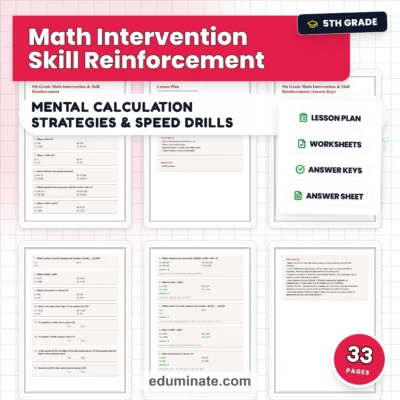
The Math Intervention Worksheets pack has 75 questions on place value, fractions, decimals and word problems for fifth grade, with an answer sheet and a lesson plan. Many fifth graders who struggle have gaps in the same three places: place value, fraction ideas and reading word problems, so the list of topics lines up well.
Scaffolded support in fourth grade
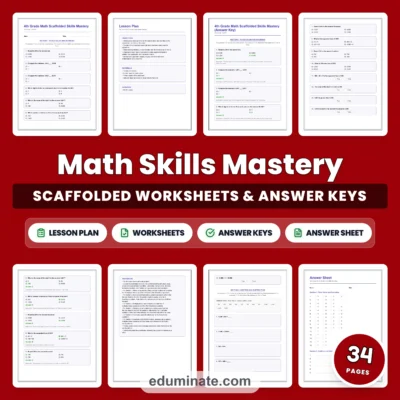
The Scaffolded Math Worksheets pack has 80 questions for fourth grade on place value, operations, fractions and geometry. Scaffolding means the support is built into the page and fades as students gain skill. Check each student’s page after a few sessions and ask them to notice how much they can now do alone.
Math worksheets for students with autism
The Math Worksheets for Autism pack has 80 clear, simple questions on addition, subtraction, patterns and comparing, for grades 1 to 4. Autistic students are not all alike, so no pack can promise a fit for everyone. It has a predictable layout and plain wording, which many students find easier to focus on. As with any material, watch how the student responds and adjust. If a page is too busy, cover part of it with a sheet of paper so only one item shows at a time.
Skill practice and review in grades 3 to 7
The Math Skills Practice Worksheets pack has 75 questions on arithmetic, fractions, percentages and algebra basics, for grades 3 to 7. The Math Skills Review Worksheets pack has 60 welcome back questions on arithmetic, fractions, decimals, word problems and geometry for grades 4 to 7, and it is a sensible first check at the start of a year. The Accelerated Math Worksheets pack has 80 challenge questions on algebra, ratios, geometry and exponents for grades 4 to 8, which is useful when part of your intervention block is a group that needs more, not less.
Check progress every week
Pick a three item check on the skill you are teaching and give it at the same time each week. Write down how many each student got right. If a student’s score has not moved after three or four weeks, change something: the tool, the amount of modeling, or the skill itself. Sometimes the real gap is one step earlier than you thought, and the check is what tells you so.
Working with an aide or a volunteer
Another adult can run practice sessions well if you give them a plain script. Write the steps on a card: show the problem, ask the student to explain, check with the key, mark only what the student got right. Remind them not to rush in with the answer, since waiting a few seconds is often what the student needs. A sheet with a key makes this possible without special training.
A simple fifteen minute intervention lesson
- Two minutes: a quick review of yesterday’s skill with three oral problems.
- Five minutes: model one new problem with objects or a drawing, thinking aloud.
- Five minutes: students try two problems while you watch, and you correct on the spot.
- Three minutes: each student explains one answer to a partner, and you note who could not.
Write the notes down. They tell you who needs the same lesson again tomorrow and who is ready to move on.
Choosing between packs
If you are unsure, match the pack to the grade of the students and then to the gap. A fourth grade group that is missing place value belongs with the scaffolded pack. A mixed group in grades 3 to 6 that is behind on several basics fits the RTI worksheets. Read the product description before you print a class set, and start with one pack, not three. You can always add a second once you see how students respond.
Keeping students motivated
- Start each session with something the student can do, so the first problem is a win.
- Let students see their own progress: a small chart of items correct each week works better than a grade.
- Do not call a group the low group. Name it after the skill: the fractions group, the regrouping group.
- Keep sheets private and neat. A child who sees a page full of red marks learns to avoid math.
Frequently asked questions
How long should a student stay in intervention?
Until the data says they have reached the skill. Check every week or two, and move students out as soon as they can do the skill alone.
Can these sheets be used at home?
Yes. Parents can print a few pages and sit with a child for ten minutes. Share the answer key so the parent can check, and ask the parent to praise effort, not speed.
Do I need all the packs?
No. Pick one pack that matches the gap you found. A single pack with 75 to 80 questions gives several weeks of short practice.
Can I print these on US Letter paper?
Every pack named here states that its A4 files print on US Letter with Fit to page.