Preschool Math Activities: Counting, Shapes, Printables
FreeFree printable for this topic: Free Fire Safety Coloring Pages Fire Drill Activity Sheets for KindergartenGet it free
Preschool math activities should be short, hands-on and spoken aloud, because most three and four year olds cannot read a question yet. At this age math means counting small sets, naming shapes, comparing sizes and finishing simple patterns. A printable page works when an adult reads it with the child. The packs below start at Pre-K and move up to kindergarten and the first grades, so you can see what comes next.
Ideas you can use today, with no printing:
- Count steps, buttons, blocks or snack pieces from 1 to 10, one touch for each number.
- Sort a bowl of mixed objects by color, then by size.
- Go on a shape hunt and name the shapes you find on a door, a book or a plate.
- Line up three objects and say which is first, which is next and which is last.
- Make a pattern with two colors of blocks and ask the child what comes next.
- Use position words while you play: inside, above, under, behind.
In this article (7 sections)
What early math covers
The core of early math is small. A child needs to say the number words in order, touch one object for each word, know that the last word tells how many, and see that some groups are bigger than others. Shapes, sizes and patterns grow from the same habit of looking closely and saying what is there.
Worksheets are not the goal. In preschool a page only checks what a child already does with real objects, so use it in small doses. A page a day for a few minutes, read aloud by an adult, is plenty.
Pre-K and preschool packs
These packs are written for children who do not read yet. The adult reads each question aloud and the child points and chooses. Both list A4 files that print on US Letter with Fit to page, and both include an answer key.
| Pack | Level | Worksheet pages | Questions | Price |
|---|---|---|---|---|
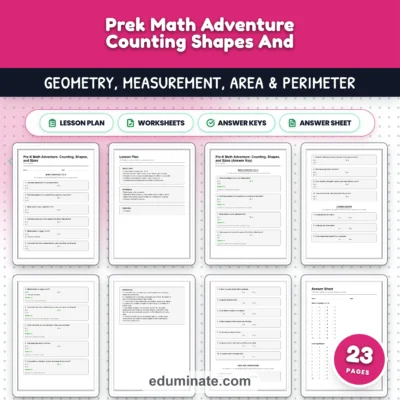
| Pre K Math Worksheets | Pre-K | 10 | 75 | $3.99 |
| Preschool Math Worksheets | Pre-K | 8 | 50 | $3.99 |
Pre K Math Worksheets covers counting small numbers, naming shapes, comparing sizes and amounts, finishing simple patterns from a Word Bank, and position words such as inside, above and under. Preschool Math Worksheets is the shorter one. It has counting from 1 to 10, the sides and points of shapes, sizes and weights, position words like inside and behind, and simple patterns and color words from a Word Bank. For one packet for a three or four year old, start with the 75-question pack. A young group that tires quickly will finish the 50-question pack more easily.
Kindergarten and transitional kindergarten packs
Children who have finished the Pre-K work, or who are already in a kindergarten room, can move to these. They are also good for take-home practice, because each question is short and meant to be read aloud.
| Pack | Grades | Worksheet pages | Questions | Price |
|---|---|---|---|---|
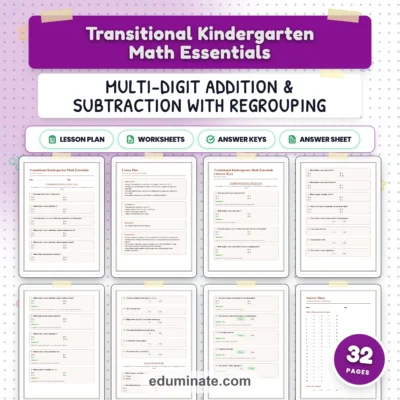
| TK Math Worksheets | K to 2 | 12 | 80 | $4.99 |
| Math Packet for Kindergarten, Take Home | K | 8 | 50 | $3.99 |
| Math Worksheets for Kindergarten | K | 11 | 65 | $3.99 |
| Kindergarten Subtraction Worksheets | K | 9 | 60 | $3.99 |
| Ordinal Numbers Worksheets | K to 3 | 13 | 80 | $4.99 |
TK math worksheets
Transitional kindergarten is the year before kindergarten in some schools. This pack covers counting and recognizing numbers, naming shapes, comparing sizes and amounts with a Word Bank, and adding small numbers. Directions are short, so an adult can read them aloud. The grade range is K to 2, which covers a wide spread of readiness.
Take-home packets
The take-home packet for kindergarten has five sections of 10 questions on counting, adding and subtracting within 10, shapes, patterns and comparing objects. The kindergarten math worksheets pack has 65 questions on counting, adding and subtracting with a Number Bank, comparing numbers with the symbols for less than, greater than and equal to, and simple shapes and patterns. Its lesson plan calls it a flexible take-home worksheet, so you can spread it over several days.
Subtraction and ordinal numbers
Kindergarten Subtraction Worksheets covers subtraction facts from 0 to 10, and its last section turns the facts into short summer stories about water bottles, sun hats and children at play. Ordinal Numbers Worksheets shows that first, second and third give position while one, two and three give how many. Children write ordinal numbers from 1st to 20th, choose the right suffix and name a position in a line.
What comes after: grades 1 to 4
If a child is moving faster than the Pre-K work, or you teach a mixed room, these packs show the next step. They are written for grades K to 4, so check the sample pages before you give one to a young child.
- The Addition Activities for Kindergarten pack has 70 questions for K to 1st grade at $3.99. It adds a few ones to numbers such as 30, 40 or 70 to show how place value works.
- The 100 More 100 Less Worksheets pack has 80 questions for grades 1 to 4 at $4.99, on what happens to a number when you add or subtract 100.
- The Equal and Not Equal Worksheets pack has 70 questions for grades 1 to 4 at $3.99, on what the equal sign means and balancing equations.
- The Break Apart Strategy Addition Worksheets pack has 70 questions for grades 1 to 4 at $3.99, in which students break a number into hundreds, tens and ones before they add.
- The Double Digit Addition Worksheets pack has 80 questions for grades 1 to 4 at $4.99, all on adding two-digit numbers.
These five are not preschool materials. They help when a kindergarten class has a few children who are ready for place value, or when you want to see where the early years are heading.
A full preschool kit
If you want more than math worksheets, the Preschool Worksheets Bundle has 22 resources and 1,116 pages in 25 PDF files for $87.47, against $145.79 for the separate prices. It holds alphabet, colors, shapes and number flashcards, classroom charts, a counting activity set and simple coloring pages. The page lists 40 percent off the separate prices. It is a classroom kit rather than a math course. The math is the number and shape flashcards and the counting set.
Simple routines for a preschool room
Count the day
At circle time, count one thing together every day: children present, jackets on hooks, pencils in a cup. Each object gets touched once, and the number is said as the finger lands.
Shape walk
Walk the room or the hallway with a clipboard and mark each shape you find. Ask the children to say whether a door is more like a square or a rectangle, and listen to their reasons.
Which is bigger
Set out two cups and ask which holds more. Fill one with beans and let the children check. Children learn bigger, smaller, heavier and lighter by handling real objects.
Pattern parade
Give each child a strip of paper and two colors of crayon. They make a red, blue, red, blue pattern and show a friend what comes next. Move to three colors when two feel easy.
Read the page aloud
When you use a worksheet, put the page in front of the child and read each question slowly. Let the child answer by pointing, then say the answer in a full sentence. For more counting practice, see counting worksheets for kindergarten.
Keep fine motor work separate from math
Some children can count to 10 aloud but cannot yet hold a pencil well. Let them point, circle with a thick crayon or place a counter on the answer. Handwriting that is not ready should not hold math back.
Frequently asked questions
At what age should a child start math worksheets?
There is no set age. Start with real objects, and bring in a page only when a child can point to an answer and enjoys it. The Pre-K packs are written to be read aloud for children who do not read yet.
How long should a session last?
A few minutes is plenty for a three or four year old. Stop while the child still wants more, and come back to the page the next day.
Which pack is the right first one?
For ages 3 to 5, Pre K Math Worksheets is the broadest. For a child already in kindergarten, the take-home packet is a short place to start.
Can I print the packs on US Letter paper?
The product pages list A4 files that print on US Letter with Fit to page.