Spiral Review Math: Daily, Weekly and Mixed Practice
FreeTry a printable pack for free first. No card needed.See free packs
Spiral review math means mixing questions on skills taught weeks or months ago into everyday practice, so students keep using them instead of forgetting them after the unit test. A good spiral sheet has a small number of items on several different topics, takes about ten minutes, and comes with an answer key so students can check it the same day. Run it as a warm-up, as weekly homework, or as the first part of a center.
A well-built spiral set usually has:
- Four or five items per day, each on a different skill.
- One or two items from the current unit and the rest from earlier ones.
- A mix of computation, a word problem and a vocabulary or reasoning item.
- A weekly page that repeats the same skills with new numbers.
- An answer key, so feedback comes quickly.
In this article (10 sections)
Why spiral review helps
Students forget skills they do not use. That is true of adults too. A unit on fractions in October is gone by January unless fractions show up again, and a teacher who has to re-teach every skill in spring loses weeks. Small, regular reminders cost a few minutes a day and usually save more time than they take.
Spiral review also gives you information. If half the class misses the same item on Wednesday, you know what to reteach on Thursday, long before a test shows it.
How to set up a spiral review routine
Keep it short and the same every day
Ten minutes at the same time each day works better than thirty minutes once a week. Many teachers use the first ten minutes of class, so students start working as they sit down. For students in the earliest grades, a similar habit is described in our guide to morning work for kindergarten.
Check it right away
Go over two or three items out loud. Do not mark every paper. Ask students to correct their own work in a different color, then collect a few pages to look for patterns.
Let students explain
Choose one item a day and ask a student to say how they solved it. Others may have used a different method, and hearing two ways is a lesson in itself.
Track what repeats
Mark the items many students miss. Those are your spiral topics for next week. A short list on a sticky note is plenty.
Daily warm-ups
These packs are built for the first minutes of class. Every pack in this guide is a PDF, and each states that its A4 files print on US Letter with Fit to page.
| Pack | Grades | Pages | Price |
|---|---|---|---|
| Math Minutes Worksheets | 3 to 6 | 32 | $4.99 |
| Do Now Math Worksheets | 3 | 28 | $3.99 |
| Daily Math Review Worksheets | 6 | 31 | $4.99 |
| Daily Math Practice Worksheets | 8 | 28 | $3.99 |
The Math Minutes Worksheets pack has 80 daily warm up questions on facts, fractions, decimals and geometry. The Do Now pack has 70 daily warm up questions for third grade on place value, facts, patterns and word problems. The Daily Math Review pack has 75 questions for sixth grade on fractions, equations, ratios, geometry and statistics. The Daily Math Practice pack has 70 questions for eighth grade on integers, pre-algebra, geometry facts and expressions. Each includes an answer key, answer sheet and lesson plan according to its description.
Weekly practice and homework
Homework works best as review of things students already know how to do. A parent should not need to teach a new method at the kitchen table. Spiral homework fits that idea well, since it asks students to use skills from earlier in the year.
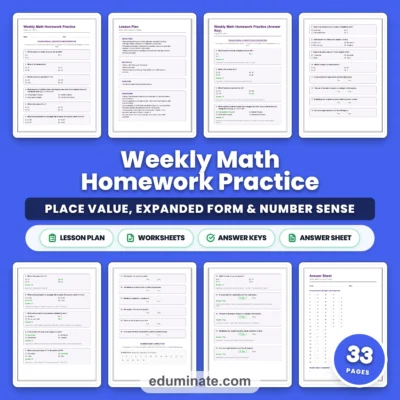
- The Math Homework Worksheets pack has 80 weekly practice questions on properties, number bank, computation and word problems. It is 33 pages for grades 3 to 6 and costs $4.99.
- The Math Homework Sheets pack has 80 questions on multiplication, base ten, fractions, time and geometry. It is 34 pages for grade 3 and costs $4.99.
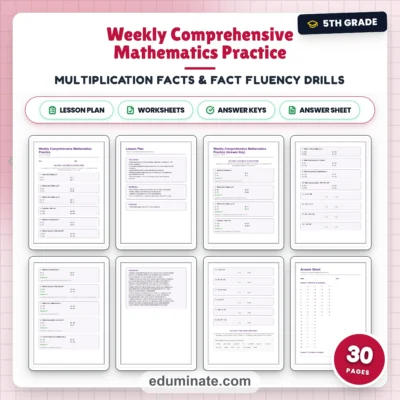
- The Weekly Math Worksheets pack has 70 questions on arithmetic, fractions, word problems, geometry and patterns. It is 30 pages for grades 3 to 6 and costs $4.99.
- The Homework for 3rd Graders Printable is an August review of 80 ELA and math questions on grammar, arithmetic and number sense. It is 34 pages for grades 3 to 6 and costs $4.99.
- The Math Packets for Home Practice pack has 55 questions for first grade on addition and subtraction within 10, comparing numbers and patterns. It is 24 pages and costs $3.99.
Send home one week’s worth at a time, and tell families the sheet should take about ten minutes a night. If it takes longer, the student should stop and you will want to hear about it.
Mixed spiral review
When you want one set that touches many skills, choose one of these.
- The Math Spiral Review Worksheets pack has 80 questions on place value, algebra, fractions, decimals and geometry. It is 32 pages for grades 3 to 6 and costs $4.99. It is the most direct fit for this topic.
- The Math Worksheets for 3rd Graders Printable pack has 55 drills on addition, subtraction, multiplication and division. It is 25 pages for grade 3 and costs $3.99.
- The Fun Math Worksheets for 3rd Graders pack has 80 summer math and literacy questions on grammar, computation and word problems. It is 32 pages for grades 2 to 5 and costs $4.99.
- The 5th Class Maths Worksheet PDF has 50 math trivia questions on geometry, vocabulary, fractions, measurement and operations for fifth grade. It is 22 pages and costs $3.99, and it makes a lighter end-of-week review.
Computation and mental math
Facts and basic computation are the part of math that fades fastest without use. A weekly computation page keeps them fresh.
| Pack | Grades | Pages | Price |
|---|---|---|---|
| Math Computation Worksheets | 3 to 7 | 33 | $4.99 |
| Mental Computation Worksheets | 3 to 7 | 31 | $4.99 |
| No Calculator Math Practice | 3 to 7 | 32 | $4.99 |
| Mental Math Strategies Worksheets | 4 | 29 | $3.99 |
The Math Computation Worksheets pack has 90 questions on addition, subtraction, multiplication, division and true or false equations. The Mental Computation Worksheets pack has 80 quick questions on operations, estimation and number sense. The No Calculator Math Practice pack has 80 mental math questions, a number bank section and word problems. The Mental Math Strategies pack has 70 questions on compensation, break apart and multiplying by 10, 100 and 1000.
For mental math, talk about strategy as much as speed. To add 29 and 47, a student can add 30 and 47 and then subtract 1. That is compensation. Students who learn it feel clever, and that helps them like math.
A sample week
- Monday: five warm-up items, check three together, note any misses.
- Tuesday: five new items, with one item reaching back to a unit from earlier in the year.
- Wednesday: five items and a partner talk about the hardest one.
- Thursday: a mental math round with no pencil for the first minute.
- Friday: a weekly page that repeats the week’s skills with new numbers, graded lightly or not at all.
The Friday page tells you what stuck. Compare it with Monday’s, and put the items that did not stick into next week’s mix.
Choosing the right level
A spiral sheet works when students can do about three quarters of it on their own. Too easy and it is busywork. Too hard and students guess. Try a page yourself first, and if you need a pencil and a minute for most items, it is probably a grade too high for a ten minute warm-up. Move to a lower pack for daily use and keep the harder one for a weekly challenge.
Common mistakes to avoid
- Making review too long. If it takes twenty minutes, students and teachers drop it.
- Grading every sheet. Review is practice, not a test, so spot-check and give feedback instead.
- Reviewing only what you taught last week. The point is to reach back further.
- Skipping the answer check. Students who practice a wrong method every night get better at being wrong.
Frequently asked questions
What is the difference between spiral review and a warm-up?
A warm-up can be on anything. A spiral review is planned so that older skills return on a schedule. Many sheets do both at once.
How many minutes a day should spiral review take?
Ten is a good target. Five works for younger students and fifteen for middle school if the page has word problems.
Can I use grade 3 sheets with a different grade?
Yes, if the skills fit. Check the grade range on each product page and read a few items first. A sheet that is slightly below grade level can be a good confidence builder or a quick review for students who are behind.
Can I print these on US Letter paper?
Every pack named here states that its A4 files print on US Letter with Fit to page.