Math Brain Teasers for Grades 2 to 8: Riddles and Logic
FreeTry a printable pack for free first. No card needed.See free packs
Math brain teasers are short puzzles that make students think about numbers instead of running a procedure: number riddles, pattern puzzles, logic clues and trick questions with a fair answer. They work as warm-ups, early finisher tasks and sub plans, and the best ones can be solved by a student who is willing to try, so no one is shut out. Pick puzzles that match the grade, then let students explain how they got the answer.
These kinds of teasers tend to work in a classroom:
- Number riddles with clues about digits, factors and place value.
- Pattern puzzles where students find the rule and continue the pattern.
- Logic clues that rule answers in or out, like a short detective case.
- Math jokes and puns that reward vocabulary knowledge.
- Error hunts, where a solution is wrong and students find the slip.
- Competition style problems on number theory and geometry.
In this article (9 sections)
What makes a good math brain teaser
A good one has a clear question, a way in for most students and an answer that rewards thinking over speed. A bad one hangs on a trick of wording that students can only get by guessing, which teaches them nothing. When you pick sheets, read two or three items yourself and ask: could a student reason their way to this, and could they explain it afterward?
Here is a quick example you can use on the board today. “I am a number between 40 and 50. My digits add up to 8. I am even. What number am I?” Students list the numbers from 40 to 50, cross out the ones whose digits do not total 8, and test the rest for evenness. The answer is 44. It takes two minutes and uses place value, addition and parity in one question.
Riddles and puzzles for grades 2 to 4
Younger students enjoy clue-based puzzles because each clue is a small success. All the packs in this guide are PDFs, and each states that its A4 files print on US Letter with Fit to page.
| Pack | Grades | Pages | Price |
|---|---|---|---|
| Math Brain Teasers Worksheets | 2 | 35 | $4.99 |
| Math Riddles Worksheets (clue based) | 3 | 26 | $3.99 |
| Solve the Riddle Math Worksheets | 4 | 25 | $3.99 |
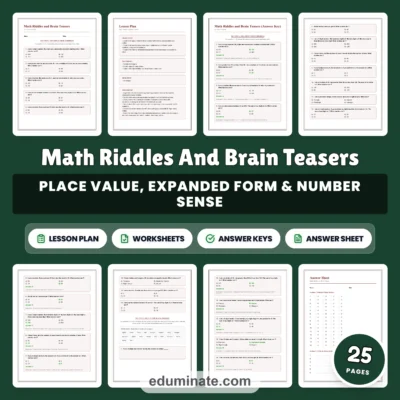
| Math Riddle Sheets | 3 to 7 | 31 | $4.99 |
The Math Brain Teasers Worksheets pack has 80 puzzles on number riddles, patterns, shapes and stories for second grade. The Math Riddles Worksheets pack has 65 clue based puzzles on place value, facts, shapes and perimeter for third grade. The Solve the Riddle pack has 60 brain teasers on place value, primes, shapes and facts for fourth grade. The Math Riddle Sheets pack has 80 questions on jokes, true or false facts, vocabulary and number riddles, which makes it a flexible choice for a class with a wide range of readers.
Jokes and trivia
Math jokes get groans and then, a moment later, understanding. A pun only lands if the student knows the vocabulary behind it, so a joke sheet is a vocabulary check in disguise.
- The Math Joke Worksheets pack has 75 questions of math puns and riddles on geometry, arithmetic and algebra. It is 32 pages for grades 3 to 7 and costs $4.99.
- The Math Trivia Worksheets pack has 50 questions on math history, geometry facts and vocabulary. It is 22 pages for grades 4 to 8 and costs $3.99.
Trivia works well on a Friday or as the last five minutes of a lesson. Students tend to remember a fact they were curious about far longer than one they were told.
Logic, detective and error analysis
These packs ask students to reason from clues and to question a solution. Both skills are easy to neglect when a unit moves fast.
| Pack | Grades | Pages | Price |
|---|---|---|---|
| Hard Logic Math Problems | 4 to 7 | 34 | $4.99 |
| Math Detective Worksheets | 4 to 8 | 33 | $4.99 |
| Find the Mistake Math Worksheets | 4 to 8 | 31 | $4.99 |
The Hard Logic Math Problems pack has 80 inferencing questions on number clues, patterns and real situations. The Math Detective Worksheets pack has 75 case puzzles on patterns, equations, word problems and geometry. The Find the Mistake pack has 75 error analysis questions on equations, fractions and rules.
Error analysis is worth doing every week. When a student finds the wrong step in someone else’s work, they have to understand the right step, and they feel less exposed than when their own paper is on the line. Try putting one wrong solution on the board each week and asking the class to find the slip.
Challenge and competition problems
For students who finish early and ask for more, or for a math club, these packs raise the level.
- The Math Challenge Problems pack has 85 questions on mental math, multiplication, word problems and place value. It is 33 pages for grades 3 to 6 and costs $4.99.
- The Math Competition Practice Problems pack has 70 questions on number theory, logic, patterns and geometry. It is 29 pages for grades 3 to 7 and costs $3.99.
- The Challenging Math Problems for 7th Graders PDF has 75 questions on integers, equations, ratios, geometry and data. It is 33 pages and costs $4.99.
- The Challenging Math Problems for 8th Graders PDF has 80 questions on equations, exponents, geometry and functions. It is 33 pages and costs $4.99.
Both the 7th and 8th grade packs come with a lesson plan, so they also work as a full period for a substitute: print, leave the key and a note, and the class has real math to do.
Four puzzles you can use without any printing
Put these on the board. The answers are here for you.
- I am a number between 50 and 100. I am a multiple of 9, and both my digits are the same. Answer: 99.
- What comes next in 3, 6, 12, 24, and what is the rule? Answer: 48, because each number doubles.
- Two numbers add up to 15 and differ by 3. What are they? Answer: 9 and 6.
- A rectangle has a perimeter of 20 and one side of 4. What is the other side? Answer: 6.
Ask students to write the first clue that helped them. Some will start with the multiple of 9, others with the digits, and that difference is worth discussing. Then ask them to write a riddle of their own for a partner. A student who can build a riddle has to hold the whole logic in their head.
How to run brain teasers without chaos
One puzzle, two minutes of silence
Put a teaser on the board. Students think alone for two minutes, then share with a partner. The silence matters, since it gives slower thinkers a chance to get to an idea before the fastest student calls it out.
Show your thinking
Require a few words or a sketch with every answer. A bare number tells you very little, and students learn that the thinking is the point.
Early finisher folders
Keep a folder of one or two pages at the back of the room. Students who finish early pick a page and work quietly. For more ideas on what to do with the minutes after a task, see our guide to early finishers activities.
Friday teaser
Choose a day each week and keep it the same. Students will start asking for it, and a regular routine keeps the teasers from feeling like a special event that needs a lot of setup.
Choosing the right level
A teaser should feel hard but possible. If more than half the class gives up in the first two minutes, drop down a grade level and try again tomorrow. If everyone finishes in thirty seconds, move up. Because the packs here run from grade 2 to grade 8, you can usually find a page one step above or below the class level and use it for a group that needs it. Keep a note of which puzzle types your students enjoy most, whether riddles, logic clues or jokes, and order more of those.
Frequently asked questions
Are brain teasers only for gifted students?
No. Clue-based riddles at the right level suit every student, and students who find standard worksheets dull often do better when the same skill arrives as a puzzle.
How long should a brain teaser take?
Two to ten minutes is a good range for a single puzzle. Longer sets, such as detective cases, can fill a center.
Which pack is best for a first try?
Match the pack to the grade. The 80 puzzle second grade pack, the 65 puzzle third grade pack and the 60 puzzle fourth grade pack are each written for a single grade, so they need little adjusting.
Can I print these on US Letter paper?
Each pack in this guide states that its A4 files print on US Letter with Fit to page.