Rocks and Minerals Worksheets for Grades 3-7
Good rocks and minerals worksheets pair short non-fiction reading with questions that check facts, vocabulary and thinking. The main pack below gives students in grades 3 to 7 ten passages on rock types, minerals, the rock cycle and the ways people use Earth materials, with an answer key and a lesson plan.
Here are the topics a solid rocks and minerals unit should cover:
- Igneous rocks formed from cooled magma and lava, such as basalt and granite.
- Sedimentary rocks built up in layers, such as limestone, and the fossils they can hold.
- Metamorphic rocks changed by heat and pressure, such as marble and slate.
- The difference between a rock and a mineral.
- The rock cycle, where one kind of rock slowly becomes another.
- Mineral hardness and the scratch test.
- Everyday uses of minerals, from pencil graphite to drywall.
In this article (9 sections)
Rocks versus minerals
Many students use the two words as if they mean the same thing. A mineral is a pure crystalline material, and a rock is usually a mix of one or more minerals. The reading pack spends a whole passage on this difference, which saves you from repeating it in every lesson. A simple check at the start of a unit is to ask each student to write one sentence that explains how a rock differs from a mineral. Keep the answers and ask again at the end.
The main pack: ten passages with questions
The Rocks and Minerals Worksheets: Reading Passages with Answer Keys pack costs $7.99 and is listed for grades 3 to 7. It has 64 pages in three PDF files: a 41 page student worksheet, a 22 page answer key and a one page lesson plan. The pages are A4 and print on US Letter with Fit to page. The product page also says the pages are formatted for black and white printing, which helps when you print a class set.
The ten passages, as listed on the product page, are:
- Pebbles and Stones, on common outdoor rocks, sorting and weathering.
- Born from Fire, on magma, lava and igneous rocks.
- Layers of History, on sediment, fossils and limestone.
- Changed by Pressure, on metamorphic rocks such as marble and slate.
- Rocks vs. Minerals.
- The Endless Cycle, on the rock cycle.
- The Hardness Scale, on Mohs scratch testing.
- Treasures of the Earth, on gemstones, gold and silver, and mining.
- Beneath Our Feet, on the crust, mantle, core and tectonic plates.
- Minerals in the Modern World, on quartz in electronics, gypsum in drywall and graphite in pencils.
Each passage comes with multiple choice questions, true or false statements, matching tasks and short answer prompts. The product page says the questions test factual recall, vocabulary in context and inference, so students must go back to the text for their answers.
Another earth science pack for older elementary
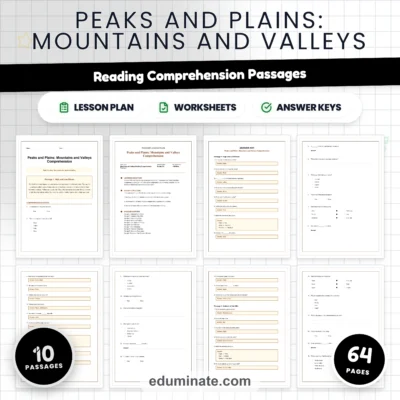
If your class has finished rocks and wants to keep going, the Mountains and Valleys Reading Comprehension Passages pack is listed for grades 2 to 6. It has 64 pages and costs $7.99. It follows the same format of passages, questions and answer keys, so students who know how to work with the rocks pack can start right away.
Eight earth science packs in one download
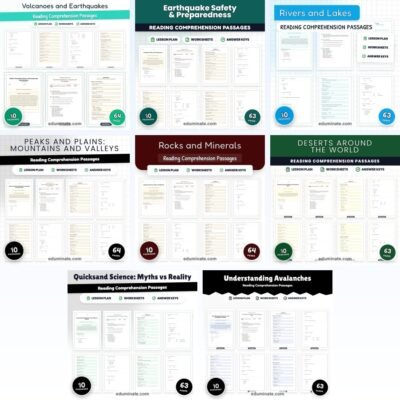
The Earth Science Worksheets Bundle holds eight reading packets and 507 pages for grades 2 to 8. It covers volcanoes, earthquakes, rivers, mountains, rocks and minerals, deserts, quicksand and avalanches. The separate prices add up to $63.92, and the bundle costs $44.74, so you save $19.18, or 30 percent. A bundle fits a teacher who plans a full year of earth science, since each packet has the same layout of passages, questions, key and lesson plan.
Using the worksheets with real rocks
Reading and handling go well together. A small collection of real stones turns the passages into something students can check for themselves.
A sorting center
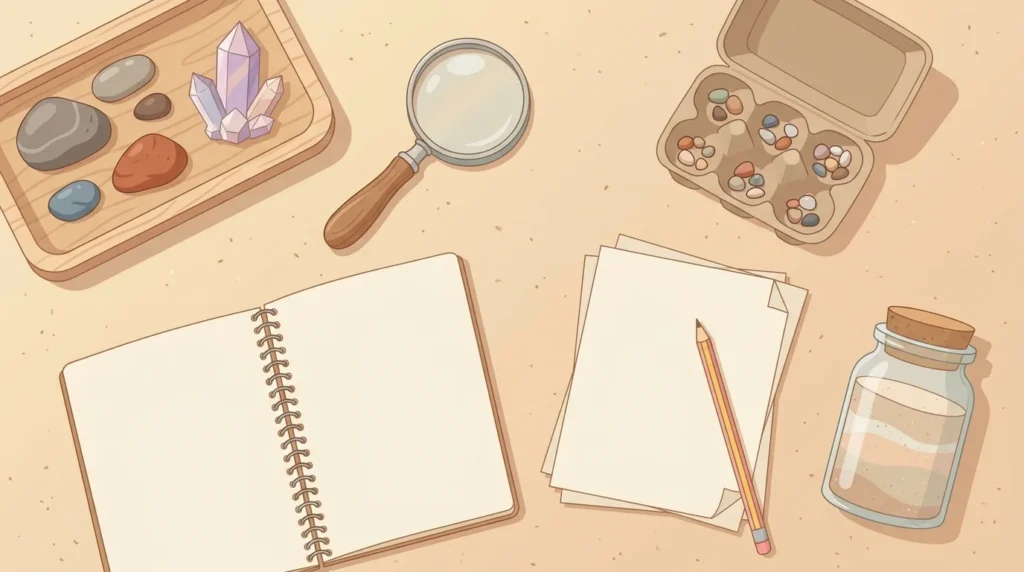
Put a tray of mixed stones on a table with a magnifying glass. Students sort them by color, texture and whether they can see grains or crystals. After they read the passage on pebbles and stones, ask them to describe one stone in three sentences using words from the text.
A simple scratch test
The hardness passage explains how scratching is used to compare minerals. In class you can use a coin, a steel nail and a fingernail to test which items scratch which. Have students record what scratches what in a small table. Keep the tools out of reach of the youngest students and have an adult handle any sharp item.
Rock cycle story
After the Endless Cycle passage, ask each student to tell the story of one grain of sand, from a mountain to a riverbed to a layer of sedimentary rock. Students who write the story in order show that they have understood the cycle, and students who skip steps show you exactly where to reteach.
A class museum
Ask students to bring one stone from home or the school yard. Each student writes a label with the color, texture and a guess about the rock type, and then checks the guess against the passages. Never ask students to remove stones from a protected place or to bring anything sharp.
How to schedule the pack
The lesson plan outlines a 150 minute block, which most teachers split into several shorter sessions. Here is one way to spread the ten passages across two weeks:
- Days 1 and 2: Pebbles and Stones, plus Rocks vs. Minerals. Sort stones.
- Days 3 to 5: One passage on each of the three rock types, with a short discussion after each.
- Days 6 and 7: The Endless Cycle and the hardness passage, with the scratch test.
- Days 8 to 10: Treasures of the Earth, Beneath Our Feet and Minerals in the Modern World, followed by a short review.
You can also use single passages as morning work, test review or science rotation tasks, as the product page suggests.
Support and challenge
For students who read slowly, read the passage aloud once while they follow along, and then let them answer the multiple choice items first. Short answer prompts can be done as a spoken answer to a partner. For fast readers, ask them to write one extra question about the passage and trade it with a classmate. Third graders can focus on the first six passages, and sixth and seventh graders can handle the full set with the short answer prompts.
Vocabulary is a large part of this topic, since words such as magma, sediment, crystal and erosion appear in many passages. Keep a word wall with a short plain meaning for each, and add a new word after each passage. If you want a different earth topic to compare with, our weather worksheets guide gives ideas that follow the same read, question and discuss pattern.
Assessing what students learned
The question pages already give you a quick score, but a short oral check adds detail. After finishing a passage, ask a student to explain one idea to a partner in their own words, for example how marble forms or why graphite is useful in a pencil. If the explanation matches the text, the student has understood it. If the student only repeats a phrase, return to the paragraph and read it together.
For a unit test, choose three or four questions from different passages and mix the formats: one matching task, one true or false item and one short answer. Ask students to write the short answer in complete sentences and to name the passage where they found the fact. This builds the habit of citing the text, which carries over to every other subject.
Keep a simple record of which passages each group has finished. Because each passage stands alone, groups can work in a different order without any trouble, and you can fill gaps later with the answer key in hand.
Frequently asked questions
What grades are the rocks and minerals worksheets for?
The pack is listed for grades 3 to 7. Students at the lower end will do best with read aloud support, and older students can work independently.
Is there an answer key?
Yes. The pack has a 22 page answer key and a one page lesson plan along with the 41 page student worksheet.
Can I print the pages on US Letter paper?
The product page says the A4 files print on US Letter with Fit to page.
Do I need real rocks to use the pack?
No. The passages and questions work on their own. Real stones are a good extra if you have them, but the reading and the questions do not depend on them.