Informational Text Reading Comprehension: Passages
Informational text reading comprehension means reading a nonfiction passage, such as an article about snow or rocks, and answering questions that check facts, vocabulary and main ideas. It works best when each passage is short enough to finish in one sitting and the questions ask children to go back to the text for evidence. The sets below cover grades 1 to 7, and each one includes an answer key, so you can check work quickly.
Here are the question types and skills that good informational passages practise:
- Finding the main idea of a passage, then naming two or three key details that support it.
- Answering multiple choice and true or false questions with proof from the text.
- Learning new words from context, such as science terms in an article about rocks.
- Writing a short response that uses a fact from the passage.
- Using text features, such as headings and captions, to find answers faster.
In this article (10 sections)
A free informational pack
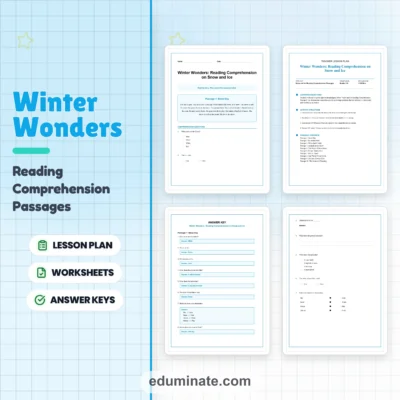
If you want to try before you buy, we have a free pack: Free Winter Reading Comprehension Worksheets. It is a 61-page set for 4th grade, with two files: a 40-page student worksheet file and a 21-page answer key. It holds ten winter reading selections, which include a passage on the snowy owl, one on unique snowflakes, one on staying safe in winter and one on the frozen pond. A free pack takes an email address, which opens a free account and keeps the file in My Library.
The free pack is a fair test of how your class handles passages with questions. The paid sets below offer other topics and other grade levels, so you can match the text to the children you teach.
What makes a good informational passage
Strong nonfiction for children does a few things well. It states its topic early. It uses real facts in plain sentences. It introduces a few hard words and explains them. And it comes with questions that cannot be answered without reading.
Teachers can check a passage with three quick questions before they print it:
- Can a child say in one sentence what the passage is about?
- Are there two or three words that children will need to learn?
- Do the questions point back to specific lines or paragraphs?
If the answer to all three is yes, the passage is ready for class. Our guide to text features shows how headings, bold words and captions help children read nonfiction faster.
Passage sets compared
Every set here is a PDF whose product page says the A4 files print on US Letter with Fit to page. Pages, grades and prices come from each product page.
- The Reading Comprehension Informational Text: 74 Easy Pages set is for 5th grade, at $8.99. It has ten reading selections, including the water cycle, honeybees, the Red Planet, photosynthesis, desert camels and healthy eating habits. Each selection comes with multiple choice, true or false, fill in the blank vocabulary and short written response questions. The pack includes a one page teacher lesson plan and 23 pages of answer keys. The description says the selections mix nonfiction with a few narrative texts.
- The Snow Worksheets: 10 Simple Reading Passages set has 72 pages for 1st to 5th grade, at $8.99. It has ten nonfiction passages, with topics such as ice on the pond, animals in the snow, the shape of snowflakes and glaciers. It includes complete answer keys and a lesson plan.
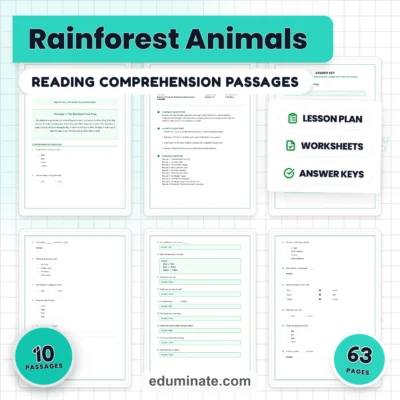
- The Rainforest Worksheets: 10 Clear Passages set has 63 pages for 1st to 5th grade, at $7.99. It has 40 student worksheet pages and 22 answer key pages, with ten nonfiction articles about rainforest wildlife.
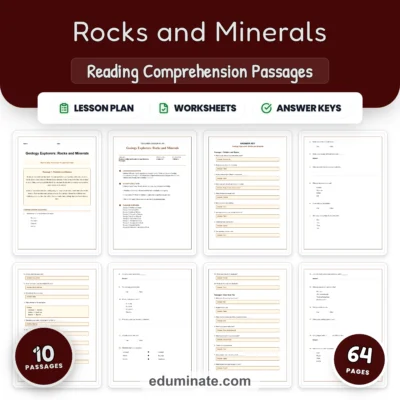
- The Rocks and Minerals Worksheets: 64 Complete Printable Pages set is for 3rd to 7th grade, at $7.99. It has ten nonfiction articles on geology, the rock cycle, crystals and mineral resources, with 41 student pages and 22 answer key pages.
The science reading bundle
The Science Reading Mega Bundle holds 27 science reading packs in one download. That is 1,708 pages in 82 PDF files, at $129.44, which is 40% off the $215.73 the packs cost separately. It includes the Snow, Rainforest Animals and Rocks and Minerals packs above, plus others on topics such as bees, bats, the water cycle, volcanoes and the human body. It is built for a school or a homeschool family that wants a full year of nonfiction reading across several grades. If you only need one topic, a single pack costs far less.
A simple routine for each passage
A repeatable routine saves planning time and helps children know what to do. Here is one that fits into twenty to thirty minutes.
- Preview, two minutes. Read the title aloud, look at any picture and ask, “What do you think this will teach us?”
- First read, five minutes. Children read silently, or you read aloud for younger groups. Ask them to underline one new word.
- Talk, three minutes. Ask for the main idea in one sentence. Write it on the board.
- Questions, ten minutes. Children answer in writing and mark the line where they found each answer.
- Check, five minutes. Use the answer key to go over the answers together, or let partners check each other.
The step where children mark the line of the answer is the most useful one. It teaches them that the answer is in the text, not in a guess.
Skills to teach through informational passages
Main idea and key details
Ask children to cover the passage and say the main idea. Then ask them to uncover it and find two details that prove it. If they cannot find two, the main idea may be too broad.
Vocabulary in context
Choose two words from each passage. Ask children to guess the meaning from the sentence, then check with a dictionary. A word wall in the room keeps the new words in sight.
Text evidence
Teach children to start written answers with “The text says” and to finish with a fact. A sentence frame helps those who find writing hard.
Cause and effect
Many science passages explain why something happens. Ask, “What happened, and why?” The snow and rocks passages are good for this.
Keep a reading log
A simple log helps children see their own progress. After each passage, they write the title, one new fact and one new word. Over a few weeks the log becomes a small book of what they learned, and it gives you a quick way to check who is picking up vocabulary. Younger children can draw a picture of the fact instead of writing a sentence.
Choosing a level
Grade ranges on the product pages are a starting point, not a rule. A 3rd grader who reads well can try a passage from a 4th grade set, and a struggling 5th grader may be more comfortable with a passage from a 2nd grade level. The sets above overlap in range, so you can give one topic to a whole class at two levels.
Ways to use passages in class
- Guided reading. Read one passage with a small group while the rest of the class works on a different task.
- Literacy centers. Print one passage and its question page for each center rotation.
- Science links. Pair a passage with a science unit, for example snow with a winter weather lesson.
- Homework. Send one passage home and ask the family to talk about it.
- Sub plans. A passage, its questions and an answer key give a guest teacher a task that needs no explanation.
Frequently asked questions
What is informational text?
Informational text is nonfiction writing that explains facts about a topic, such as an article about rainforest animals. It often has headings, new vocabulary and details that support a main idea.
Do these sets include answer keys?
Yes. The 5th grade set has 23 pages of answer keys, the Rainforest and Rocks and Minerals sets have 22 pages each, and the Snow set includes complete answer keys. The free winter pack has a 21-page answer key.
What grades do these passages suit?
The listed grades run from 1st to 7th. The Snow and Rainforest sets cover 1st to 5th grade, the Rocks and Minerals set covers 3rd to 7th grade, and the informational text set is for 5th grade.
Where should I start?
Try the free winter pack if your class is in 4th grade. For other grades, pick a topic your class already enjoys, such as snow or rainforest animals, and start with one passage.