Watermelon Coloring Page Ideas for Class and at Home
A watermelon coloring page gives children a bold, familiar fruit to color, and it opens the door to short lessons on colors, seeds and fruit names. This guide shows how to use one in class or at home, with color tips, simple counting tasks and fruit sets for a larger unit.
Why a watermelon coloring page works well
A watermelon has a clear, easy shape. A slice is a half circle with a thick green edge, a red middle and a scatter of dark seeds. Children can spot each part at a glance, so they know where to put each color.
The fruit also comes with a short set of colors that children already know: red, green, light green and black. That makes it a gentle first page for a child who is still learning to color inside lines.
A single page can serve several goals:
- Color practice with a small, clear palette.
- A quiet activity for a break or an early finisher.
- A link to a food or plant lesson.
- Simple counting, since the seeds are easy to count.
The parts of a watermelon
Before children color, take a minute to name the parts. If you have a real slice in the room, hold it up. If not, a picture or the printed page will do.
- Rind: the hard green outside of the fruit. It is often striped with a lighter green.
- Flesh: the juicy red or pink middle that people eat.
- Seeds: the small dark shapes spread through the flesh.
Ask children to say each name as they color that part. A child who colors the rind green and says “rind” is linking the word to the shape. You can also point out that watermelons grow on a vine along the ground. Our guide to healthy eating activities for preschoolers has more ways to talk about fruit with young children.
Color tips for watermelon coloring pages
Watermelon coloring pages are a good place to teach a few simple coloring skills.
Green and red
Green and red sit across from each other on the color wheel, so they look strong together. Ask children to color the rind and the flesh and notice how the two colors make each other stand out.
Light to dark
Press lightly for a pale green on the inside of the rind and press harder for a deeper green on the outside. A child who does this gets a fruit that looks rounder and more real.
Stripes
The outside of a watermelon often has stripes. Give children two greens and ask them to color alternating stripes, such as dark, light, dark, light. It is a quick way to practice a pattern.
Choosing tools
Crayons are easy to hold and good for younger children. Colored pencils allow thin seeds and soft shading. Markers give a bright red that is hard to match, but a spare sheet of paper underneath helps stop bleed-through.
Counting seeds and simple math
Seeds give you a ready-made counting task. Here are a few ways to use them, with the answers worked out so you can check quickly.
- Count and color. Ask children to count the seeds on their slice and write the number on the back of the page.
- Addition. One slice has 4 seeds and a second slice has 3 seeds. How many seeds in all? The answer is 7.
- Subtraction. A slice has 9 seeds. A child colors 4 of them black. How many are left to color? The answer is 5.
- More and fewer. Place two finished slices side by side and ask which one has more seeds and how many more.
For a hands-on version, give each child a handful of small paper circles to place on the seeds, then count them as they go.
Fruit coloring pages for a bigger unit
Once children have colored a watermelon, they often want to try another fruit. A set of fruit coloring pages lets you build a full unit around different foods. These are some sets to look at.
- The Fruits and Vegetables Coloring Pages set has 40 preschool healthy food pages featuring smiling apples, carrots, broccoli and watermelons.
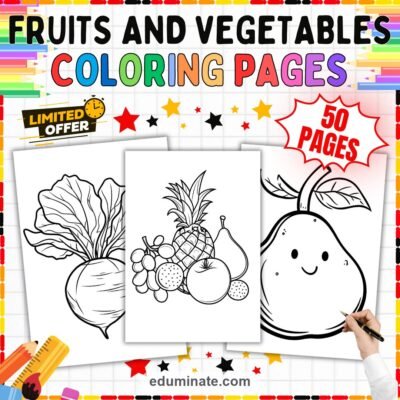
- The Fruit and Vegetable Coloring Pages set has 50 printable worksheets featuring root beets, tropical pineapples, sweet grapes and orchard pears.
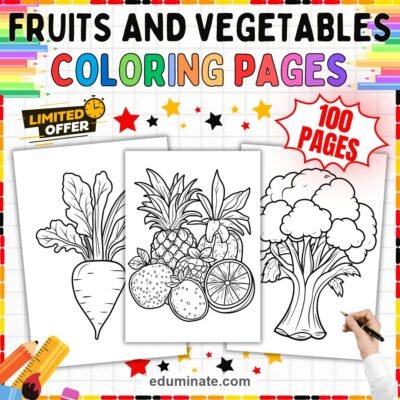
- The Fruits and Veggies Coloring Pages set has 100 printable worksheets featuring broccoli crowns, root radishes, tropical pineapples and sliced citrus.
- The Printable Fruits and Vegetables Coloring Pages set has 79 pages for preschool and elementary nutrition units, science lessons and classroom art.
- The Fruit and Veggie Coloring Pages set has 22 quick printable activities featuring ripe bananas, spiky pineapples and freshly pulled carrots.
The Healthy Eating Coloring Pages Bundle gathers eleven coloring packs in one download, covering fruits, vegetables, nutrition and healthy drinking water, in 611 pages. It is useful when you want one download to cover a whole food unit.
Summer fruit activities with watermelon pages
Watermelon is a summer fruit for many families, so these pages fit the warm months well. Here are some ways to build a short activity around them.
- Fruit chart. Make a chart with three columns: red fruits, green fruits and yellow fruits. Children sort their finished pages into the columns.
- Favorite fruit vote. Each child colors a page of a fruit they like. Tape the pages on the wall in groups and count how many there are of each.
- Fruit stand. Turn finished pages into signs for a pretend fruit stand. Children take turns being the shopper.
- Describing words. Ask children to give one word for each fruit, such as juicy, sweet, crunchy or sour.
Tips for printing and organizing
A few small habits keep coloring time smooth.
- Print a few extra copies, since children often want a second try.
- Use heavier paper if the class will use markers or paint.
- Keep finished pages in a folder with each child’s name on the back.
- Offer a small tray with only red and green pencils for quick, focused watermelon pages.
Watermelon pages for reading and writing
A finished page gives children something real to talk and write about. These tasks need only a pencil and a few cards.
- Label the parts. Draw lines from the rind, flesh and seeds and write each word. Younger children can copy the words from the board.
- Describing words. Ask for three words about the fruit, such as juicy, sweet and cold. Write them around the picture.
- Sentence frame. Write “A watermelon is …” on the board and let children finish the sentence in their own way.
- Short paragraph. Older children can write three or four sentences about when they like to eat watermelon and what it looks like inside.
- Beginning sounds. Say the word “melon” and ask children to find other words that start with the same sound, such as moon, map and mud.
How a watermelon grows
A watermelon page can start a short talk about plants. A watermelon begins as a seed, which is why the seeds on the slice matter. The seed grows into a long vine that spreads along the ground. Flowers appear on the vine, and the fruit grows from a flower.
Ask children to put four steps in order:
- A seed goes into the soil.
- A small plant sprouts and grows a vine.
- A flower opens on the vine.
- A watermelon grows and gets bigger.
Children can color four small boxes, one for each step, and glue them in order on a strip of paper. It is a gentle introduction to a life cycle and to the idea of sequence.
A watermelon station for a center or a quiet corner
If you want an activity that runs without much help, set up a small station.
- A stack of watermelon pages, plus a few extra fruit pages.
- A cup of red, pink, green and black crayons or pencils.
- A small tray of paper circles for counting seeds.
- Index cards with the words rind, flesh and seeds.
- A basket for finished pages.
Children color the page, place the word cards beside the right parts and count the seeds. When they finish, they put the page in the basket and take a card to write on.
Grouping and comparing fruit
Once there are several fruit pages in the room, sorting and comparing come naturally.
- By color. Sort into red, green, yellow and orange fruits.
- By inside. Which fruits have seeds that you can see inside? Which have a peel you do not eat?
- By size. Put the fruits in order from smallest to largest, for example a grape, an apple, a watermelon.
- By taste word. Make groups for sweet, sour and juicy fruits.
A quick comparison like this builds vocabulary without a worksheet. Children use the pages as proof for their answers.
Tips for different ages
Preschool and kindergarten
Choose pages with big slices and thick lines. Let children use crayons and focus on naming colors and counting a few seeds. A page with a clear half circle shape is easiest.
First and second grade
Add labels, simple addition with seeds and a sentence about the fruit. Ask children to explain why they chose each color.
Third grade and up
Try shading with colored pencils, a short paragraph, or a pattern around the border. Older children can also make a small poster that shows how a watermelon grows.
Frequently asked questions
What colors do I need for a watermelon?
Red or pink for the flesh, two shades of green for the rind and black or dark brown for the seeds. A light yellow can also be used for the thin pale layer inside the rind.
How can I use a watermelon page for math?
Count the seeds on the slice, write the number, then add or subtract with a second slice. Children can also compare which slice has more seeds.
Are fruit pages only for preschool?
No. Younger children enjoy the bold shapes, and older children can use the same pages for labeling, shading or a short writing task about a favorite fruit.
Do I need a real watermelon?
No. A picture or the printed page is enough to name the parts. A real slice is a nice extra if you have one.