Apostrophe Rules: Contractions and Possessives Explained

An apostrophe does two jobs: it shows that letters are missing in a contraction, and it shows that something belongs to someone. These apostrophe rules explain both jobs with a list of contractions, rules for singular and plural possessive nouns, and a table of common mistakes.
Apostrophe rules at a glance
| Job | What the apostrophe does | Example |
|---|---|---|
| Contraction | Replaces missing letters | do not becomes don’t |
| Possession | Shows who owns something | the dog’s bone |
In school writing, an apostrophe does not make an ordinary word plural.
What are contractions
What are contractions? A contraction is two words squeezed into one. The apostrophe takes the place of the letters that were left out.
- I am becomes I’m (the letter a is gone).
- do not becomes don’t (the letter o is gone).
- she will becomes she’ll (the letters wi are gone).
List of contractions
This list of contractions has twenty common ones and the words they come from.
| Full words | Contraction | Full words | Contraction |
|---|---|---|---|
| I am | I’m | does not | doesn’t |
| you are | you’re | did not | didn’t |
| he is | he’s | is not | isn’t |
| she is | she’s | are not | aren’t |
| it is | it’s | cannot | can’t |
| we are | we’re | will not | won’t |
| they are | they’re | would not | wouldn’t |
| I will | I’ll | let us | let’s |
| you will | you’ll | I have | I’ve |
| she will | she’ll | do not | don’t |
Two of these look different from the rest. Cannot is one word, and its contraction can’t drops the letters no. Will not becomes won’t, which changes the vowel as well as dropping a letter. Students learn these two by memory. Our post on there vs their vs they’re goes deeper on one contraction students often mix up.
Other common contractions include that’s (that is), there’s (there is), what’s (what is), who’s (who is), they’ve (they have) and we’d (we would or we had). A name can join with is too: Tom’s here means Tom is here, while Tom’s book shows ownership. The sentence tells you which one it is.
Contractions examples
Each of these contractions examples is shown with the full words next to it.
| With a contraction | With the full words |
|---|---|
| I’m happy today. | I am happy today. |
| They don’t have homework. | They do not have homework. |
| She’s reading a book. | She is reading a book. |
| We can’t see the board. | We cannot see the board. |
| It isn’t raining. | It is not raining. |
| You’ll love this story. | You will love this story. |
Contraction rules
The contraction rules fit in a few lines:
- The apostrophe goes where the letters were removed, not between the two words. It is don’t, not do’nt.
- A contraction replaces two words, so it counts as one word in a sentence.
- To check a contraction, say the full words in its place. We’re becomes we are, and the sentence should still make sense.
- Contractions sound like speech. Some formal assignments ask for the full words, so follow your teacher’s instructions.
One pair needs extra care. It’s is a contraction of it is or it has, as in It’s cold outside. Its with no apostrophe shows ownership, as in The dog wagged its tail. To check, say it is in place of the word. If the sentence still makes sense, use it’s. For practice on this pair, the its vs it’s practice pack has a 70-question worksheet with a plain answer key, a teacher key and a one-page lesson plan, built for grade 4.
Possessive nouns
Possessive nouns use an apostrophe to show that someone or something owns another thing. The dog’s bone means the bone that belongs to the dog. Where the apostrophe sits shows whether there is one owner or more than one.
Pronouns work differently. The words his, hers, ours, yours, theirs and its already show ownership, so they never take an apostrophe.
Singular possessive nouns
For singular possessive nouns, add ‘s to the owner: the dog’s bone, the teacher’s desk, my mother’s car.
For a singular name ending in s, two styles are accepted. James’s book and James’ book are both correct. Ask students to follow the style their school or teacher uses.
Plural possessive nouns
For plural possessive nouns, look at how the plural is spelled.
- Plural ends in s: add just the apostrophe after the s. The dogs’ bones means the bones that belong to more than one dog. The teachers’ room belongs to several teachers.
- Plural does not end in s: add ‘s, just as for a singular noun. The children’s toys. The men’s coats.
Comparing one owner and many owners shows the difference: the girl’s backpack (one girl) and the girls’ backpacks (more than one girl). The apostrophe moves from before the s to after it.
A three-step routine helps students choose the right form:
- Find the owner. Who or what has the thing?
- Decide whether there is one owner or more than one, and write the owner in the correct singular or plural form.
- Look at the last letter. If the word ends in s, add just an apostrophe. If it does not, add apostrophe and s.
Try it on the sentence The toy that belongs to the boy. The owner is boy, there is one, and it does not end in s, so the answer is the boy’s toy. For The toys that belong to the boys, the owner is boys, there are several, and it ends in s, so the answer is the boys’ toys. For The shoes that belong to the women, the owner is women, and it does not end in s, so the answer is the women’s shoes.
Possessive nouns examples
These possessive nouns examples show each form with the number of owners.
| Phrase | Number of owners | How it is formed |
|---|---|---|
| the girl’s backpack | One | girl + ‘s |
| the girls’ backpacks | More than one | girls + ‘ |
| the cat’s tail | One | cat + ‘s |
| the cats’ bowls | More than one | cats + ‘ |
| the child’s coat | One | child + ‘s |
| the children’s coats | More than one | children + ‘s (irregular plural) |
| the bus’s mirror | One | bus + ‘s |
| the babies’ blankets | More than one | babies + ‘ |
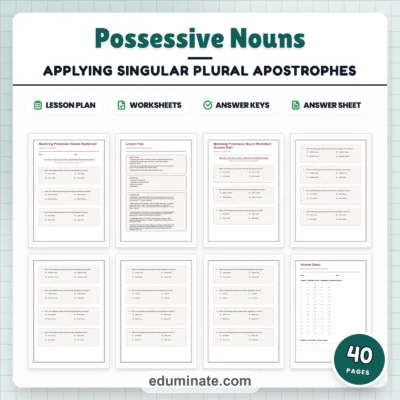
For a full set of practice, the possessive nouns packet has 40 pages, with 70 questions across five ownership sections, a four-page recording sheet and a 17-page answer key, for grades 3 to 5.
Apostrophe examples and common mistakes
These apostrophe examples show frequent errors and their fixes. The first row is the most common one: apostrophe in plurals. A plural noun does not take an apostrophe only because it is plural.
| Wrong | Right | Why |
|---|---|---|
| Apple’s for sale | Apples for sale | The word is a plain plural, so no apostrophe. |
| The dogs bone | The dog’s bone | The bone belongs to the dog, so the apostrophe is needed. |
| Your welcome | You’re welcome | You’re means you are. |
| The childrens toys | The children’s toys | Children is plural without s, so add ‘s. |
| Its raining | It’s raining | It’s means it is. |
| The dog wagged it’s tail | The dog wagged its tail | Its with no apostrophe shows ownership. |
When to use an apostrophe
When students ask when to use an apostrophe, give them three questions to run through:
- Are letters missing from two joined words? If yes, it is a contraction.
- Does it show that something belongs to someone? If yes, it is a possessive.
- Is it just more than one thing? If yes, no apostrophe.
This quick check is how to use apostrophes without memorizing a long list. Apostrophes also appear inside dialogue, where they sit next to quotation marks. Our posts on quotation marks rules and comma rules cover the punctuation around them.
Ways to teach it
Sort cards: contraction or possession
Write phrases on cards, such as can’t, the boy’s hat, we’re and the girls’ room. Students sort them into contraction and possession piles and say why.
Squeeze the words
Write two words on separate strips of paper, such as did and not. Students slide the strips together, cross out the missing letters and write the contraction.
Fix the sign
Make a short list of signs with apostrophe mistakes, like Hot dog’s for sale. Students rewrite each one correctly and explain the change.
Practice material
For contractions, the contractions packet for grade 3 has 54 questions across four practice sections, with an answer key, a student answer sheet and a lesson plan.
The nouns bundle puts four noun packets in one download: regular and irregular plurals, possessive apostrophes, and how much or how many with countable and uncountable nouns. It runs 182 pages, for grades 2 to 5. For more punctuation, the punctuation rules packet has 44 pages for grades 4 to 6, with 70 questions across 6 sections.
Frequently asked questions
Do plural words take an apostrophe?
No. A plural noun does not take an apostrophe just because it is plural. An apostrophe appears only when the plural also shows ownership, as in the dogs’ bones.
Can I use contractions in school writing?
It depends on the assignment and the teacher. Informal writing and dialogue use them freely. Some formal assignments ask for the full words.
What grade learns contractions?
Schools differ, so check your curriculum. For reference, our contractions packet is listed for grade 3, the its vs it’s pack for grade 4, the possessive nouns packet for grades 3 to 5 and the nouns bundle for grades 2 to 5.
Is ‘s always possessive?
No. The ending ‘s can be a possessive (the dog’s bone), or it can be a contraction of is or has. In She’s happy, it stands for is. In He’s gone home, it stands for has. It’s is another contraction of this kind.
Related resources
- Contractions Worksheets, Sentences Practice Packet, Combining Words Exercises
- Its Vs It’s Grammar Worksheet, Contractions and Possessives, Practice Pages
- Possessive Nouns Worksheet Packet With Singular and Plural Apostrophe Work
- Nouns Worksheets Bundle, Plurals, Possessives and Countable Nouns Practice
- Punctuation Rules Worksheets, End Marks Commas Colons and Semicolons Packet