Short O Words: CVC Lists, Blends and 2 Syllable Words
Short o words are words in which the letter o makes the vowel sound in “hot”, written /o/. This guide lists short o words by word family, blends and syllables, then adds sentences, a comparison with short a and long o, and activities for home or class.
Short o words
The short o sound is the vowel in “hot”, “pot” and “mop”. To make it, open the mouth wide and let the jaw drop, as if saying “ah” at the doctor. Children can feel the difference between this open sound and the rounded long o in “go”.
As with the other short vowels, a CVC word is the easiest place to hear it: one vowel between two consonants. The short a words post introduces all five short vowels and closed syllables, the short i words post covers the vowel before this one in the usual teaching order, and the short u words post comes next.
One honest note about this vowel: it varies from accent to accent. In some regions “cot” and “caught” sound the same, and words like “dog”, “frog”, “log” and “off” are said with a different vowel than “hot”. The lists below stay with words where the short o sound is clear. If a word sounds different in your accent, go by how you say it.
Short o CVC words
A CVC word has a consonant, a vowel and a consonant, and each letter makes one sound. The CVC words guide explains the pattern in detail. These short o CVC words are grouped by ending:
- -ot: hot, pot, dot, got, lot, not, cot, rot
- -op: top, hop, mop, pop, cop
- -ob: job, sob, cob
- -od: nod, pod, rod, cod
- -ox: box, fox, ox
- Other short o words: mom, on, Tom, Don
Read each family in a row, saying the ending first and then adding the starting sound. For the -ot family: /ot/, then /h/ for “hot”, /p/ for “pot”, /d/ for “dot”. The child hears that only the first sound changes.
The letter x stands for two sounds, /k/ and /s/, so “box” has four sounds even though it has three letters: /b/ /o/ /k/ /s/. Point this out when you reach the -ox words.
Short o words for kindergarten
A small set is enough for one lesson. These short o words for kindergarten use common letters and clear sounds:
- hot, pot, top, hop, mop, box, fox, job
- dot, got, lot, not, nod, pop, rod, pod
Read them together as a list, then mix them so that the child checks each word. Once the child is comfortable, short sentences and stories come next. The CVC word lists pack gives sixty decodable words across six pages for Pre-K to 1st grade, in PDF and PowerPoint formats. When the words are secure, a short text from the decodable books guide gives the child something real to read with just these sounds.
Short o words with blends and digraphs
Blends keep both consonant sounds audible, like “st” in “stop”. Digraphs are two letters that make one sound, like “ch” in “chop”. The vowel in each of these short o words with blends is still the short o sound.
- Beginning blends: stop, drop, crop, flop, plop, spot, slot, plot, trot, blob, clock, block, stock, flock
- Digraphs: shop, chop, shock, chomp
- Ending blends: pond, bond, stomp, romp
- Ending -ck: sock, rock, lock, dock, clock, block
The -ock family is a favorite. The letters “ck” make one sound, /k/, so “sock” has three sounds, /s/ /o/ /k/, and “block” has four: /b/ /l/ /o/ /k/. Practice with “sock”, “rock”, “lock” and “dock” first, then add blends to get “clock”, “block”, “shock” and “stock”.
2 syllable short o words
In the 2 syllable short o words below, the first syllable is a closed syllable, with one vowel followed by a consonant, so the o is short. The second syllable is said lightly. Split the word between the consonants in the middle to read it: rock-et, pock-et, prob-lem.
- Compound words: laptop, desktop, hopscotch, chopstick, popcorn, sunspot, cobweb, bobcat
- Everyday words: rocket, pocket, socket, doctor, problem, comic, common, object, ostrich, olive, robin, dolphin
Compound words are the easiest to start with. “Laptop” splits into lap-top, and “hopscotch” into hop-scotch. Each half is a short word the child may already read. Show the split with a line on paper, read each part, then say the whole word smoothly. The closed syllable section of the short a words post has the same steps for every vowel.
Short o sound words
Short o sound words are all the words with the /o/ sound, whatever their spelling. A few common words spell it with the letter a, mostly after w:
- wa: watch, swan, wasp, want, swamp
These are good to teach as a small group once the basic o words are secure.
The opposite problem comes up with words that have one o and end in a consonant, yet the vowel is long: “most”, “both”, “old”, “cold”, “gold”, “bolt”, “post” and “roll”. They look like closed syllables and they are not short o words, so keep them in a separate list and teach them as a pattern of their own.
A simple order for teaching short o
One way to plan the first lessons is to move from the easiest words to the hardest, adding one new thing at a time:
- Three-letter words from one family, such as -op or -ot.
- Three-letter words from two or three families, mixed together.
- Words with an ending blend or the -ck ending, such as stomp, pond and sock.
- Words with a beginning blend or a digraph, such as stop, shop and chop.
- Two-syllable words.
- Short sentences and then short stories.
If a child stumbles at any step, go back one step and stay there for a few days. A step that feels easy is the signal to move on. Short, frequent practice with a few words works better than one long session with many.
Spelling short o words
Reading and spelling use the same skill in opposite directions. To spell a short o word, the child says the word slowly, counts the sounds on their fingers and writes one letter for each sound. Dictate three or four words from one family, then a few mixed words, and check each one together. For words like block, shop and clock, remind the child that two letters can share one sound.
Short o words in sentences
The sentences below let a child read short o words in context. The words with the short o sound are in bold. The other words are simple ones that children learn on the side.
- The fox hid in the box.
- Tom got a job at the shop.
- The pot is hot.
- Stop at the dock and drop the box.
- A sock is on the rock.
- Mom will mop the spot.
- I will trot to the pond.
Have the child read each sentence twice, first slowly and then smoothly. Ask a short question afterward, such as what is hot or where the sock is. That keeps the reading tied to meaning.
Short o vs short a
Short o and short a both use an open mouth, and children sometimes swap them. Word pairs that change only the vowel train the ear:
- hot and hat
- pot and pat
- mop and map
- top and tap
- cot and cat
- rock and rack
- sock and sack
- lock and lack
Read each pair slowly and stress the vowel. Then ask the child which word is which in a sentence, such as “The pot is hot” and “The hat is on the mat”. The short a words guide has the full lists for the other half of each pair.
Short o vs long o
A silent e at the end of a word usually turns a short o into a long o, the sound that says the letter name. These pairs show the change:
- hop and hope
- not and note
- rod and rode
- cod and code
- slop and slope
- glob and globe
Read the short word, add the e and read it again. Ask what changed in the sound and what changed in the word.
Short o activities
Keep each short o activity short, and always read the words aloud.
Build and read
Write an ending such as -op on a card. The child adds starting letters on small cards to build “top”, “hop”, “mop”, “pop” and “stop”, reading each word as it appears.
Change one letter
Begin with “hot” and change one sound at a time: “hot”, “pot”, “pod”, “nod”, “not”, “dot”. The child writes each word and reads the full chain at the end.
Sound boxes
Draw one box per sound. For “block”, draw four boxes and push a counter into each as you say /b/ /l/ /o/ /k/. Then write a letter or letter pair for each sound. Remember that “ck” shares one box.
Sort the vowels
Write short o words and short a words on cards. Mix them up, sort them into two piles and read each pile aloud. Use the pairs above to make the sort harder.
Practice material
When word lists feel easy, move to connected reading. These printable sets use decodable stories and sentences with short vowels:
- Short Vowel Worksheets for Kindergarten to 1st grade: ten decodable phonics stories with questions across thirty-one worksheet pages, and twenty pages of teacher answer keys.
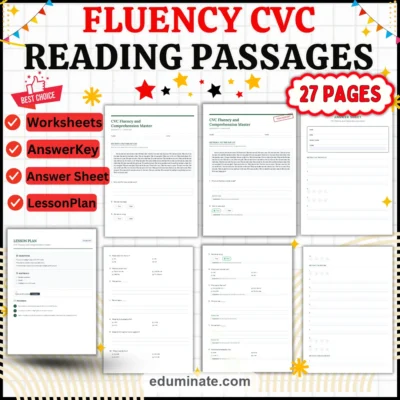
- Kindergarten CVC Worksheets: five short vowel stories with multiple choice, true or false and fill in the blank items, plus answer recording sheets, a lesson plan and answer keys.
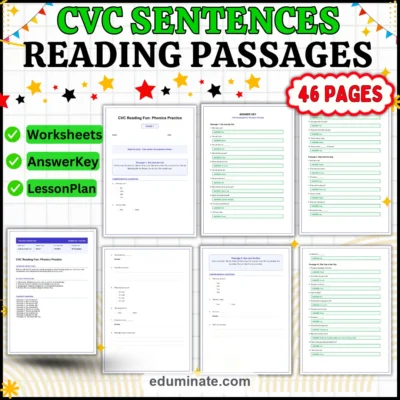
- Reading Simple CVC Sentences for Kindergarten to 1st grade: ten decodable stories, thirty-one worksheet pages, a lesson plan and fourteen pages of answer keys.
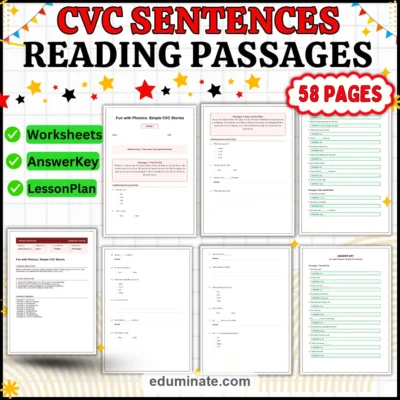
- CVC Stories for Kindergarten to 1st grade: ten decodable stories, forty student worksheet pages, a lesson plan and seventeen pages of answer keys.
- Decodable CVC Passages for 1st to 3rd grade: ten short vowel adventure stories with 150 comprehension questions across thirty student pages.
The other vowels have their own lists: short a, short e, short i and short u.
Frequently asked questions
What are short o words?
Short o words have the vowel sound in “hot”. Most are spelled with the letter o, like “top”, “box” and “clock”.
Is “dog” a short o word?
It depends on the accent. Many speakers say “dog” with a slightly different vowel than “hot”, and others say them the same. Use the word if it has the short o sound when you say it, and leave it out of a list if it does not.
Why are “old” and “cold” not short o words?
The o in these words is long, even though a single o is followed by consonants. Endings such as -old, -olt and -ost are taught as their own patterns.
What grade learns short o words?
The printable sets above are made for Kindergarten to 1st grade, and the decodable passages for 1st to 3rd grade.
Related resources
- Short Vowel Worksheets: CVC Words Reading Passages and Questions
- Kindergarten CVC Worksheets: Reading Passages with Questions
- Reading Simple CVC Sentences Worksheets
- CVC Stories Reading Comprehension Passages for Kindergarten and Grade 1
- Decodable Passages: Decodable CVC Printable Pages
- CVC Word Lists: Winter Phonics Worksheets