Kindergarten Activity Sheets: What to Include Each Week
Kindergarten activity sheets are short printable pages that give young learners practice with letters, sounds, numbers and the small hand movements behind writing. This guide shows what to include across a school week, how to keep each page useful, and where cards and coloring pages fit alongside the pencil work.
For the full set in one download, the Kindergarten Worksheets Bundle has 22 packs and 1180 printable pages of CVC reading, sight words, counting and early math.
What kindergarten activity sheets are for
A set of kindergarten activity sheets is not a test. It is one small, focused chance to practice something the class has already met. A child traces a letter after seeing it taught, or counts a row of objects after counting them aloud as a group.
That shapes what a good page looks like:
- One skill per page, so a child knows what to do at a glance.
- Clear instructions that an adult can say out loud in a few words.
- Large print and plenty of white space for big handwriting.
- Room to be finished without help, so the page also works as independent practice.
Pages are one tool among many. Kindergarten learning also happens through talking, building, sorting real objects and play. Worksheets should add to that, not replace it.
The main areas to cover
Most kindergarten plans touch the same handful of areas. Here is a plain way to sort them.
Letters and sounds
Children meet the alphabet, learn what each letter is called and begin to connect letters with sounds. Typical pages ask a child to circle a letter, match uppercase to lowercase, or trace a letter. Our posts on letter recognition worksheets and alphabet tracing worksheets go into more detail on each step.
Early reading
Once a child knows some letter sounds, short words come next. Many classrooms teach sight words, which are words that show up often in text, and CVC words, which are three-letter words with a consonant, a vowel and a consonant, such as cat or sun. See our lists of sight words for kindergarten and CVC words for words to work with.
Numbers and counting
Early math starts with counting, recognizing numerals and comparing amounts. Pages might ask a child to count a group of objects and write the number, or fill in the missing number in a short sequence. Our guide to counting worksheets for kindergarten covers the steps in order.
Shapes, patterns and simple addition
Later in the year, many classes move on to naming shapes, copying patterns and putting small groups together. For that stage, see kindergarten addition worksheets.
Fine motor skills
Holding a pencil, tracing a line and coloring inside a shape all build the hand control that handwriting needs. Almost every page in the areas above also gives a child hand practice, which is one reason pages with tracing and coloring have a place in a plan.
How to plan a week of kindergarten practice
A week does not need to be complicated. One way to do it is to give each day a small anchor, then fill the rest with whatever your class needs most.
- Monday: letters. Introduce or review a letter, then a page of tracing or matching.
- Tuesday: sounds and words. Practice the sound of the week’s letter, and add a page with a few sight words or CVC words.
- Wednesday: numbers. Count aloud together, then a counting or number-writing page.
- Thursday: mixed review. A page that brings back something from earlier in the week.
- Friday: a quieter, creative page. A coloring page that ties back to a number, a shape or a letter, so the week ends without pressure.
Treat this as a starting shape, not a rule. If your class needs another day on letters, take it. The plan serves the children, not the other way around.
Kindergarten activity sheets as morning work
Many teachers use a page as the first thing children do when they arrive. Morning work has a quiet job: it settles the room while the teacher takes attendance, greets families and handles the small things that come up. A good morning page is one a child can do alone, with no new teaching. See our post on morning work for kindergarten for more ideas on routines that keep the start of the day calm.
Review pages make strong morning work, because the child is not meeting a new idea. They are returning to one they already know.
Cards, coloring pages and other formats
Not every practice has to be a page of boxes and lines. Variety keeps young learners interested, and different formats let a child practice the same skill in a new way.
Word and phonics packets
For early reading, the CVC Worksheets Bundle gathers nine reading packets covering CVC words, short vowels, decodable passages and simple stories, in 371 pages. It is a way to keep a child reading words they can actually sound out.
Flashcards
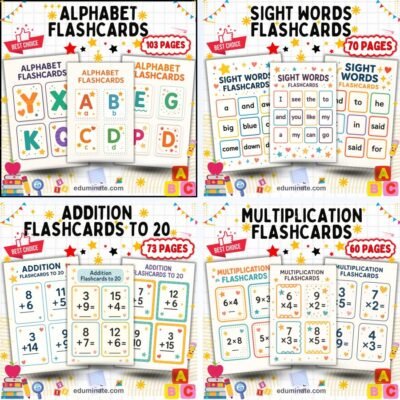
Cards work well for quick, repeated practice in small groups or at home. The Alphabet Flashcards PDF Bundle has four flashcard sets in one download: alphabet cards, sight words, addition facts and multiplication facts, 306 pages in all. For counting, the Number Flashcards Bundle holds five sets of number cards from 1 to 20, in 346 pages.
Cards are easy to use in short bursts. Hold one up, have the child say it, and move to the next. If a card is hard, set it aside and return to it later.
Math coloring pages
Coloring pages that include numbers let a child practice counting while using their hands. The Kindergarten Math Coloring Pages pack offers 114 printable pages that combine number tracing, counting practice and creative art. The Math Coloring Sheets Bundle collects nine coloring packs covering numbers, shapes, addition and subtraction, 535 pages in all. Our post on kindergarten math activities shows more ways to turn these pages into centers and small-group work.
Tips for making pages work well
- Model the first one. Do the first item on the board or with the group, then let children try the rest.
- Keep sessions short. Young children tire quickly. Stop at the natural end of a page, and do not add extras to fill time.
- Give chunky tools. Fat crayons and short pencils are easier for small hands to hold.
- Praise effort and details. Notice a carefully traced line or a number written in the right direction.
- Let a page be unfinished. If a child is tired, saving the rest for later does no harm.
- Reuse pages. Slip a page into a clear sleeve and let children write with a dry-erase marker, so one page serves many practices.
Using kindergarten activity sheets at home
Parents can use the same pages with a small tweak. Pick a quiet spot, sit beside the child, and keep it light. A few pages a few times a week, mixed with real-life counting and reading, goes a long way. Read the instruction aloud, let the child try, and talk about the answer afterward.
If a page is too hard, do not push through. Go back to something easier, and return to the harder page after a few days. The goal is a child who feels capable and wants to keep going.
Choosing kindergarten activity sheets that fit
When you look at a set of pages, ask a few quick questions. Is there one skill per page? Are the instructions short and clear? Is the print large enough for a beginner? Does the set include more than one format, so practice stays fresh? Can you use the pages again, in a sleeve or by copying?
It also helps to know what is inside a set before you commit. Check the page count, the skills listed and whether answer pages are included. A bundle can be a good way to get many pages across several skills in one download, which suits a teacher who plans a full year or a parent who wants a steady supply of practice.
Knowing when a child is ready to move on
Pages tell you something about each child, if you look. A child who finishes a counting page with ease, and can explain how they did it, is probably ready for the next step. A child who guesses, or who covers the page in erased marks, may need more hands-on work first, such as counting real objects before counting pictures.
A few quick signals can guide you:
- The child can do the page without prompting from an adult.
- The child can say aloud what they did and why.
- The same kind of page, on another day, goes just as well.
When all three hold, move on. When they do not, repeat the skill in a new format, such as cards or a coloring page, before adding anything harder.
Keeping a simple record
You do not need a complicated system. A single sheet with each child’s name and a few skills, such as letters known, sounds known and counting to a set number, is plenty. Mark a skill when you see it done on a page or during a small group. Over a few weeks, the sheet shows who needs another round of practice and who is ready for more, and it makes conversations with families easy and specific.
Frequently asked questions
How many pages should a kindergartner do in a day?
There is no set number. One or two focused pages is a sensible start, with more if the child is enjoying it. Watch the child’s energy and stop before frustration sets in.
Should kindergarten activity sheets include writing?
Many do, since pencil control is part of the year. Start with tracing and copying, and add free writing as the child gets comfortable. Some pages can use circling or matching instead, so children who are still building hand strength can still take part.
Are coloring pages useful for practice?
Coloring builds hand control, and pages that include numbers or shapes add a skill to practice at the same time. They also make a good calm activity at the end of the week or after a harder lesson.
Can I print the same page more than once?
Yes, within the terms of the license that comes with the product. Many teachers keep a master copy and print fresh ones as needed, or place a page in a sleeve for repeated use.