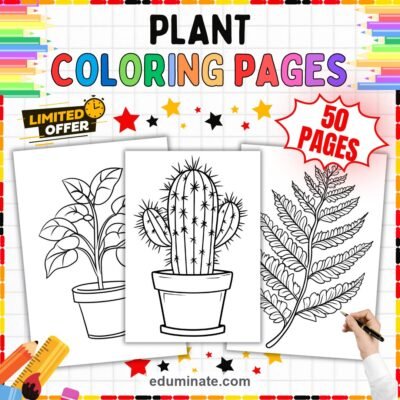

Science Coloring Pages: Plants, Weather, Space and Tech
FreeFree printable for this topic: Bat Conservation Reading Comprehension Passages and Printable Science PacketGet it free
Science coloring pages let children draw and color the things they are studying: a seed splitting open, a rain cloud, a ring of planets, a laptop and its parts. The best sets use clear outlines, one subject per page and, for older children, labeled diagrams they can fill in. Our science packs cover plants, weather, space, technology and Earth Day, and they suit Pre-K to 5th grade.
Page types you will find:
- Parts of a plant with roots, stems and flowers to color and learn.
- Seed, sprout and life cycle pages.
- Planets, stars and spacecraft.
- Weather pages for daily forecast and sky watching.
- Laptops, tablets, circuit boards and coding screens for computer science.
- Recycling and caring for nature pages for Earth Day.
In this article (9 sections)
Free science coloring pages
One free pack fits the science theme. Free Earth Day Coloring Pages has 16 printable sheets for Pre-K to 3rd grade with flowers, trees, watering cans and recycling. A free pack takes an email address, which opens a free account and keeps the file in My Library. It is a good trial for a class before a full unit.
The paid packs go deeper. A free sampler gives you one lesson, while a full pack gives you 40 to 100 pages of the same subject in one PDF, enough to run a unit, plus spare pages for early finishers and centers.
Plants and parts of a plant
Plants are the easiest science topic to bring into a classroom, since a pot and a bean seed cost almost nothing. Coloring helps children notice what they see when the real plant grows.
| Pack | Grades | Pages | Price |
|---|---|---|---|
| Parts of a Plant Coloring Pages | K to 4th | 40 | $5.99 |
| Plant Coloring Pages, Botany Life Cycle | Pre-K to 4th | 50 | $6.99 |
| Plant Coloring Pages, 80 Potted Botanical Sheets | Pre-K to 3rd | 80 | $9.99 |
The Parts of a Plant pack has labeled diagrams of roots, stems and flowers, and it lists US Letter printing with Fit to page. Use it first. The Botany Life Cycle pack covers seed sprouting, garden plants, leaves and the life cycle, so it fits a longer unit. The 80-page potted plants pack has potted plants, succulents, garden flowers and seedlings, and it gives the most pages per dollar for a big class.
The Plant Coloring Pages Printable Bundle includes six packs, covering potted plants, foliage, plant parts and life cycles, in 385 pages for Pre-K to 5th grade. It costs $34.96. The separate prices add up to $49.94, so the bundle saves $14.98, or 30 percent.
Computer science and technology
Computer science coloring pages work as a warm-up before a coding lesson or a lab period. A child who has colored a laptop and named its parts often asks better questions when the real one is on the desk.
| Pack | Grades | Pages | Price |
|---|---|---|---|
| Computer Science Coloring Pages | Pre-K to 3rd | 56 | $6.99 |
| STEM Technology Coloring Pages | 1st to 5th | 70 | $8.99 |
The Computer Science pack has 56 pages with laptops, smartphones, game controllers and CPU chips, and it lists US Letter printing with Fit to page. The STEM Technology pack has 70 pages with robotics, circuit boards, solar panels and drone scouts for 1st to 5th grade, so it suits older children who already know what a circuit is. If you want a larger shelf, the Technology Coloring Sheets Bundle has four packs in 198 pages for Pre-K to 5th grade at $20.22, against $26.96 separately, which saves $6.74, or 25 percent.
Weather
The Printable Weather Coloring Pages pack has 40 pages for Pre-K to 2nd grade at $5.99. It is made for morning calendar time, weather wheels and early science stations. Children can color a page to match the day’s sky. For worksheets on the same topic, see our article on weather worksheets.
A weather coloring page works well as a daily habit. Each morning a child colors one page and adds it to a class book, and after a month the class can sort the pages and count how many days were sunny, rainy or cloudy.
Space and Earth
The Planets Coloring Pages pack has 100 pages for K to 5th grade at $11.99, featuring the planets of the solar system, asteroid belts and astronauts. For a full space unit, the Space Coloring Sheets Bundle has seven packs and 380 pages for Pre-K to 5th grade, covering planets, the solar system, stars, the sun, the moon and spacecraft. It costs $34.25 against $48.93 separately, a saving of $14.68, or 30 percent. Our longer guide to space coloring pages covers that theme in more detail.
For Earth Day, the Caring for Nature Coloring Pages pack has 50 pages on recycling, conservation and tree planting for K to 3rd grade at $6.99. It is the larger paid version of the free Earth Day pack above.
Planning a science unit around coloring pages
Coloring pages do not replace an experiment, but they hold a unit together. A simple plan for a two week science unit on plants looks like this. On day one, plant a bean seed in a clear cup and color the first page from the life cycle pack. On days two to five, observe the cup, draw what you see and color one new page each day. In the second week, move to the parts of a plant, label each part on a diagram and compare the diagram with your own seedling. End by asking each child to put the plant life cycle pages in order and tell the story to a partner.
The same plan works for weather (one page a day for ten days) and for space (one planet a day, then a class poster). Keep the colored pages in a folder so children can see how much they covered, and so you have something to show at a parent meeting.
Using science coloring pages in class
Label and color
For the parts of a plant, give each child a diagram and ask them to color the roots brown, the stem green and the flower any color they like. Then have them point to each part and say what it does: roots take in water, the stem carries it up, leaves make food from sunlight. Older children can write the job of each part beside it.
Science notebooks
Glue a colored page into a notebook beside a real observation. A child who draws the bean seedling in the pot on Monday and compares it with the colored life cycle page on Friday sees the same stages twice.
Early finishers
Keep a science folder with one page for each topic you have studied. A child who finishes early picks a page, colors it and writes one fact on the back.
Centers and sub plans
At a science center, set out a page, a few colored pencils and a magnifying glass. A substitute can run a quiet science lesson by handing out a page and reading its topic aloud, then asking each child to tell a neighbor one fact.
Discussion prompts
- Which part of the plant do you think is the most important, and why?
- What did the sky look like this morning?
- Which planet would you want to learn more about?
- What does a computer need before it can work?
- How can we take care of the place where we live?
Fine-motor and focus tips
- Start younger children with the biggest shape on the page, then the small details.
- Offer crayons for large areas and pencils for labels and thin lines.
- Choose pages with fewer details for Pre-K, and pages with circuits or leaf veins for older children.
- Set a short timer so a restless child finishes one part of the page before moving on.
Frequently asked questions
Are these science coloring pages free?
One pack is free, the 16-page Earth Day set, and it takes an email address that opens a free account. The rest are paid packs with 40 to 100 pages.
What grades do they suit?
The packs listed here cover Pre-K to 5th grade. The plant diagrams start at K, and the technology pack with circuits starts at 1st grade.
Do the pages have labels?
The Parts of a Plant pack has labeled diagrams. Check the product page for the other packs, since many pages are line art only.
Can I print on US Letter paper?
The packs that list it, including Parts of a Plant, Botany Life Cycle and Computer Science, say their A4 files print on US Letter with Fit to page.