
Grammar Worksheets for 3rd Graders: A Practical Guide
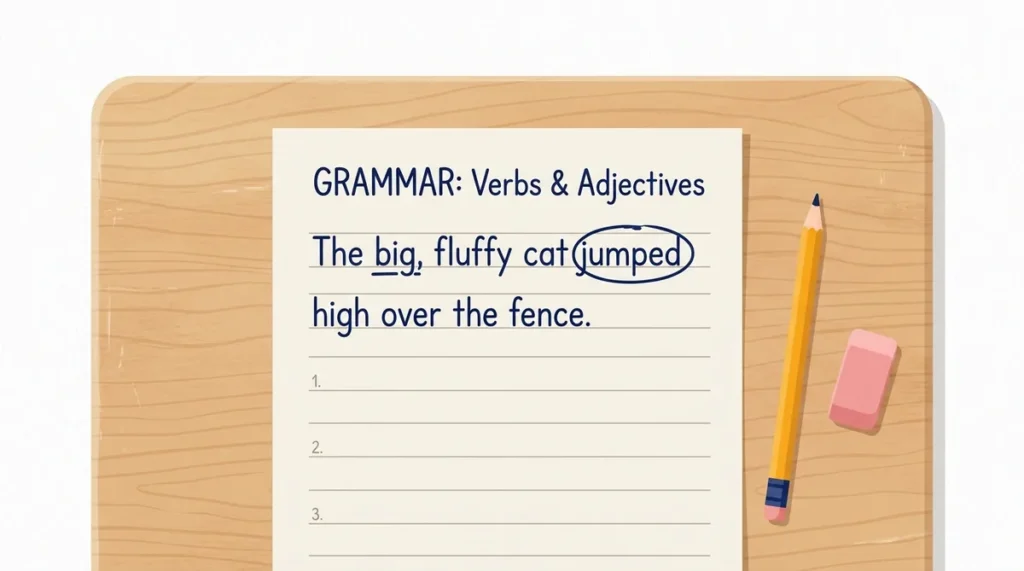
Third grade is the year grammar gets names. Children have been writing sentences for a few years, but now they are asked to say what a noun, verb or adjective is doing in a sentence, to choose between walked and walks, and to join two short sentences with and or because. By fifth grade the list grows to verb tenses like had walked, commas after introductory words and pairs like either/or.
Grammar worksheets for 3rd graders, and later for 4th and 5th graders, can help with all of this, as long as they are used in short, regular doses and tied back to the writing students already do. This guide covers what to teach at each grade, how to get real value from a grammar worksheet, and a weekly routine that takes about 15 minutes a day.
What grammar do 3rd graders learn?
Many US states use the Common Core State Standards or a version adapted from them, so they are a useful map even if your state has its own version. The third grade language standards (Common Core, Language, Grade 3) ask students to:
- Explain what nouns, pronouns, verbs, adjectives and adverbs do, both in general and in a particular sentence.
- Form and use regular and irregular plural nouns (boxes, mice).
- Use abstract nouns such as childhood.
- Form and use regular and irregular verbs, and the simple tenses: I walked, I walk, I will walk.
- Make subjects and verbs agree, and make pronouns match the nouns they stand for.
- Use comparative and superlative adjectives and adverbs (faster, the fastest).
- Use coordinating and subordinating conjunctions.
- Write simple, compound and complex sentences.
On the punctuation side, third graders capitalize words in titles, use commas in addresses, punctuate dialogue with commas and quotation marks, and form possessives.
That is a long list for one year. In practice, the skills that show up most in third grade writing are verb tenses (especially irregular past tense verbs like ran, brought and thought), subject-verb agreement, plurals and run-on sentences joined by a string of and then. If you only have time to go deep on a few topics, start there.
What changes in 4th and 5th grade
The skills build on each other, so it helps to know where third grade is heading. In fourth grade (Grade 4 standards), students add relative pronouns like who and which, progressive tenses (I was walking), helping verbs such as can, may and must, prepositional phrases, fixing fragments and run-ons, and commonly confused words like to, too and two.
Grammar worksheets for 5th graders: what to focus on
Fifth grade (Grade 5 standards) is where verb tense gets precise. Students form the perfect tenses (I had walked, I have walked, I will have walked), use tense to show time and sequence, and spot shifts in tense that don’t belong. They also learn correlative conjunctions such as either/or and neither/nor, and how conjunctions, prepositions and interjections work in a sentence.
Punctuation gets busier too: commas in a series, a comma after an introductory word or phrase, commas with yes and no, tag questions and direct address (Is that you, Sam?), and how to show titles of works.
Grammar is only one part of English language arts in these grades. For reading and writing practice, see our guide to ELA worksheets for 4th graders.
For fifth graders, the best grammar worksheets ask them to edit, not only to identify. Labeling the verb in ten sentences is easy by this age. Rewriting a paragraph so the tense stays consistent is the skill they actually need in their own essays.
How to use grammar worksheets well
A worksheet is a tool for practice, not for teaching a skill from scratch. These habits make the difference between a page that sticks and one that gets finished and forgotten.
Teach first, then practice
Spend three or four minutes modeling before handing anything out. Write two sentences on the board, think aloud as you fix them, and let students try the third one with you. Then the worksheet becomes practice of something they have seen, not a guessing game.
One skill per page
A page that mixes plurals, commas and adjectives is fine for review in May. For a new skill, students need a page that sticks to one idea so they can notice the pattern. If a worksheet covers several skills, cut it in half or assign only the matching section.
Keep it short
Ten to fifteen minutes of focused practice is usually enough for third graders. If most of the class gets the first eight items right, the last eight add little. Let them stop and move to the writing step instead.
Check a few items together right away
Feedback is most useful while the thinking is fresh. Go over three or four items as a class before collecting the page, and ask students to explain their choice: “Why mice and not mouses?” Explaining a choice out loud is where many students realize what the rule is.
Bring it back to their own writing
The goal is not a perfect worksheet. It is fewer run-ons in Friday’s journal entry. After a week on past tense verbs, ask students to underline every past tense verb in something they wrote earlier and fix any that are wrong. This step is the one most often skipped, and the one that matters most.
Mark patterns, not every error
When you check a page, look for the mistake that repeats. A student who writes goed and runned needs irregular verb practice. A student who gets the verbs right but forgets capital letters needs something else. Two or three notes on patterns help more than a page full of red.
A weekly grammar routine (about 15 minutes a day)
This routine works for one grammar skill a week and fits at the start of a writing block or as morning work. Adjust the day count to your schedule.
Monday: see it in a real sentence
Show a sentence from a read-aloud book that uses the skill. If the skill is irregular past tense verbs, it might be She ran to the door and caught the letter. Ask what students notice. Name the skill, write the rule in student-friendly words and add it to an anchor chart.
Tuesday: guided practice
Hand out a short worksheet on the skill. Do the first three items together, then let students work alone or with a partner. Check a few items as a class before the time is up.
Wednesday: build sentences
Students write their own sentences with the skill. Give a small prompt: “Write three sentences about the weekend using these verbs: bring, think, swim.” Share a few aloud. This is often where you see who really understands the rule.
Thursday: edit
Give a short paragraph with four or five errors of this week’s type. Students find and fix them. You can write this paragraph yourself in two minutes, or use the editing section of a worksheet. Then students reread one piece of their own writing looking for the same error.
Friday: quick check and review
A five-item check on this week’s skill, plus two items from an earlier week. The review items matter: grammar learned in October is easy to forget by December without a little spiral practice.
Over a school year this routine covers around 30 skills with time left for review weeks. That lines up well with the third grade list above.
Mixed groups, early finishers and extra help
Not every child in a third grade class is working at a third grade level in grammar, and the same is true in fifth.
- Students who need more support: give them the first half of the page with a word bank, or let them work with a partner. Short oral practice before writing helps a lot, especially for English learners.
- Students who finish early: ask them to write their own two items for the class to solve on Friday, or to fix a sentence that uses the skill in a harder way.
- Combined 3rd and 5th grade groups (common in small schools and homeschooling): pick a shared topic, like verbs, and give each grade its own level. Third graders practice simple past tense while fifth graders practice perfect tenses with the same sentences as a starting point.
Using grammar worksheets at home
For parents, one short page two or three times a week is plenty. Sit nearby for the first few items, read the instructions aloud and let your child explain their answers. If your child gets stuck, look at the example together rather than giving the answer.
Then connect it to everyday writing: a grocery list, a note to a grandparent, a sentence about a book. “Can you find the verb in what you just wrote?” takes ten seconds and builds the habit of noticing grammar outside a worksheet.
Where to find grammar worksheets
Whatever you use, look for pages that focus on one skill, give an example at the top, include an answer key and leave room for students to write their own sentences. If you want ready-to-print pages, our grammar worksheets are PDF files you can print as many times as you need for your class, and the shop can be filtered by grade.
Frequently asked questions
How many grammar worksheets should a 3rd grader do in a week?
Two or three short pages a week is a reasonable amount, as part of a routine that also includes writing sentences and editing. More pages rarely help if students are not applying the skill in their own writing.
Should 5th graders still practice parts of speech?
Yes, but in a different way. Fifth graders usually know the basic parts of speech, so practice should move toward using them: choosing a precise verb, keeping tense consistent, or using conjunctions and prepositions to build longer sentences.
My child gets the worksheet right but still makes the same errors when writing. Why?
Spotting an error in a sentence someone else wrote is easier than avoiding it while you are thinking about ideas. That is why the editing step matters. Ask your child to reread their own writing for one skill at a time, for example “check only your past tense verbs”.
What grammar should I start with at the beginning of 3rd grade?
Start with complete sentences and capital letters and end punctuation, then nouns and verbs. Those skills come up in every piece of writing, so practice pays off right away. Irregular verbs and plurals are good next steps.