Math Word Problems for Grades 1 to 8: Practice by Level
FreeTry a printable pack for free first. No card needed.See free packs
Math word problems ask students to read a short story, decide what is being asked, choose an operation and check that the answer makes sense. Students get better at them when they follow the same few steps every time and when the numbers and the story are simple enough that reading, not arithmetic, is the thing being practiced. Start with one step in first grade, add a second step in third, and move to ratios and percents in middle school.
These are the types of problems worth practicing across a school year:
- Join and take away stories within 20 or 100 for early grades.
- Equal groups and sharing, which lead into multiplication and division.
- One step problems with a number bank for quick warm-ups.
- Two step and multi-step problems that use several operations.
- Money, measurement and fraction stories for grades 3 to 6.
- Ratio, percent and geometry problems for grades 7 and 8.
In this article (8 sections)
- A five step routine students can remember
- Grades 1 and 2: addition and subtraction stories
- Grades 2 to 5: themed sets with all four operations
- Strategy packs: teaching students how to solve
- Grades 3 to 6: mixed and multi-step practice
- Grades 7 and 8: ratios, percents and geometry
- Ways to use word problems in class
- Frequently asked questions
A five step routine students can remember
Whatever sheet you use, a fixed routine matters more than the page. This one works from second grade up.
- Read the problem once without a pencil.
- Read it again and underline the question.
- Circle the numbers and cross out any that the question does not need.
- Draw a quick picture or bar and write the number sentence.
- Solve, then ask: does my answer fit the story?
The last step is the one students skip. A child who finds that 5 buses hold 340 passengers each has not read the problem again. Make “does it make sense” a habit you say out loud every day.
If your students handle one step problems well, our guide to two step word problems picks up from there with worked examples.
Grades 1 and 2: addition and subtraction stories
Young students do best with short problems about things they can picture. Keep the numbers small and let them use counters. The packs here are PDFs, and every one of them states that its A4 files print on US Letter with Fit to page.
| Pack | Grades | Pages | Price |
|---|---|---|---|
| Addition Word Problems: 65 Questions Within 100 | 1 | 29 | $3.99 |
| Easy Subtraction Word Problems | 1 to 4 | 32 | $4.99 |
| Word Problems of Addition and Subtraction (fruit) | 1 to 4 | 29 | $3.99 |
| Addition Subtraction Word Problems Worksheets (spring) | 2 | 31 | $4.99 |
The Addition Word Problems pack has 65 questions on sums within 100, for first grade. The Easy Subtraction Word Problems pack has 80 how many are left questions. The fruit pack has 70 questions with true or false items and a number bank. The spring pack has 70 spring themed questions within 100 for second grade.
Some things to try with this age group:
- Have students act out the problem with cubes before they write anything.
- Ask them to say the story in their own words to a partner.
- Let them write a matching story for a number sentence. Writing a problem is harder than solving one, so it shows more of what a student knows.
Grades 2 to 5: themed sets with all four operations
When students are ready for more than one operation, a theme keeps the page interesting without making the math harder.
- The Word Problems for Second Graders pack has a picnic theme and 80 questions on addition, subtraction, grouping and sharing. It is 34 pages for grades 2 to 5 and costs $4.99, and the key is included.
- The Adding and Subtraction Word Problems pack has a school bus theme and 80 questions on passengers, routes, miles and time. It is 33 pages for grades 1 to 5 and costs $4.99.
- The Multiplication and Division Word Problems pack has a cereal theme and 80 questions on arrays, sharing, fractions and patterns. It is 34 pages for grades 1 to 5 and costs $4.99.
Themed sets are handy for a week of practice. Run the bus pack for five days in a row and students will know the setting, which frees their attention for the math.
Strategy packs: teaching students how to solve
Some students can do the arithmetic and still freeze at a story. For them, a strategy matters more than extra practice.
- The CUBES Method for Word Problems pack has 80 questions on the strategy steps and on applying them. CUBES is a memory aid for the steps of reading a problem, and the pack practices those steps one at a time. The pack is 36 pages for grades 2 to 6 and costs $4.99.
- The One Step Word Problems Worksheet has 75 warm up questions with true or false items, a number bank and some multi-step practice. It is 34 pages for grades 3 to 5 and costs $4.99.
- The Logical Reasoning Word Problems Worksheets pack has 50 math sentence frame questions on vocabulary and reasoning. It is 24 pages for grades 2 to 6 and costs $3.99.
Sentence frames are underrated. A frame such as “There are ___ groups with ___ in each group, so there are ___ in all” gives a student who is stuck a place to start, and you can take the frames away later.
Grades 3 to 6: mixed and multi-step practice
| Pack | Grades | Pages | Price |
|---|---|---|---|
| Math Problem Worksheets for 3rd Graders | 3 | 33 | $4.99 |
| Math Problems for 5th Graders to Solve | 5 | 32 | $4.99 |
| Math Word Problems Worksheet (multi step) | 3 to 7 | 35 | $4.99 |
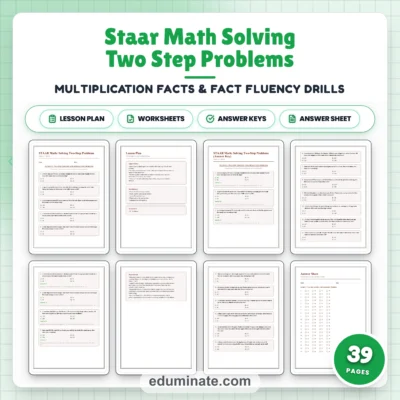
| Two Step Story Problems (STAAR style) | 3 to 5 | 39 | $4.99 |
| Spring Math Word Problems (garden) | 3 to 6 | 38 | $4.99 |
The 3rd grade pack has 75 performance task questions on word problems, area, fractions and data. The 5th grade pack has 80 weekly review questions on place value, decimals, fractions and geometry. The multi-step pack has 80 questions on operations, fractions, money and measurement. The two step pack has 80 STAAR style questions on all four operations and equations, with a 2 page lesson plan. The garden pack has 80 questions on all four operations.
For a class with mixed levels, the multi-step pack covers the widest range of grades, since it lists 3 to 7. If your state tests use a two step format, the STAAR style pack gives students a feel for it. Whatever the name suggests, any class can use it as general two step practice.
Grades 7 and 8: ratios, percents and geometry
- The Maths Word Problems Year 7 pack has 80 questions on ratios, percentages, geometry and algebra. It is 33 pages for grade 7 and costs $4.99.
- The Percent Story Problems Worksheet has 80 would you rather questions on deals, rates, exponents and units. It is 36 pages for grade 8 and costs $4.99.
Would you rather questions work well with older students because they invite an opinion first and a calculation second. Ask students to pick an option, then prove with numbers that their choice is the better deal.
Ways to use word problems in class
Problem of the day
Put one problem on the board for the first five minutes. Students solve it silently, then compare with a neighbor. Take three different methods from the room and talk about each.
Error hunt
Write a wrong solution on the board and ask students to find the mistake. This is quick and shows how a bad reading becomes a wrong answer.
Write your own
Give students a number sentence and ask them to write a story that fits it. Swap papers and solve a partner’s story.
Math talk
After solving, ask one student to say the answer in a full sentence that includes the unit: “There are 24 passengers left on the bus.” It sounds small, but it ties the number back to the story and catches answers that do not fit.
Small groups
Pull a group of four and read the problem aloud together before anyone writes. Students who struggle with reading often do better when the text is heard.
Frequently asked questions
Why do students struggle with word problems when they know the facts?
Usually the trouble is reading, not computing. They rush, grab the numbers and pick an operation without asking what the story is about. A fixed routine slows them down in a useful way.
Which pack should I try first?
For grades 3 to 7 the 80 question multi-step pack is a broad starting point. For younger students, the picnic pack covers addition, subtraction, grouping and sharing for grades 2 to 5.
Can I print these on US Letter paper?
Every pack named here states that its A4 files print on US Letter with Fit to page.
Do the packs have answer keys?
The product descriptions mention an answer key or a key, and many also mention an answer sheet and a lesson plan. Check the page of the pack you choose for the full list.