Short A Words and Short Vowel Words Lists for Kids
Short a words are words in which the letter a makes the sound /a/ as in cat. Below are lists of words with short a, followed by matching lists for e, i, o and u, and a short guide to short and long vowels and closed syllables.
Short a words
The short a sound is the vowel in cat, map and jam. These twenty short a words include some with blends (two consonant sounds together, like cl in clap) and some with digraphs (two letters, one sound, like ch in chat).
| Short a words |
|---|
| cat, hat, bag, map, pan, jam, tap, crab, clap, flag |
| snap, plan, grab, black, track, chat, stamp, lamp, sand, camp |
Many short a words belong to families that share an ending. The -at family has cat, hat, mat and bat. The -ap family has map, tap, clap and snap. The -ag family has bag, flag and brag. Reading a family together shows children that only the first sounds change.
Short e words
Short e words have the vowel sound in bed, written /e/. This list also mixes simple words with blends and digraphs.
| Short e words |
|---|
| bed, pen, net, red, leg, ten, jet, wet, step, sled |
| spell, shell, chest, nest, desk, tent, fresh, bench, check, west |
The -ed family has bed, red and sled. The -et family has net, jet and wet. The -en family has pen and ten. The -est ending shows up in chest, nest and west.
Short i words
Short i words have the sound in sit, written /i/. Say the vowel quickly and keep it short, not the long sound in ice.
| Short i words |
|---|
| sit, pig, pin, lip, big, dig, kid, zip, grin, slip |
| trip, drip, chip, ship, fish, dish, stick, list, quick, twig |
Try the -ip family: lip, zip, slip, trip, drip, chip and ship. The -ig family has pig, big, dig and twig. The -ick ending gives stick and quick, and -ish gives fish and dish.
Short o words
Short o words have the sound in hot, written /o/. The vowel sound can vary a little between accents, especially in words like dog, so go by how you say the word.
| Short o words |
|---|
| hot, pot, mop, top, hop, job, nod, stop, clock, block |
| frog, shop, chop, sock, rock, drop, spot, box, fox, dog |
The -op family has top, hop, stop, shop, chop and drop. The -ock family has clock, block, sock and rock. The -ot family has hot, pot and spot.
Short u words
Short u words have the sound in cup, written /u/. It is a quick, relaxed sound made with the mouth only slightly open.
| Short u words |
|---|
| cup, sun, bug, mud, rug, hug, nut, bus, jug, run |
| gum, plum, duck, truck, brush, jump, lunch, plug, club, stuck |
The -ug family has bug, rug, hug, jug and plug. The -uck ending gives duck, truck and stuck. The -un family has sun and run.
Short vowel words
Short vowel words have one vowel letter and the vowel makes its short sound. Each vowel has a key word that helps children remember the sound. This short vowel words list is the one to put on a chart.
| Vowel | Sound | Key word |
|---|---|---|
| a | /a/ | cat |
| e | /e/ | bed |
| i | /i/ | sit |
| o | /o/ | hot |
| u | /u/ | cup |
The letters between slashes show the sound, not the letter name. When you see /a/, say the sound you hear in cat.
Short vowel words can be read in sentences too. In these examples, every word has the short vowel shown, apart from the small word a or the, which children learn separately:
- The fat cat sat and had a nap. (short a)
- Ben fed ten red hens. (short e)
- Tim did a big skip. (short i)
- The frog hops on a log. (short o)
- The pup dug up a bug. (short u)
The short a sound
The short a sound is made with the mouth fairly open and the tongue low and flat. Children can feel the jaw drop as they say a, a, cat.
Not every word with an a has the short a sound. The word was sounds like /wuz/, and the vowel in all and ball is a different sound again. These words are not short a words, so keep them out of short a lists and teach them as their own words.
Short vs long vowels
A long vowel says its own name. A common way to turn a short vowel into a long one is to add a silent e at the end. The table compares short vs long vowels in word pairs.
| Vowel | Short | Long |
|---|---|---|
| a | hat, mat | hate, mate |
| e | bed, met | bead, meet |
| i | pin, kit | pine, kite |
| o | hop, not | hope, note |
| u | cub, tub | cube, tube |
To compare a pair, read the short word first, then add the e and read it again: hat, then hate. The vowel sound changes, and so does the meaning. The pairs for a, i, o and u use the silent e. Long e is usually spelled with a vowel team, such as ea or ee, so the e pairs look different.
Closed syllable words
Closed syllable words follow a simple pattern. A closed syllable has one vowel followed by one or more consonants, and the vowel sound is short. A syllable ending in a consonant “closes in” the vowel.
- cat and stop are one-syllable closed syllable words.
- rabbit has two closed syllables: rab-bit.
- picnic has two closed syllables: pic-nic.
- sunset has two closed syllables: sun-set.
Splitting a longer word into closed syllables lets children use what they know about short vowels to read it. To split a word like rabbit, find the vowels, then divide between the two consonants in the middle: rab-bit. Each part is a closed syllable, so each vowel is short. Basket splits into bas-ket in the same way.
Syllable types
Closed syllables are one of six syllable types. A short description of each:
- Closed: one vowel followed by a consonant, short sound (cat).
- Open: ends with a vowel, long sound (me, go).
- Vowel-consonant-e: a vowel, a consonant and a silent e, long sound (kite).
- Vowel team: two letters make one vowel sound (rain, boat).
- R-controlled: a vowel followed by r changes the sound (car, bird).
- Consonant-le: a consonant plus le ends a word (table, puzzle).
Ways to practice short vowels
Start with a few words from one list. When a student reads them smoothly, add a second vowel and mix the words, so the student has to check the vowel every time instead of relying on the pattern. Keep each session to a handful of words and read each one aloud.
Word sort by vowel
Write words from the lists on cards and mix them up. Students sort them into five piles by the vowel sound, then read each pile aloud.
Sound boxes
Draw boxes on paper, one for each sound in a word. For ship, draw three boxes, since sh is one sound: /sh/ /i/ /p/. Students push a counter into each box as they say the sounds.
Change one letter
Start with hat and change one letter at a time: hat, hot, hit, hut. Each change makes a new word, and the vowel sound changes with it.
Read the list from the bottom up
After students can read a list from top to bottom, ask them to read it from the bottom up. The words are no longer in a familiar order, so they have to look at each word again. For more quiet word work, see our early finishers activities.
Practice material
Once children can read the lists, they need connected text. The packs below include stories built around short vowel words, as described on each page:
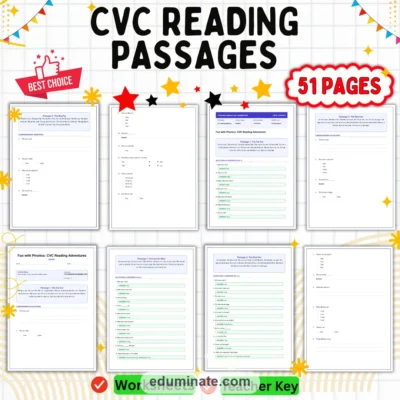
- CVC reading passages for kindergarten and first grade: five short vowel decodable stories, ten questions per section, bubble answer sheets and a ninety minute lesson plan, for kindergarten to grade 1.
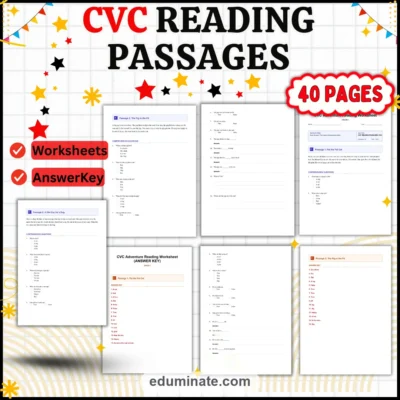
- Short vowel CVC words reading passages: ten decodable phonics stories, with questions across thirty-one worksheet pages and twenty pages of answer keys, for kindergarten to grade 1.
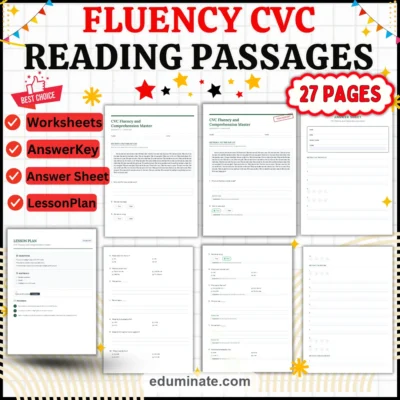
- Kindergarten CVC reading fluency passages: five targeted short vowel stories with multiple choice, true or false and fill in the blank questions, for kindergarten to grade 1.
- Reading simple CVC sentences: ten decodable stories across thirty-one worksheet pages, with a lesson plan and answer keys, for kindergarten to grade 1.
- CVC sentences reading comprehension: ten decodable stories and thirty-one student worksheet pages, for kindergarten to grade 1.
- Decodable CVC reading passages: ten short vowel adventure stories with 150 comprehension questions across thirty student worksheet pages, for grades 1 to 3.
Frequently asked questions
What is the difference between a short and a long vowel?
A short vowel makes a quick sound, like the a in cat. A long vowel says its own name, like the a in cake.
What order should I teach short vowels in?
Schools differ, so follow the order your curriculum uses. One way is to introduce one vowel at a time and practice it before adding the next.
Are words like ship short i words?
Yes. In ship, the letters sh make one sound and the vowel i is short. Words with digraphs like sh, ch and th can still be short vowel words.
What grade learns short vowels?
Schools differ, so check your curriculum. For reference, our short vowel reading packs are listed for kindergarten to grade 1, and one decodable set is listed for grades 1 to 3.
Related resources
- CVC Reading Passages Worksheets for Kindergarten and First Grade Phonics Set
- Short Vowel Worksheets, CVC Words Reading Passages and Questions 1st Grade
- Kindergarten CVC Worksheets, Reading Passages with Questions and Answer Key
- Decodable Passages, Decodable CVC Printable Pages, Questions and Answer Key
- Reading Simple CVC Sentences Worksheets for Kindergarten and 1st Grade Class
- CVC Sentences Kindergarten, Reading Passages, Questions and Answer Key Grade 1