High Frequency Words: Word Lists and How to Teach Them
High frequency words are the words that appear most often in written English, such as “the”, “and”, “is” and “you”. This guide explains how they relate to sight words, sorts a starter word list by how each word can be taught, and gives routines for kindergarten and first grade.
What are high frequency words?
High frequency words are the words readers meet again and again in print. A small group of short words shows up very often: “the”, “of”, “and”, “a”, “to”, “in” and “is”. Because they come up so often, children who know them well can read more of a page without stopping.
The idea comes from counting words in large amounts of text and ranking them. Two well-known rankings are the lists made by Edward Dolch and Edward Fry, and both are covered here in separate guides: Dolch sight words and Fry sight words. A high frequency word list can also come from a reading program or a school, and these lists overlap heavily.
High frequency words and sight words
High frequency words and sight words are often used as if they meant the same thing, but they describe two different ideas. High frequency describes the word: how often it appears in text. Sight word describes the reader: whether a child knows the word at a glance. A very frequent word is a good candidate for becoming a sight word, since a child sees it so often.
The reverse is also true. A word can be rare and still become a sight word for a child, such as a name or a favorite place. Teachers who keep the two ideas apart can ask two questions about any word. First, is this word worth teaching because it comes up so often? Second, has this child reached the point where it is automatic?
This is why the phrase high frequency sight words shows up in classroom materials. It means the words that appear most often and that children should know by sight. The guide to sight words for kindergarten covers how to build that automatic knowledge step by step.
A high frequency word list sorted by job
A high frequency word list reads more easily when it is sorted by what the words do in a sentence. The words below are some of the most common ones in English, grouped by job.
Small connecting words
a, an, the, and, but, or, so, if
Pronouns
I, you, he, she, it, we, they, me, my, your, his, her, them
Position and direction words
in, on, at, to, of, for, with, from, up, out, by, about
Common verbs
is, are, was, were, have, had, do, can, said, will, see, go, make
Question and pointing words
what, when, how, who, not, this, that, there
Lists of the first 100 high frequency words, such as the one in the Fry guide, are built from words like these. A list of 100 high frequency words is mostly small words, with a few nouns among them. A child who reads them with ease can move through an early reader without stopping so often.
High frequency words for kindergarten
The high frequency words kindergarten classes teach first can be the shortest ones. A kindergarten high frequency word list can hold twenty to forty words, grouped by the order in which children learn letter sounds. Keep the list small, and keep it flexible. If a class spends its first weeks on the sounds of s, a, t, p, i and n, the early words can be “at”, “sat”, “it”, “in”, “tip” and “pin”.
Not every high frequency word in the first set will be one the class can sound out yet. The word “the” appears in almost any text, so children meet it in week one even though its spelling is hard. Teach it as a whole word, point out the letters, and let the sound pattern come later.
Decodable high frequency words
Decodable high frequency words are the ones children can read by blending the letter sounds they know. These are good to start with because they build confidence and connect directly to phonics lessons.
am, an, and, at, can, did, get, had, not, on, up, but, will, big, run, sit, red, ran, let, yes
Many of these are CVC words, so a class working through CVC words is already working on high frequency words at the same time. When a child blends a word like “can” or “run”, point out that it is a word they will meet in nearly every book. That connection helps phonics feel useful.
Irregular high frequency words
Irregular high frequency words have a part that does not match the usual sound. These words cannot be fully sounded out, so children need a different approach.
the, of, was, said, you, are, they, one, have, do, what, were, from, there, come, some
Look at “have”. The letters h, a and v follow the usual sounds, but the final e does not make the vowel long. Look at “one”. The o says a sound that has nothing to do with the usual short or long o. Look at “said”. The letters s and d match, and ai says a short e. In each case, the odd part is small. Mark it, say the word, and have the child write it.
Some teachers call the odd part the heart of the word, as in a part to learn by heart. The rest of the word can often be sounded out, so a child has fewer letters to memorize than it first seems.
Teaching high frequency words step by step
Teaching high frequency words works best with a short, steady routine. The routine below uses the same steps for decodable and irregular words, with a small change for each.
- Say the word, and ask the children to say it back.
- Tap the sounds. For a decodable word, tap and blend. For an irregular word, tap the letters that match and stop at the odd one.
- Spell the word aloud, then write it while saying each letter.
- Use the word in a spoken sentence, and ask a child to make a second one.
- Read the word again in a short sentence on a card or a board.
Practice should not end with the card. Children need to see the word inside a real text soon after the lesson. Pick a passage that repeats the word, and ask children to find it, circle it and read the sentence around it.
A high frequency word wall
A high frequency word wall gives children a spot to look when they are writing or reading. Add words slowly, a few at a time, after they have been taught. Print each word in large lowercase letters, and group the words by first letter or by the sets you taught.
A word wall is a reference tool. Point to it during writing time, and ask children to find a word they need. Remove words that are firmly known if the wall gets crowded, and keep the tricky ones up.
Spelling and writing the words
High frequency words matter for writing as much as for reading. A child who can spell “the”, “and”, “is” and “was” without stopping can keep a thought moving on paper. After a set of words has been read, ask children to write each one from memory. Say the word, use it in a sentence, and let the child write it on a whiteboard before checking it against the card.
Short dictation gives another check. Read a sentence made from taught words, such as “I can see the red hat”, and ask the class to write it. Look at the common words first: are they spelled correctly, and did the child leave a space after each one? Then look at the rest of the sentence. This order keeps the focus on the words that appear most often.
Keeping track of progress
A simple record helps a teacher see which words are firm. Write the word list down the left side of a page, with a column for each month. Mark a word when a child reads it quickly and spells it correctly. Words without marks go into the next set of lessons.
Share the record with parents in a plain way, such as a short list of five words to practice at home this week. Children respond well when they can see a clear, small goal.
High frequency words printable cards and pages
High frequency words printable cards are easy to make: one word per card, large lowercase letters and a plain background. Print two sets, one for the class and one for each child to keep. If you add a small dot under the odd part of an irregular word, children learn where to look.
Pages with a word to trace, a word to find in a row and a sentence to read give writing practice with the same words. Look for pages with only a few target words, so each word gets enough attention.
Reading high frequency words in connected text
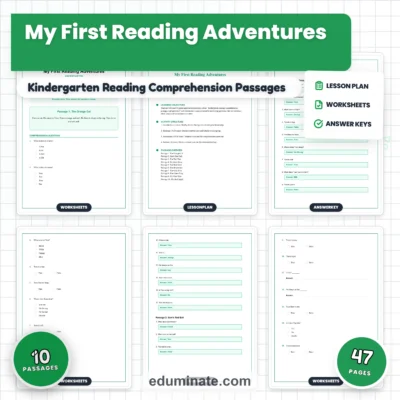
Connected text puts the words to work. Passages and short stories repeat the same words in different sentences, and that repetition helps them become automatic. The kindergarten reading passages and questions packet contains ten early literacy texts with comprehension questions and complete answer keys, and children practice sight words, simple sentences and recall in its pages. The first grade packet offers ten stories in the same format.
For stories made from words children can sound out, the CVC reading fluency passages hold five short vowel stories with multiple choice, true or false and fill in the blank tasks. The CVC words reading passages add ten decodable phonics stories, thirty-one worksheet pages and twenty pages of teacher answer keys. The simple CVC sentences set holds ten decodable stories with a lesson plan. If you want to know what makes a text decodable, read the guide to decodable books.
Frequently asked questions
Are high frequency words the same as sight words?
The two terms overlap, but they are not identical. High frequency words are defined by how often they appear in print. Sight words are defined by whether a reader knows them at a glance. Many high frequency words become sight words with practice.
How many high frequency words should kindergarten learn?
The number varies from class to class. A list of twenty to forty words is a workable start, and it can grow as children gain letter sound knowledge.
Why are some high frequency words hard to sound out?
English spelling holds many words whose spellings no longer match their sounds. Words like “was”, “of” and “said” fall into this group. Children learn them best by marking the odd part and seeing the word many times in context.
Where do I find a high frequency word list?
The Dolch and Fry lists are good places to start, and both are described in the guides linked above. A school or reading program may also supply its own list.
Related resources
- Kindergarten Reading Worksheets: Reading Passages, Questions and Answer Key
- Reading Comprehension Activities: First Grade Reading Passages and Questions
- Kindergarten CVC Worksheets: Reading Passages with Questions and Answer Key
- Short Vowel Worksheets: CVC Words Reading Passages and Questions 1st Grade
- Reading Simple CVC Sentences Worksheets for Kindergarten and 1st Grade