Reading Comprehension Practice: How to Choose and Use
Reading comprehension practice gives a student a passage to read and a set of questions that show how much of it was understood. This guide explains what a good set includes, how to match one to a reader, and how to run a page so it builds skill instead of just filling time.
If you want a full set in one download, the Reading Comprehension Worksheets Bundle gathers ten reading packets for grades 1 to 4, and the sections below explain how to use pages like these.
What good reading comprehension practice includes
Most sets have the same three parts, and each part has a job.
- The passage. A short text, either a story or an article that explains something. The passage is the only thing the questions are allowed to ask about.
- The questions. These check whether the reader took in the words on the page. Good questions point back to the text.
- The answer key. This lets a teacher, parent or student check the work without guessing.
A set may also add a lesson plan, a page for recording answers, or a graphic organizer. Those extras are useful, but the three parts above decide whether the pages are worth printing.
The word “comprehension” is worth a moment. Reading aloud smoothly and understanding the text are two different skills. A child can say every word correctly and still be unable to say what happened. Reading comprehension questions after each passage make that gap visible, which is why regular practice is a common tool for checking understanding.
How to choose pages for reading comprehension practice
Before printing anything, look at four things.
Reading level
A passage that is too hard turns every question into a decoding problem. A passage that is too easy tells you nothing. Pick a level where the student can read most of the words without help, so the effort goes into thinking about meaning.
Text type
Stories and informational text ask different things of a reader. A story has characters, a setting and a problem. An article has facts, a topic and often headings or a list. Students need practice with both, so a mix is better than a stack of one kind. Our guide to fiction vs nonfiction lays out the differences you can point out when you switch.
Question variety
A set that only offers one question style gets repetitive fast. Look for several: multiple choice questions, true or false, fill in the blank and short written answers. Each shows something a little different about the reader.
A real answer key
An answer key that gives only a letter is thin. Better keys show the line of the passage that supports each answer, or at least a model sentence for written responses. That helps a parent who is checking work at the kitchen table, and it saves a teacher time.
Reading comprehension practice by grade band
The needs of a reader change a lot between kindergarten and fourth grade. Here is one way to think about each stage.
Kindergarten and early readers
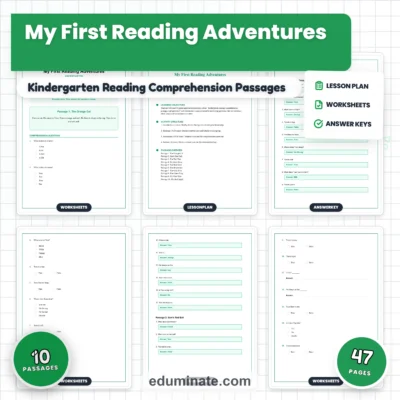
At this stage the passage is a few short sentences built from familiar words. Questions ask about something stated outright: who was in the text, what they did, where it happened. The Kindergarten Reading Worksheets packet is a 47-page set with ten early literacy texts, covering sight words, simple sentences and recall, with complete answer keys. If your students are still learning to decode, pair reading practice with our list of sight words for kindergarten.
First and second grade
Passages get longer and sentences get more varied. Students can start answering in a full sentence. This is a good time to introduce the habit of finding the answer in the text and underlining it.
Third and fourth grade
Informational text becomes more common, and questions begin to ask for more than a quick lookup. A student might need to explain why something happened, compare two ideas or work out what a word means from the sentence around it. The Reading Comprehension Worksheets Bundle gathers ten reading packets for grades 1 to 4, with multiple choice and informational text, in one download of 657 pages.
Question types worth recognizing
Students answer better when they can name what a question is asking. A short list helps.
- Literal questions. The answer sits in the text in plain words. “What did the writer say covers the hive?”
- Vocabulary in context. The question asks what a word means as it is used. Students look at the sentence around the word.
- Main idea. The question asks what the whole passage is mostly about. Our guide to what is the main idea shows how to separate the main idea from a detail.
- Inference. The answer is not stated, so the reader combines clues from the text with what they already know. See what is an inference for a step-by-step way to teach it.
- Sequence and cause. The question asks what came first, or what made something happen.
When a student misses a question, ask which type it was. Often the pattern is clear: strong on literal questions, weaker on inference. That tells you what to practice next.
How to use a worksheet in a lesson
A worksheet is a tool, and the routine around it matters as much as the page. Here is one way to do it.
- Read the passage first. Have students read it once without stopping to answer anything. A first pass for the gist helps later.
- Read the questions. Before going back, students look at what is being asked. This gives the second reading a purpose.
- Return to the text. Students reread with a pencil, underlining the lines that answer each question. This is the heart of close reading.
- Write the answers. For multiple choice questions, students should be able to say why the other choices are wrong. For written answers, ask for a full sentence that uses words from the question.
- Check with the key. Students compare their answers, and discuss any miss before moving on.
If you run a small group, finish by asking the students to retell the passage in their own words. A retelling shows understanding in a way no tick box can.
Using science reading passages
Informational passages about the natural world are a good fit for comprehension practice, because the facts give students something concrete to find and discuss. They also let you tie reading to a science unit, so one lesson serves two goals.
Several of our packets are built around a single topic. The Bees Worksheets packet has ten informational passages, 200 questions across 40 student worksheet pages, 21 answer key pages and a lesson plan, aimed at grades 2 to 4. The Animal Habitats Worksheets packet offers ten passages that explore biomes around the globe, in 64 pages for elementary students. For a wider range, the Science Worksheets Bundle holds nine reading packets of elementary science passages and questions, 553 pages in all, and the Insects Reading Comprehension Bundle collects nine packets on bees, beekeeping, honey, ants, butterflies, insects and spider webs.
A single topic packet has one more advantage. By the third or fourth passage, students already know some of the vocabulary, so they can spend more attention on the questions.
Common mistakes to avoid
- Treating the worksheet as a test. Used as practice, a worksheet is a chance to learn. Make it low pressure and talk about the misses.
- Skipping the passage and guessing from the questions. Some students learn to scan for a matching word. Ask them to point to the line that proves the answer.
- Using only multiple choice. Choosing a letter does not show whether a student can explain an idea. Mix in written answers.
- Moving up too fast. If a student is missing most questions, drop back to an easier passage and build up again.
- Never rereading. Good readers return to the text. Make rereading part of the routine, not a sign of failure.
For more on the habits behind these worksheets, read our post on reading comprehension strategies. If you want to try a few pages before buying a pack, our roundup of free printable reading comprehension pages is a good place to start.
Adjusting reading comprehension passages for different readers
In most rooms, students read at different levels. You do not need a separate lesson for each one. Small changes to how you hand out the same pages can do a lot.
- For students who need more support: read the first paragraph together, then let them continue alone. Cover the questions they are not ready for and start with the literal ones.
- For students who are ready for more: ask them to write one question of their own about the passage, and swap it with a partner. Writing a good question requires understanding the text well.
- For students who rush: ask them to mark the line that proves each answer. It slows the pace and makes the thinking visible.
With a bundle, you can also hand different packets to different groups on the same day, each at a level that fits.
Making reading comprehension practice a habit
Skill grows with steady practice. A single page each day or a few each week, kept at the right level, does more than a long session once a month. Keep the format familiar so students spend their energy on the thinking, not on working out what to do. Keep a simple log of which question types a student gets right, and change the next passage to fit.
At home, the same ideas work. A parent can read a passage aloud first for a younger child, then let the child try the questions. Praise the specific thing the child did well, such as finding the proof in the text, and keep the mood relaxed.
Frequently asked questions
How long should a reading comprehension practice passage be?
It depends on the reader. Early readers do best with a few short sentences. By the middle elementary years, a passage of several paragraphs is reasonable. Choose a length that lets the student finish reading without losing focus.
Should students read the questions before the passage?
Either order can work. One way to do it is to read the passage once for the gist, read the questions, and then reread the passage to find the answers. That keeps the first read natural and gives the second read a purpose.
Are multiple choice questions enough?
They are a good start and they are easy to check, but they should not be the only format. Written answers show whether a student can explain an idea in their own words.
Can parents do reading comprehension practice at home?
Yes. Sets with a full answer key are especially handy at home, because a parent can check the work without needing to be an expert on the topic.